
Last updated on August 25th, 2026 at 01:03 pm
The Engine Control Module (ECM) and Powertrain Control Module (PCM) in your 2000 Mercury Villager serve as the central computer managing engine fuel delivery, ignition timing, emissions controls, and transmission shifting. When this processor fails, the vehicle may exhibit drivability problems or fail to run at all.
If your 2000 Mercury Villager is running poorly, stalling, or refusing to start, the Engine Control Module or Powertrain Control Module may be the culprit. These two names often cause confusion because manufacturers use them differently, but both refer to the central computer that manages your van’s engine and transmission functions. This guide explains what these modules do in your specific vehicle, the symptoms of failure to watch for, and what the replacement process involves according to factory procedures. You will gain a clear understanding of whether your Villager’s issue likely stems from the control module, what the repair entails, and why choosing a VIN-programmed replacement from Flagship One can simplify the process considerably. Whether you are diagnosing a no-start condition or planning ahead for a known-weakness repair, the information here helps you make informed decisions about your vehicle’s computer system.
The 2000 Mercury Villager uses a Powertrain Control Module that integrates the functions of both an Engine Control Module and a Transmission Control Module into a single unit. This integrated computer handles critical operations for the 3.3L V6 engine including fuel injector pulse width, ignition coil firing timing, idle air control, and emissions sensor monitoring. Additionally, it controls the automatic transmission shift points and line pressure based on inputs from the vehicle speed sensors, throttle position sensor, and transmission fluid temperature sensor. replacement engine computers for the Villager are designed to replicate all original software calibrations specific to your vehicle’s powertrain. When this module fails, the engine may run rough, stall, or not start at all because the computer can no longer properly meter fuel or time the ignition events. The module also stores diagnostic trouble codes that help identify failures in other sensors, making it a central hub for troubleshooting drivability issues. Because the PCM interfaces with nearly every major electrical system in the vehicle, a failure can manifest in many different ways depending on which circuits are affected inside the processor.
2000 Mercury Villager
OEM programmed ECM for your 2000 Mercury Villager — plug & play, no dealer visit.
Free shipping · Lifetime warranty
According to the factory service procedure, the control module on your 2000 Mercury Villager is located behind the glove box assembly. To replace it, the technician must first remove the glove box door and any associated trim panels to gain access to the unit mounted in the passenger compartment. The book time for this Remove and Replace operation is 0.9 hours, which reflects the labor involved in accessing the module, disconnecting the electrical harness, removing the old unit, and installing the new one. The module is typically secured with mounting screws or bolts, and proper torque specifications should be followed when reinstalling to ensure reliable operation. After the physical installation is complete, the electrical connections should be verified for proper seating and corrosion-free contact before reassembling the glove box and trim components. This access method avoids the need to drop the instrument panel or work from underneath the dashboard, making the job more straightforward than some other vehicle applications where the computer is buried deeper in the firewall area.
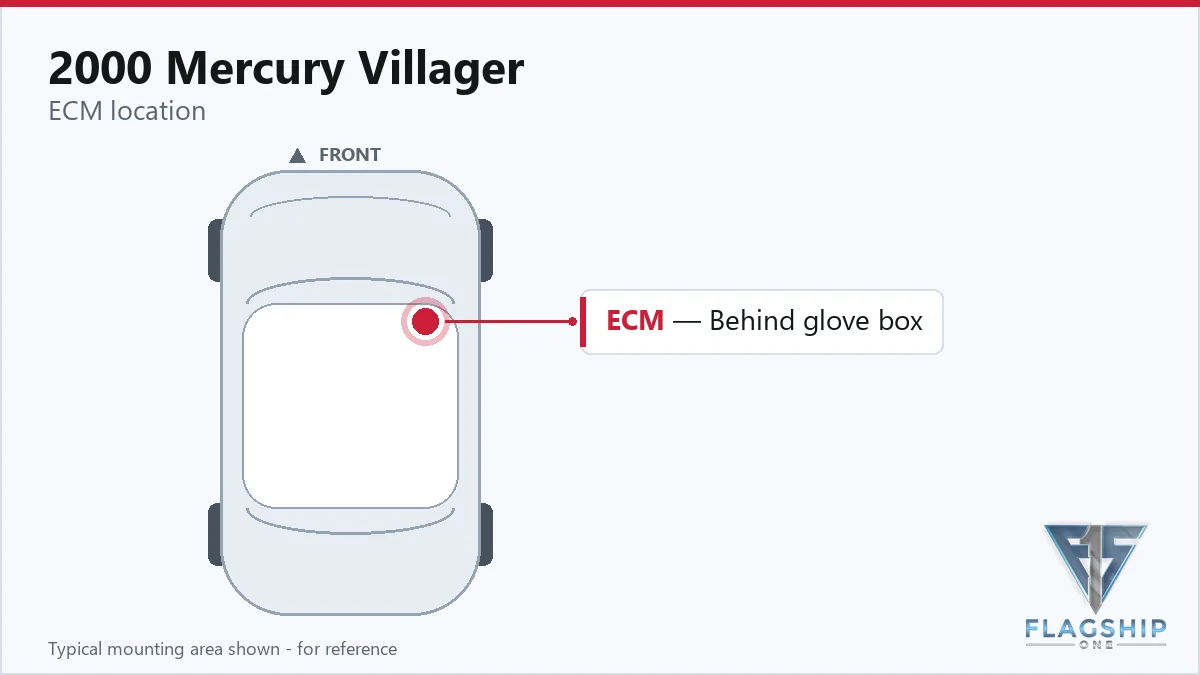
Work with the ignition off, and treat the module as static-sensitive: avoid touching the connector pins at any point.
| Operation | Configuration | Book Time |
|---|---|---|
| Engine Control Module R&R | All configurations | 0.9 hr |
| Powertrain Control Module R&R | All configurations | 0.9 hr |
| Powertrain Control Module Relearn | All configurations | 0.5 hr |
After physically installing a replacement PCM in your 2000 Mercury Villager, the factory procedure requires a relearn process that takes approximately 0.5 hours of book time. This procedure allows the new module to initialize and adapt to your vehicle’s specific engine and transmission characteristics, learning idle airflow settings, fuel trims, and transmission shift adaptions. Without completing this relearn sequence, the vehicle may run poorly or exhibit drivability concerns until the computer completes its adaptation cycle through normal driving. a VIN-programmed replacement unit from Flagship One arrives already configured with your specific vehicle identification number pre-loaded into memory. This means the technician can install the module and proceed directly to the relearn procedure without spending additional time at the dealer or with a programming tool to input the VIN and download the correct software calibration. The result is a faster repair with less potential for issues related to incorrect programming.
When the PCM or ECM in your 2000 Mercury Villager begins to fail, you may notice the engine cranks but refuses to start, or the vehicle stalls unexpectedly while driving. Common symptoms include rough idle, hesitation under acceleration, and a general lack of engine power that makes the van feel sluggish. The check engine light may illuminate with fault codes related to engine sensors, but these codes can be misleading because the underlying issue may actually be the computer’s inability to process the sensor signals correctly. In some cases, the transmission may exhibit harsh shifting, delayed engagement, or the vehicle may become stuck in a single gear because the PCM can no longer properly control the shift solenoids. Communication failure with scan tools is another indicator—when the diagnostic scanner cannot establish a link with the vehicle’s computer, it often points to a failed PCM or a power supply issue to the module itself. Intermittent electrical faults, such as flickering gauges or random instrument cluster warnings, can also stem from internal processor failures within the control module. If your Villager displays multiple seemingly unrelated electrical symptoms along with drivability problems, the PCM is a prime suspect and should be tested before replacing more expensive components.
A used PCM from a salvage yard may work, but it will likely require dealer programming to accept your vehicle’s VIN and download the correct software calibration. This programming service often costs as much or more than purchasing a professionally refurbished unit that arrives pre-programmed. Additionally, used units carry no warranty and may have the same failure mode about to occur.
When a scan tool cannot communicate with any module on the 2000 Mercury Villager, it typically points to a failed PCM, a blown PCM fuse, or a wiring issue affecting the computer’s power supply. The PCM supplies the communication bus for all modules, so if it is completely dead, the scan tool will show no connection. A qualified technician should check fuses and power circuits before assuming the PCM itself is faulty.
If the transmission issues are caused by a failed PCM, replacing the module may resolve harsh shifting, delayed engagement, or stuck gear problems. However, transmission mechanical failures and faulty shift solenoids can produce similar symptoms. A thorough diagnosis should verify that the PCM is actually the root cause before replacing it, as the new module will not repair mechanical transmission damage.
The factory book time for the relearn procedure is 0.5 hours, though actual time may vary based on the specific procedure the technician follows. Some relearn processes require a specific driving cycle while the computer adapts to your vehicle’s engine and transmission characteristics. This adaptation occurs naturally during normal driving over several days.
The 2000 Mercury Villager uses a combined Powertrain Control Module that handles both engine and transmission functions in a single unit. This integration means one module controls fuel delivery, ignition timing, emissions, and automatic transmission shifting. When replacing this unit, you do not need to source separate ECM and PCM components.
If your 2000 Mercury Villager has been diagnosed with a failed control module or you are experiencing the symptoms described above, you have two primary repair options. You may choose a genuine dealer part, which typically requires additional programming fees after installation. Alternatively, a professionally refurbished replacement from Flagship One arrives with your specific VIN pre-programmed, allowing for a simpler installation process with less labor overhead. Consider your budget, timeline, and whether the additional dealer programming steps are worthwhile for your situation when making your decision.
Flagship One stocks a refurbished, VIN-programmed PCM for the 2000 Mercury Villager with a lifetime warranty, free shipping and no core charge. The full Mercury Villager module lineup covers other engine configurations as well.
The Powertrain Control Module in your 2000 Mercury Villager is the brain behind every major engine and transmission function, making it critical to proper vehicle operation. Recognizing the symptoms of failure early and understanding the replacement process helps you avoid being stranded or spending money on unnecessary repairs. Whether you opt for dealer parts or a VIN-programmed replacement unit, having a functional computer is essential for getting your Villager back on the road reliably.