
Last updated on August 25th, 2026 at 01:04 pm
The PCM in a 1996 Mercury Villager coordinates engine timing, fuel delivery, and emissions. Failure can cause misfires, poor fuel economy, or loss of power.
Replacing the Powertrain Control Module on a 1996 Mercury Villager can feel daunting, but a clear understanding of the process and expected outcomes makes it manageable. This guide explains what the module does, where it sits, how to replace it, and what to watch for after the job. By following these steps, you’ll know how to protect the module, recognize common failure symptoms, and avoid costly errors during installation.
The PCM in a 1996 Mercury Villager manages engine and transmission functions, interpreting sensor inputs to optimize performance. 1996 Mercury Villager PCM is crucial because it ensures proper fuel timing, idle control, and emission regulation. When it fails, you may notice erratic idling, sudden loss of power, or persistent check‑engine lights. Replacing the PCM restores reliable communication between the engine, transmission, and other electronic systems.
1996 Mercury Villager
OEM programmed ECM for your 1996 Mercury Villager — plug & play, no dealer visit.
Free shipping · Lifetime warranty
The Powertrain Control Module is positioned behind the glove compartment, identified by location code 06010. Removing it typically takes 0.9 hours, while reinstalling also requires the same amount of time. Access involves removing the glove compartment panel and carefully disconnecting the wiring harness. No special torque specifications are listed, but secure connections are essential to prevent future communication issues.
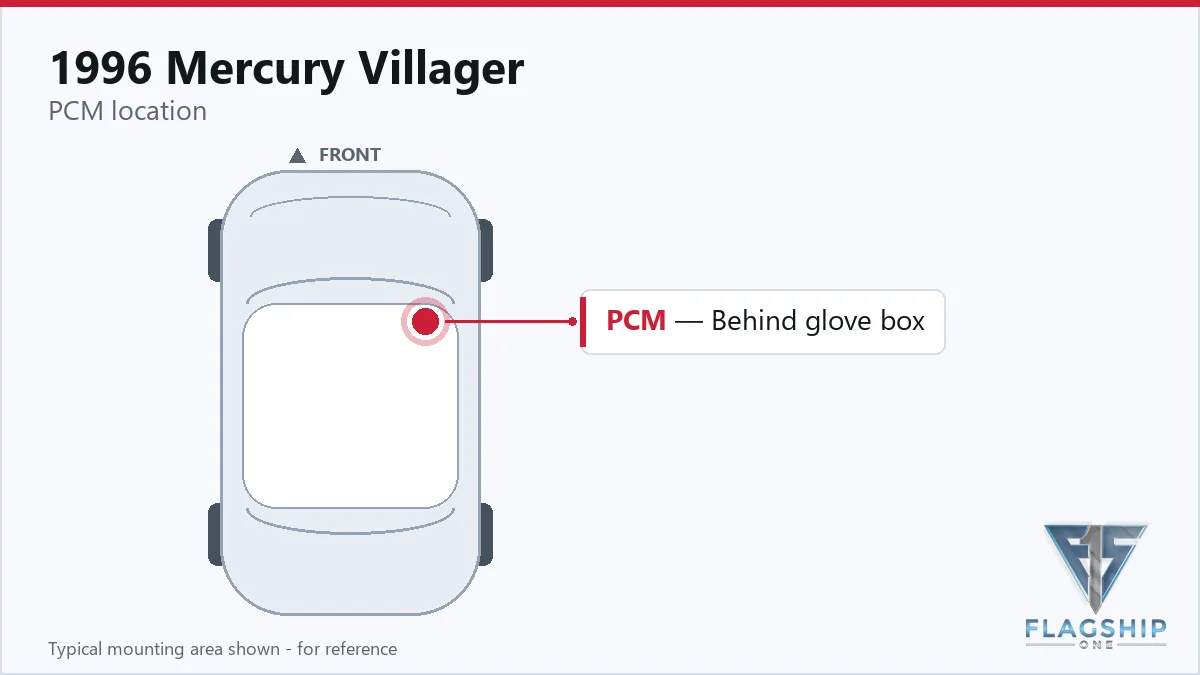
Work with the ignition off, and treat the module as static-sensitive: avoid touching the connector pins at any point.
| Operation | Configuration | Book Time |
|---|---|---|
| Engine Control Module R&R | All configurations | 0.9 hr |
| Powertrain Control Module R&R | All configurations | 0.9 hr |
| Powertrain Control Module Relearn | All configurations | 0.5 hr |
After the PCM is installed, the factory requires a relearn procedure. However, Flagship One units arrive VIN‑programmed, so the relearn step is already completed. VIN‑programmed replacement unit eliminates the need for additional programming or memory updates.
A failing PCM in a 1996 Mercury Villager can present as rough idling, stalling, or unexpected acceleration. You may also see a check‑engine light with codes such as Powertrain Control Module Failure. In some cases, the vehicle may fail to start or exhibit erratic shifting behavior due to loss of communication between the engine and transmission.
TSB 98‑18‑04 addresses MIL illumination with codes P0120, P0510, P0731, P0732, and P0733 stored in memory but without driveability concerns. TSB 98‑20‑15 covers MIL illumination with code 32 or P0400 stored in memory.
| Bulletin | Subject | What It Addresses |
|---|---|---|
| 98-18-04 | LAMP – MALFUNCTION INDICATOR LAMP (MIL) – MALFUNCTION INDICATOR LAMP (MIL) ILLUMINATED WITH DIA | — |
| 98-20-15 | LAMP – MALFUNCTION INDICATOR LAMP (MIL) – MALFUNCTION INDICATOR LAMP (MIL) ILLUMINATED WITH DIA | — |
The process typically requires around 0.9 hours for removal and the same for reinstallation. This includes accessing the module behind the glove compartment and reconnecting the harness.
Flagship One units come VIN‑programmed, so the relearn step is already complete. No additional calibration is necessary.
Check for any remaining fault codes. If codes persist, inspect the wiring harness and connectors for damage or corrosion, and verify that the new module is correctly seated.
Once the PCM is installed, you can choose to proceed with a full diagnostic scan or opt for a refurbished replacement if you prefer a cost‑effective solution. The 1996 Mercury Villager’s PCM is essential for maintaining smooth engine operation, and a reliable replacement ensures your vehicle stays on the road.
Flagship One stocks a refurbished, VIN-programmed PCM for the 1996 Mercury Villager with a lifetime warranty, free shipping and no core charge. The full Mercury Villager module lineup covers other engine configurations as well.
Replacing the PCM in a 1996 Mercury Villager restores accurate engine and transmission control, reducing the risk of misfires and performance loss. Take advantage of a VIN‑programmed unit to simplify the process and keep your vehicle running reliably.