
Last updated on August 25th, 2026 at 12:10 pm
In the 1999 Mercury Villager the Powertrain Control Module and Engine Control Module manage engine timing, fuel delivery and transmission shift logic. A failure in either unit can cause loss of power, erratic shifting or a complete no‑start condition, often flagged by communication or strategy codes.
When a 1999 Mercury Villager begins to exhibit no‑start behavior, rough idle or unexpected shift changes, the control modules are a common culprit. Understanding how the Engine Control Module (ECM) and Powertrain Control Module (PCM) function, where they sit, and what the factory recommends after a swap can save you time and money. This guide walks you through the removal process, the labor involved, and the post‑install drive cycle, so you know exactly what to expect whether you choose a new unit or a refurbished replacement.
The ECM and PCM in the 1999 Mercury Villager act as the vehicle’s brain, interpreting sensor data to control fuel injection, ignition timing and transmission shift points. By constantly adjusting these parameters, the modules help maintain smooth operation, fuel efficiency and emissions compliance. A malfunction can interrupt communication with the engine, leading to fault codes and drivability loss. Proper operation is essential for reliable performance, and a faulty unit often triggers a strategy reset request. For owners seeking a swap, replacement engine modules for Villager provide a direct fit without additional wiring changes.
1999 Mercury Villager
OEM programmed ECM for your 1999 Mercury Villager — plug & play, no dealer visit.
Free shipping · Lifetime warranty
Factory service information indicates that the control module sits behind the glove box, allowing technicians to reach it without removing major interior panels. The removal and reinstall procedure is timed at 0.9 hours for each module, reflecting the straightforward access path. Once the glove box is lowered, the module can be disengaged from its mounting bolts and connector, then swapped with a new or rebuilt unit. Reinstallation follows the reverse order, ensuring the connector seats fully before securing the bolts to the specified torque, if any is noted in the service guide.
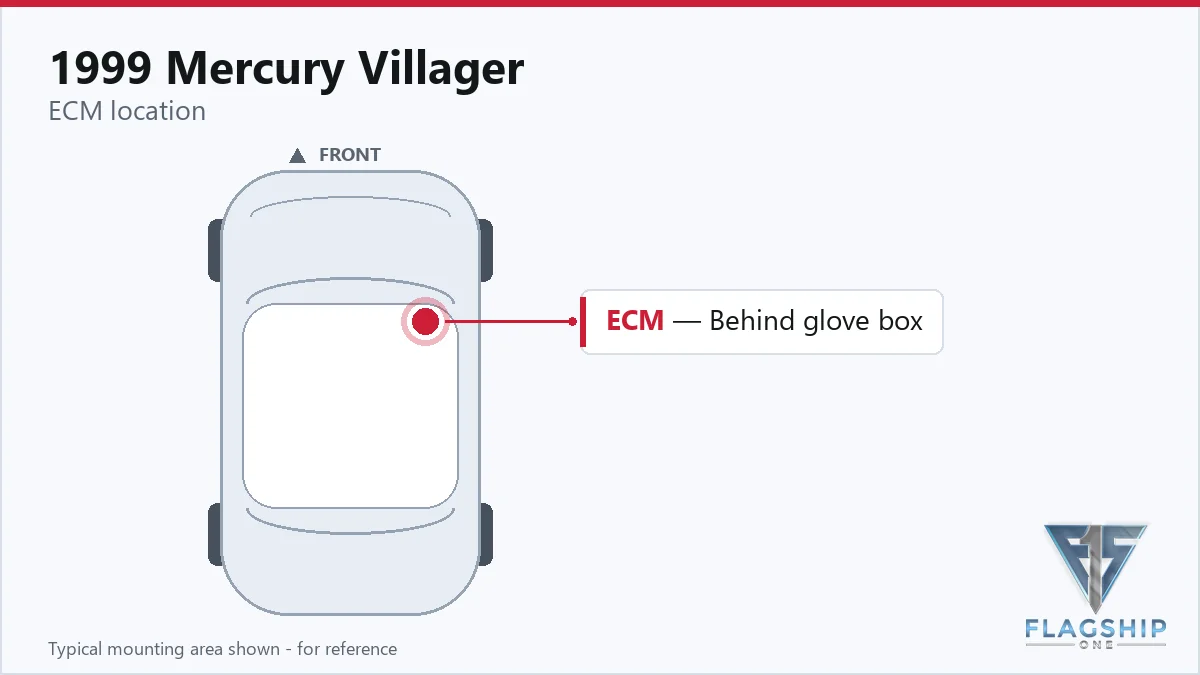
Work with the ignition off, and treat the module as static-sensitive: avoid touching the connector pins at any point.
| Operation | Configuration | Book Time |
|---|---|---|
| Engine Control Module R&R | All configurations | 0.9 hr |
| Powertrain Control Module R&R | All configurations | 0.9 hr |
| Powertrain Control Module Relearn | All configurations | 0.5 hr |
After installing a new module in a 1999 Mercury Villager, the factory recommends a drive cycle of at least 16 km (10 miles) to allow the PCM to relearn its operating strategy. Flagship One units arrive pre‑programmed to the vehicle’s VIN, so the relearn step is already satisfied, eliminating the need for a separate calibration. Nonetheless, a short road test of a VIN-programmed replacement unit helps confirm that the module communicates correctly with the engine and transmission systems.
Typical signs of a failing ECM or PCM in a 1999 Mercury Villager include a complete no‑start condition, rough idle, unexpected stalling, and transmission shift delays. Scan tools often report communication faults such as communication fault, indicating the control unit is not responding to the vehicle’s data bus. Drivers may also notice a loss of power during acceleration or an illuminated check engine light accompanied by codes related to fuel trim or misfire detection.
The factory book time lists 0.9 hours for removing and reinstalling the Powertrain Control Module on this vehicle.
Access is achieved by lowering the glove box, which generally requires standard hand tools and a torque wrench for the mounting bolts.
The manufacturer recommends a drive of at least 16 km (10 miles) to allow the module to relearn its strategy.
Yes, Flagship One units are pre‑programmed to the vehicle’s VIN, so the factory relearn step is already completed.
Code P0601 signals a communication fault between the PCM/ECM and the vehicle’s data bus.
When the control module in your 1999 Mercury Villager needs attention, you can choose a brand‑new unit or a professionally refurbished replacement. Both options restore the vehicle’s electronic management, but a refurbished part often provides a cost‑effective solution while meeting the same specifications. Consider your budget, warranty preferences and the availability of a VIN‑programmed unit when deciding which path fits your repair plan.
Flagship One stocks a refurbished, VIN-programmed PCM for the 1999 Mercury Villager with a lifetime warranty, free shipping and no core charge. The full Mercury Villager module lineup covers other engine configurations as well.
Replacing the ECM or PCM in a 1999 Mercury Villager can return reliable performance and eliminate drivability issues. Whether you select a new or refurbished unit, follow the factory removal steps and the recommended drive cycle to ensure proper relearning. Contact Flagship One for a VIN‑programmed replacement that streamlines the process.