
Last updated on August 25th, 2026 at 12:11 pm
The powertrain control module in your 1997 Mercury Villager manages engine and transmission functions. It processes sensor data to control ignition timing, fuel injection, and automatic shift points. Internal solder joint degradation or voltage spikes from jump-starts often trigger erratic behavior, warning lights, or complete communication loss with scan tools.
When your 1997 Mercury Villager develops intermittent stalling, hard starting, or unexplained transmission shifting issues, the powertrain control module often becomes the primary suspect. This onboard computer coordinates critical functions across your 3.0L engine and automatic transmission, interpreting data from numerous sensors to maintain optimal performance and fuel efficiency. Understanding how this module operates, where it resides within the cabin, and what symptoms indicate degradation helps you make informed repair decisions without unnecessary parts replacement or diagnostic guesswork. You will learn the specific labor times involved for professional replacement, the factory relearn requirements that follow installation, and important service bulletins affecting this specific model year. We will also cover essential precautions regarding static electricity that can destroy sensitive circuitry during handling or storage. Whether you are troubleshooting a persistent check engine light or planning a complete module replacement, this guide provides accurate technical context specific to your Villager. You will gain clarity on whether professional programming is mandatory, how to identify internal versus external faults, and what practical steps protect your investment during service. The information focuses on measurable outcomes rather than theoretical speculation, ensuring you can discuss repairs confidently with your technician.
The powertrain control module serves as the central processing unit for your 1997 Mercury Villager, integrating engine management with transmission control in a single housing mounted behind the dashboard. Unlike earlier vehicles that used separate engine and transmission computers, your Villager employs a unified architecture that monitors throttle position, coolant temperature, vehicle speed, and transmission pressure simultaneously through a complex network of sensors. This integration allows precise coordination between gear changes and engine load, resulting in smoother acceleration and improved fuel economy during daily driving conditions. The module contains integrated circuits that interpret analog signals from oxygen sensors and mass airflow meters, converting them into digital commands for fuel injectors and ignition coils with millisecond precision. Over time, thermal cycling and vibration can compromise internal solder connections, leading to erratic voltage outputs or complete circuit failure that disables critical systems. When these failures occur, you may experience symptoms ranging from subtle performance degradation to catastrophic no-start conditions that strand you unexpectedly. Installing replacement PCMs for the Villager requires careful attention to pin alignment and connector seating to ensure proper communication with the multiplexed wiring system used throughout your Mercury. The module stores adaptive strategies for transmission shift points and idle speed, which means each unit learns your specific driving habits over thousands of miles. Understanding this adaptive behavior explains why immediate relearn procedures matter after hardware replacement to restore factory calibration standards.
1997 Mercury Villager
OEM programmed ECM for your 1997 Mercury Villager — plug & play, no dealer visit.
Free shipping · Lifetime warranty
Your 1997 Mercury Villager houses the powertrain control module behind the glove compartment, requiring dashboard disassembly to access the mounting bracket. Professional labor guides allocate 0.9 hours for the removal and replacement procedure, which typically involves lowering the glove box assembly and disconnecting the multi-pin electrical connectors. You should allow additional time for careful handling since electrostatic discharge can destroy sensitive internal circuits without proper grounding straps. After physical installation, the relearn process requires 0.5 hours according to standard labor schedules, though this step may vary depending on equipment availability. The engine control module service operation also lists 0.9 hours, reflecting similar access requirements when servicing that related component. Technicians must follow proper grounding protocols before touching the unit to prevent static electricity from damaging the pins. No specific torque values were provided for the mounting hardware, so standard fastener practices apply during reassembly.
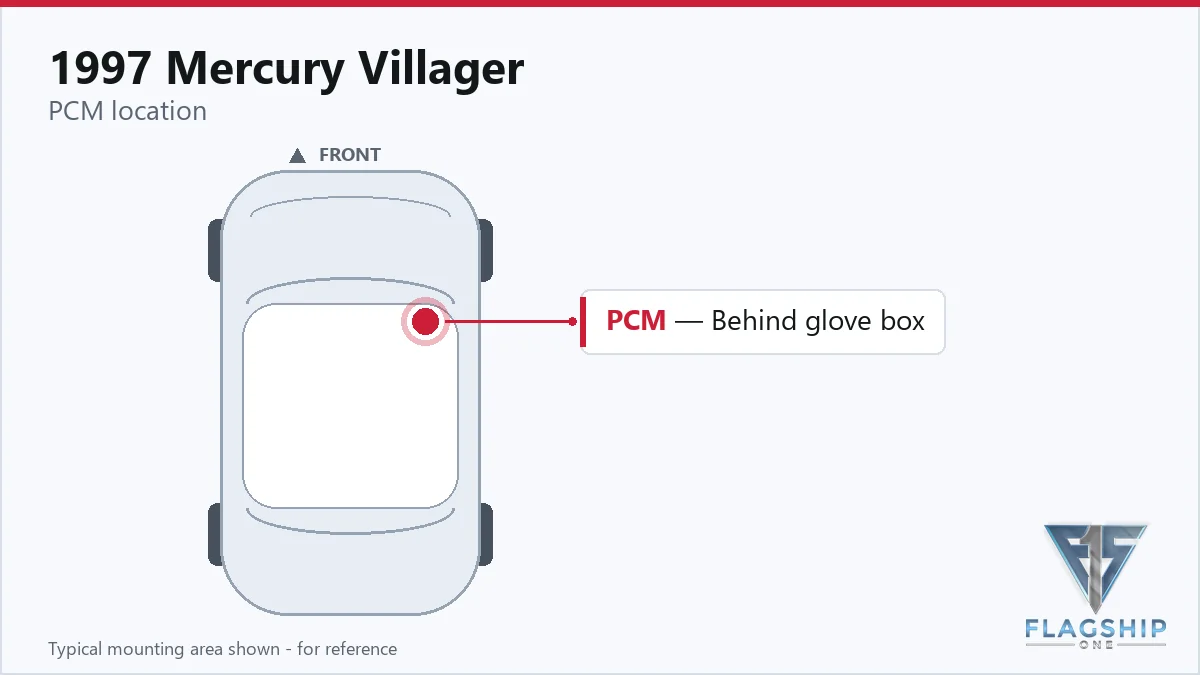
Work with the ignition off, and treat the module as static-sensitive: avoid touching the connector pins at any point.
| Operation | Configuration | Book Time |
|---|---|---|
| Engine Control Module R&R | All configurations | 0.9 hr |
| Powertrain Control Module R&R | All configurations | 0.9 hr |
| Powertrain Control Module Relearn | All configurations | 0.5 hr |
After installing new hardware in your 1997 Mercury Villager, factory procedures mandate a Powertrain Control Module Relearn requiring 0.5 hours of labor to establish baseline transmission adaptive values and idle control parameters. This process typically involves proprietary scan tool communication to reset learned strategies and synchronize the new module with existing vehicle systems including the instrument cluster and anti-theft components. However, when you receive a VIN-programmed replacement unit, the essential calibration data for your specific Mercury arrives already installed, eliminating the need for initial programming at the shop. Your technician can proceed directly to the installation and relearn phases without waiting for dealership software sessions or worrying about incorrect flash files. This preparation streamlines the service process significantly, reducing total downtime while ensuring the module recognizes your vehicle’s unique configuration immediately upon connection. You still need to complete the adaptive relearn procedure so the transmission and engine management systems optimize for your driving patterns, but the foundational security and calibration programming remains intact from the moment you unbox the component.
A failing powertrain control module in your 1997 Mercury Villager often manifests through intermittent no-start conditions where the engine cranks but fails to ignite, particularly after the vehicle sits overnight in varying temperatures. You may notice erratic transmission shifting where the automatic gearbox holds gears too long or shifts harshly between second and third, sometimes accompanied by the malfunction indicator lamp illuminating unexpectedly during highway cruising. Communication failures with diagnostic scan tools frequently indicate internal module damage, preventing technicians from retrieving stored codes or viewing live data streams during testing. When TSB 98-18-04 conditions occur, you might see incorrect first gear ratio stored alongside other transmission faults even though no perceptible driveability issues exist during normal operation. Engine stalling at stoplights or surging during steady cruise speeds suggests corrupted processing of throttle position or mass airflow sensor signals within the processor. Misfire codes that persist after replacing spark plugs and ignition components often trace back to the module’s inability to trigger coils at the proper interval, causing rough idle and reduced acceleration. Hard starting when the engine is warm, accompanied by extended cranking times, points to fuel injector timing irregularities controlled by the PCM circuitry. You should address these symptoms promptly since degraded module performance can eventually damage the catalytic converter or transmission clutches through improper fuel mixture and shift management strategies.
Technical Service Bulletin #98-18-04 addresses specific instances where the malfunction indicator lamp illuminates on your 1997 Mercury Villager without accompanying driveability concerns. The bulletin documents conditions where diagnostic trouble codes P0120, P0510, P0731, P0732, and P0733 store in memory simultaneously. These codes relate to throttle position, idle speed control, and transmission gear ratios. Importantly, technicians observed that vehicles exhibiting this specific code combination often operated normally despite the warning light, suggesting internal calibration issues rather than mechanical failures. The bulletin provides diagnostic steps to verify whether the powertrain control module requires reprogramming or replacement to resolve the false indicators.
| Bulletin | Subject | What It Addresses |
|---|---|---|
| 98-18-04 | LAMP – MALFUNCTION INDICATOR LAMP (MIL) – MALFUNCTION INDICATOR LAMP (MIL) ILLUMINATED WITH DIA | — |
Internal solder joint degradation from thermal cycling and voltage spikes from jump-starts or failing alternators often damage the integrated circuits. Moisture intrusion through compromised seals may also corrode connector pins over time.
You can physically install the unit behind the glove compartment using basic hand tools, but the 0.5 hour relearn procedure requires professional scan equipment. Static electricity precautions are essential during handling to prevent immediate damage.
TSB 98-18-04 documents this exact scenario where codes P0120, P0510, and P0731-P0733 store without driveability issues, often indicating internal module calibration faults rather than mechanical transmission problems.
Factory procedures require a 0.5 hour relearn process, but VIN-programmed units arrive with your specific calibration installed, allowing immediate installation though adaptive learning still occurs during initial driving.
Labor guides indicate 0.9 hours for removal and installation plus 0.5 hours for the relearn procedure, though actual shop time may vary depending on access conditions and diagnostic verification needs.
When your 1997 Mercury Villager exhibits persistent powertrain symptoms, you face the choice between repairing existing connections or installing a replacement module. Professional installation with proper static precautions ensures reliable operation and protects your investment in quality components. Understanding the 0.9 hour installation time and 0.5 hour relearn requirement helps you evaluate repair quotes effectively. Whether you choose dealership service or an independent specialist, ensure they follow the specific service bulletins affecting this model year.
Flagship One stocks a refurbished, VIN-programmed PCM for the 1997 Mercury Villager with a lifetime warranty, free shipping and no core charge. The full Mercury Villager module lineup covers other engine configurations as well.
Your 1997 Mercury Villager depends on a fully functional powertrain control module for reliable daily operation across varying driving conditions. By recognizing early failure symptoms and respecting static electricity precautions during service, you can restore proper engine and transmission coordination without unnecessary delays. Consider professional replacement options that include proper calibration and post-installation relearn procedures to ensure your Mercury continues performing as designed for years to come.