
Last updated on August 25th, 2026 at 12:31 pm
The Engine Control Module (ECM) on your 1992 Pontiac Grand Prix is the central computer that manages fuel delivery, ignition timing, and emissions systems. When this module fails, your vehicle may not run properly or may not start at all.
If your 1992 Pontiac Grand Prix has developed starting problems, intermittent stalling, or erratic shifting, the Engine Control Module may be the culprit. This vehicle predates OBD-II, meaning diagnostic procedures differ from modern cars. The ECM serves as the brain of your 3.1L V6, coordinating engine and transmission functions. This guide explains what the module does, where it is located, common failure symptoms, and what replacement involves.
The Engine Control Module in your 1992 Pontiac Grand Prix is the primary computer responsible for managing the 3.1L V6 engine’s fuel injection, ignition timing, and emissions controls. It processes inputs from various sensors and adjusts engine operation accordingly. This module also interfaces with the transmission control system, making it critical for both drivability and shifting performance. When the internal processor or memory corrupts, you may experience no-start conditions, stalling, or the scan tool may fail to communicate with the vehicle. Replacement engine computers for the Grand Prix restores proper engine management and transmission function.
1992 Pontiac Grand Prix
OEM programmed ECM for your 1992 Pontiac Grand Prix — plug & play, no dealer visit.
Free shipping · Lifetime warranty
On the 1992 Pontiac Grand Prix, the PCM is mounted inside the passenger compartment beneath the instrument panel on the left side. This location differs significantly from most vehicles, where the computer sits in the engine compartment. Access requires removing lower dashboard panels. The ECM R&R book time is 1.0 hour; however, some shops may quote differently based on their labor rate structure. Replacement involves disconnecting the battery (with ignition OFF per factory caution), removing the module mounting hardware, transferring the connector, and installing the new unit. Plan for additional time if the connector or mounting brackets show corrosion.
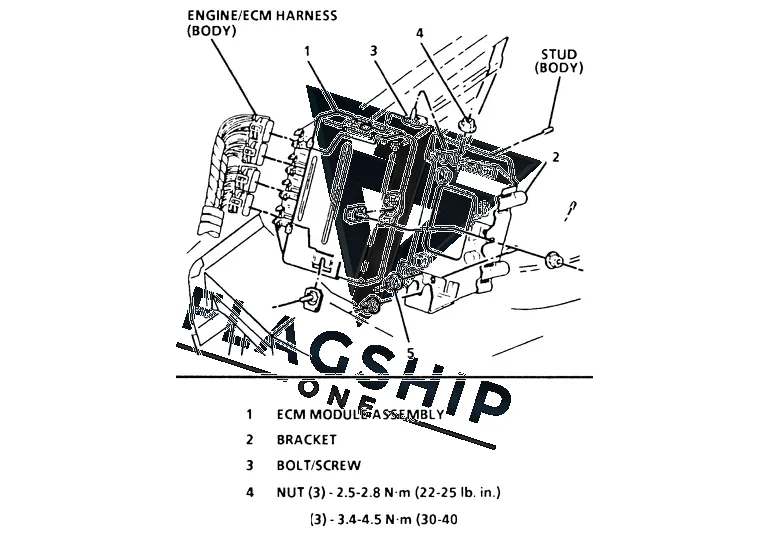
Work with the ignition off, and treat the module as static-sensitive: avoid touching the connector pins at any point.
| Operation | Configuration | Book Time |
|---|---|---|
| Engine Control Module R&R | All configurations | 1.0 hr |
| Engine Control Module Relearn | All configurations | 0.5 hr |
| Powertrain Control Module Relearn | All configurations | 0.5 hr |
| Powertrain Control Module R&R | All configurations | 0.5 hr |
After installing a replacement ECM on your 1992 Pontiac Grand Prix, the factory procedure requires a relearn procedure to calibrate the new module to your vehicle’s specific engine and transmission characteristics. The ECM relearn procedure takes approximately 0.5 hours according to book time. This step is necessary because the module must adapt to your engine’s unique sensor readings and calibration data. Flagship One units arrive VIN-programmed with the correct calibration for your specific vehicle, meaning those initial programming steps are already completed. Your technician will still need to perform the relearn procedure to ensure optimal drivability.
Every VIN-programmed replacement unit from Flagship One arrives with these steps already completed.
When the Engine Control Module fails on a 1992 Grand Prix, common symptoms include a no-start condition or hard-starting, especially when the engine is warm. You may experience intermittent stalling, particularly at idle or during low-speed maneuvers. The transmission may exhibit harsh or delayed shifting, or the vehicle may get stuck in gear. In some cases, the scan tool will not communicate with the vehicle at all, suggesting an internal module failure. These symptoms often develop gradually as the internal processor degrades, though a sudden failure can also occur following an electrical event like a jump-start performed with the ignition in the ON position.
Factory service bulletins for this era of GM vehicles address intermittent no-start conditions and drivability concerns that may trace to the ECM. Technical bulletins recommend verifying module ground integrity and checking for proper battery voltage before replacing the control module. These bulletins provide diagnostic flowcharts to help technicians determine whether the ECM is the root cause versus a wiring or sensor issue.
No. The ECM must be matched to your vehicle’s specific VIN and engine combination. Flagship One provides units programmed with your exact VIN, ensuring plug-and-play installation.
If you have moderate automotive experience, you can replace the module. However, you must follow the factory caution to disconnect the battery with the ignition OFF. The relearn procedure may require a scan tool.
The 1.0 hour R&R time covers physically removing and installing the module. The separate 0.5 hour relearn time covers the post-install calibration procedure required to initialize the new module.
When your 1992 Pontiac Grand Prix requires ECM replacement, you have two primary options. You can purchase a new or refurbished unit from a dealership, which typically requires dealer programming at additional cost. Alternatively, a VIN-programmed replacement from Flagship One arrives ready to install, with the relearn procedure being the only post-install step. Consider your budget, timeline, and access to scan tools when making your decision.
Flagship One stocks a refurbished, VIN-programmed PCM for the 1992 Pontiac Grand Prix with a lifetime warranty, free shipping and no core charge. The full Pontiac Grand Prix module lineup covers other engine configurations as well.
The 1992 Pontiac Grand Prix relies on its Engine Control Module for reliable operation. If you are experiencing starting issues, stalling, or shifting problems, the ECM may be the cause. Following proper disconnection procedures protects your investment. A quality replacement unit programmed to your VIN restores your Grand Prix to proper operation.