
Last updated on August 25th, 2026 at 02:01 pm
The engine control module (ECM) in the 1994 Mazda RX-7 is the brain of the rotary engine management system. When it fails, the engine may not start, run poorly, or exhibit erratic behavior. Replacement requires a properly programmed unit to restore performance.
Owning a 1994 Mazda RX-7 with the 1.3L rotary engine means you have a unique and powerful sports car. However, like any vehicle from that era, the engine control module (ECM) can eventually fail. The ECM is the central computer that manages fuel injection, ignition timing, and other critical functions for the rotary powerplant. When it malfunctions, the car may refuse to start, idle erratically, or lose power. This guide will help you understand what the ECM does in your RX-7, where it is located, what symptoms to watch for, and what replacement involves. You will also learn about the importance of proper programming and how to avoid common pitfalls. Whether you are troubleshooting a no-start condition or planning a preventative replacement, this information will give you a clear path forward.
1994 Mazda RX-7
OEM programmed ECM for your 1994 Mazda RX-7 — plug & play, no dealer visit.
Free shipping · Lifetime warranty
The engine control module in the 1994 Mazda RX-7 is a sophisticated computer that interprets sensor data and adjusts engine parameters in real time. For the 13B rotary engine, the ECM controls the primary and secondary fuel injectors, the leading and trailing spark plugs, and the turbocharger wastegate solenoid. It also manages the air pump system for emissions and the cooling fan relays. Because the rotary engine has a unique combustion cycle, the ECM’s timing and fuel maps are specifically calibrated for this powerplant. A failing ECM can cause the engine to run rich or lean, leading to poor performance, fouled spark plugs, or even engine damage. When you need a replacement, you must choose a unit that is correctly programmed for your vehicle. That is why many owners turn to replacement ECMs for the 1994 RX-7 that come pre-programmed with the correct VIN and calibration data, ensuring plug-and-play operation without the need for a dealer visit.
The ECM in the 1994 Mazda RX-7 is typically located under the front console or behind the center console. Accessing it requires removing the center console trim, which may involve unscrewing or prying off plastic panels. Once the console is removed, you will see the metal bracket holding the ECM. Disconnect the battery negative terminal first to avoid any electrical shorts. Then unplug the two large harness connectors from the module. Remove the mounting bolts and slide the ECM out. Installation is the reverse: secure the new module, reconnect the harnesses, and reinstall the console. No special tools are needed, but take care not to damage the connectors or wiring. The job can be done in a driveway with basic hand tools, though patience is required to avoid breaking aged plastic trim.
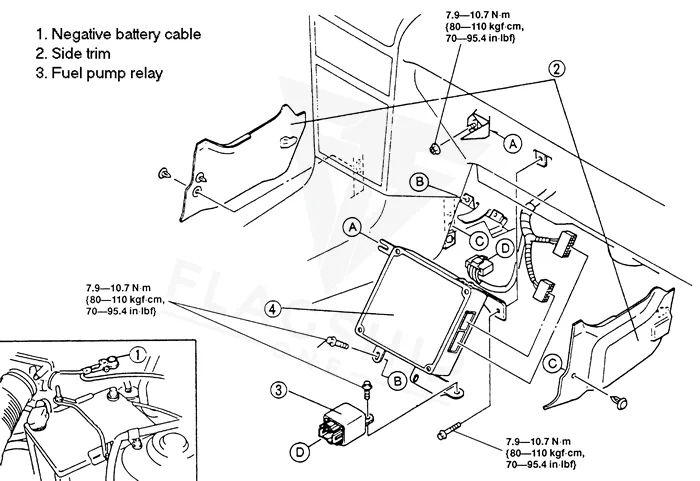
Work with the ignition off, and treat the module as static-sensitive: avoid touching the connector pins at any point.
After replacing the ECM in a 1994 Mazda RX-7, the factory procedure requires that the new module be programmed with the vehicle’s VIN and specific calibration data. This typically involves using a dealer-level scan tool to initialize the unit and set the correct fuel and ignition maps for the rotary engine. Without this step, the engine may run poorly or not start at all. Flagship One eliminates this hassle by shipping a VIN-programmed replacement unit that is already configured for your RX-7. You simply install the module, reconnect the battery, and start the engine. No additional programming or dealer visit is needed, saving you time and money while ensuring the ECM works correctly from the first crank.
When the ECM in a 1994 Mazda RX-7 begins to fail, you may notice several symptoms. The most common is a no-start condition where the engine cranks but does not fire. The rotary engine may also flood easily if the ECM is not controlling the injectors properly. Stalling, especially when coming to a stop, is another frequent complaint. You might experience rough idle, hesitation during acceleration, or a sudden loss of power. The check engine light may illuminate, but since this is a pre-OBD-II vehicle, you cannot retrieve standard diagnostic trouble codes. Instead, you would need a Mazda-specific tool to read the ECM’s internal fault codes. Other signs include erratic tachometer readings, the cooling fan running constantly, or the engine running rich with black smoke from the exhaust. If you encounter any of these issues, the ECM should be a prime suspect.
Common signs include no-start, stalling, rough idle, and loss of power. Since the RX-7 is pre-OBD-II, you cannot read standard codes. A Mazda-specific scan tool can retrieve internal fault codes. If other components test good, the ECM is likely the culprit.
Yes, the ECM is accessible under the front or behind the center console. Removing the console trim and disconnecting the harnesses is straightforward with basic hand tools. However, the new module must be programmed to your vehicle. A VIN-programmed unit from Flagship One makes it a direct swap.
The engine may not start or may run very poorly. The ECM needs the correct VIN and calibration data to operate the rotary engine’s fuel and ignition systems. Without programming, the module will not communicate properly with the sensors and actuators.
No, the ECM is specifically calibrated for the 13B rotary engine and the RX-7’s turbo system. Using a module from another model would cause incorrect fuel and timing maps, leading to poor performance or engine damage. Always use a unit designed for your exact vehicle.
The physical swap takes about 30 to 60 minutes, depending on your experience and how easily the console trim comes apart. The most time-consuming part is carefully removing the plastic panels without breaking them. No special tools are required.
When your 1994 Mazda RX-7’s ECM fails, you have two main options: repair the original module or replace it with a refurbished unit. Repair can be cost-effective for simple issues like bad capacitors, but internal failures often require a full replacement. A refurbished ECM from a trusted supplier ensures reliability and comes pre-programmed for your RX-7, eliminating the need for a dealer visit. This approach saves time and gets your rotary engine back on the road quickly.
Flagship One stocks a refurbished, VIN-programmed ECM for the 1994 Mazda RX-7 with a lifetime warranty, free shipping and no core charge. The full Mazda RX-7 module lineup covers other engine configurations as well.
The 1994 Mazda RX-7’s ECM is a critical component for the rotary engine’s performance and reliability. Understanding its location, symptoms of failure, and replacement process empowers you to address issues confidently. Whether you choose repair or a VIN-programmed replacement, proper installation and programming are key to restoring your RX-7’s legendary driving experience.