
Last updated on August 25th, 2026 at 02:01 pm
The powertrain control module (PCM) in your 1993 Mazda B2600 acts as the vehicle’s central computer, managing fuel delivery, ignition timing, and emissions systems. Failure often leads to hard starting, stalling, or poor engine performance without clear mechanical causes.
If your 1993 Mazda B2600 has been acting unpredictably—stalling at stops, refusing to start, or running roughly—it may not be a fuel pump or ignition issue. The powertrain control module (PCM), the brain behind your engine’s operations, could be failing. Unlike mechanical components, a faulty PCM often produces symptoms that seem unrelated, making diagnosis tricky without the right knowledge. Understanding what this module does, where to find it, and how replacement works can save you time and frustration. You’ll learn how to identify failure signs, what the repair process involves, and why a pre-programmed replacement unit can simplify the job. With this information, you can approach the repair with confidence, whether you’re tackling it yourself or working with a shop.
The PCM in your 1993 Mazda B2600 is responsible for controlling critical engine functions, including fuel injection, ignition timing, and idle speed. It constantly adjusts these parameters based on inputs from sensors throughout the vehicle, ensuring optimal performance and emissions compliance. Without a properly functioning PCM, your engine may run too rich or too lean, misfire, or fail to start altogether. This module is particularly important in pre-OBD-II vehicles like yours, where diagnostics rely more on manual troubleshooting than standardized codes. If the PCM fails, you might notice symptoms that mimic other issues, such as a bad fuel pump or faulty ignition coil. Replacing the module with replacement PCMs for the B2600 can restore normal operation, but it’s essential to follow the correct installation and programming steps to avoid further complications.
1993 Mazda B2600
OEM programmed ECM for your 1993 Mazda B2600 — plug & play, no dealer visit.
Free shipping · Lifetime warranty
The PCM in your 1993 Mazda B2600 is mounted inside the vehicle, under the dashboard on the right (passenger) side. Accessing it is straightforward: you’ll need to remove the lower dashboard panel, which is typically secured with a few screws or clips. Once the panel is off, the PCM is visible and can be unplugged by releasing the electrical connector. Replacement involves removing the old module, installing the new one, and securing it in place. There are no special torque specifications for this installation, but ensuring the connector is fully seated is critical to avoid intermittent electrical issues. The entire process is designed to be accessible, even for those with basic mechanical experience.
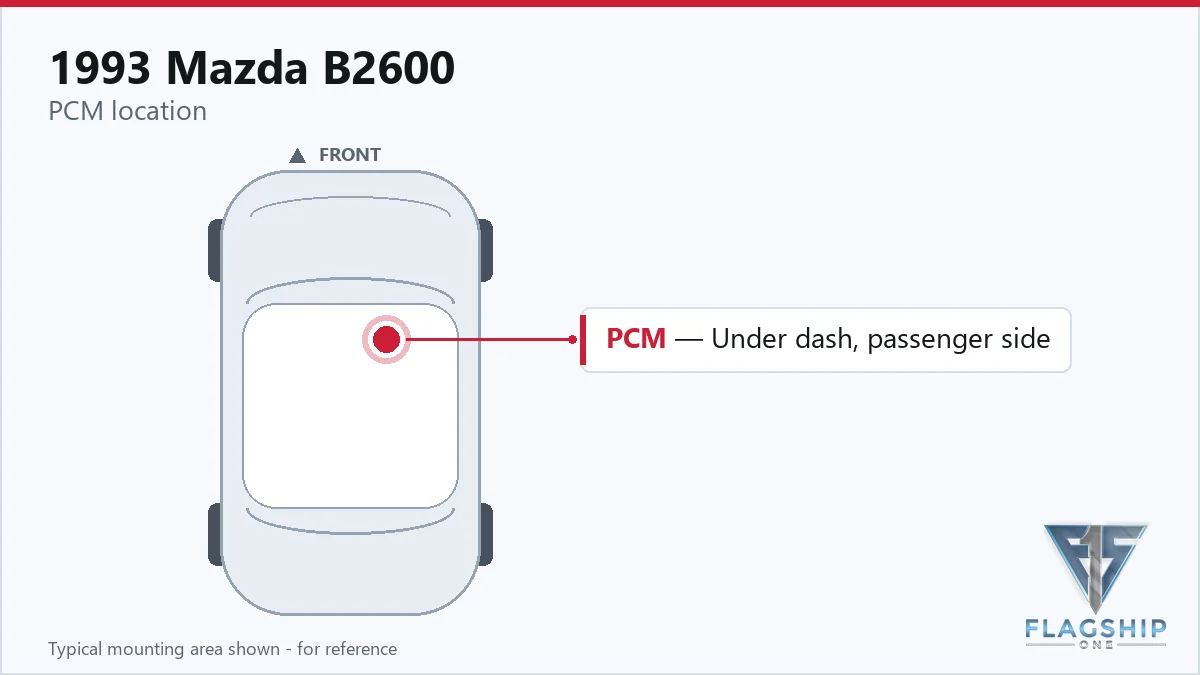
Work with the ignition off, and treat the module as static-sensitive: avoid touching the connector pins at any point.
After installing a new PCM in your 1993 Mazda B2600, the factory procedure requires programming the module to match your vehicle’s VIN. This step ensures the module communicates correctly with the engine’s sensors and other systems. Without proper programming, the vehicle may not start or could run poorly. However, when you use a pre-programmed replacement unit, this step is already completed. The module arrives ready to install, eliminating the need for specialized diagnostic tools or dealer programming. This not only simplifies the repair but also reduces the risk of errors during the programming process. Always verify that the replacement unit is compatible with your specific vehicle to avoid compatibility issues.
A failing PCM in your 1993 Mazda B2600 can cause a range of symptoms that may seem unrelated at first. One of the most common signs is a no-start condition, where the engine cranks but refuses to fire. Stalling at idle or during acceleration is another frequent issue, often accompanied by rough running or misfires. You might also notice poor fuel economy, as the PCM struggles to maintain the correct air-fuel mixture. In some cases, the vehicle may exhibit erratic shifting if the module affects transmission control signals. Another telltale sign is a complete lack of communication with a scan tool, indicating the PCM is unresponsive. While these symptoms can point to other problems, such as a faulty fuel pump or ignition system, they often align with PCM failure, especially if they occur intermittently or worsen over time.
Intermittent stalling in your B2600 can stem from several issues, including a failing PCM. The module controls fuel delivery and ignition timing, so if it malfunctions, the engine may cut out unexpectedly. Other potential causes include a faulty fuel pump or ignition system, but if those components check out, the PCM is a likely culprit. Testing the module’s response to sensor inputs can help confirm the diagnosis.
Without a scan tool, diagnosing a failing PCM in your B2600 relies on observing symptoms. Look for patterns like hard starting, stalling, or poor engine performance that don’t align with mechanical issues. If the vehicle runs fine after sitting overnight but acts up after warming up, the PCM may be struggling with heat-related failures. Checking for consistent fuel pressure and spark can help rule out other causes.
Replacing the PCM in your B2600 is a straightforward process, provided you have basic hand tools. The module is located under the dashboard on the passenger side, and accessing it requires removing a few screws or clips. The most critical step is ensuring the electrical connector is fully seated after installation. If you’re comfortable with simple automotive repairs, this is a manageable DIY job.
Installing a used PCM from another B2600 may work, but it’s not guaranteed. The module must be compatible with your vehicle’s engine and transmission configuration. Even if it fits, the used PCM may not be programmed to your VIN, which can cause starting or running issues. A pre-programmed replacement unit is a more reliable option, as it eliminates these compatibility concerns.
Yes, a failing PCM in your B2600 can lead to emissions test failures. The module controls the air-fuel mixture and ignition timing, both of which directly impact emissions output. If the PCM is malfunctioning, the engine may run too rich or too lean, increasing harmful emissions. Addressing PCM issues before testing can help ensure your vehicle meets emissions standards.
If your 1993 Mazda B2600 is experiencing symptoms that point to a failing PCM, you have options for repair. While a refurbished or used module might seem cost-effective, compatibility and programming issues can complicate the process. A pre-programmed replacement unit ensures the module is ready to install, eliminating the need for dealer programming and reducing the risk of errors. Whether you choose to tackle the repair yourself or have a shop handle it, understanding the steps involved can help you make an informed decision.
Flagship One stocks a refurbished, VIN-programmed ECM for the 1993 Mazda B2600 with a lifetime warranty, free shipping and no core charge. The full Mazda B2600 module lineup covers other engine configurations as well.
The PCM in your 1993 Mazda B2600 plays a critical role in keeping your engine running smoothly. When it fails, symptoms like stalling, hard starting, or poor performance can disrupt your daily driving. By understanding the module’s function, location, and replacement process, you can approach the repair with confidence. Whether you opt for a DIY fix or professional help, addressing PCM issues promptly will help restore your vehicle’s reliability and performance.