
Last updated on August 25th, 2026 at 02:01 pm
The engine control module in a 1993 Mazda RX-7 is the central computer that manages fuel delivery, ignition timing, and the sequential twin-turbo system for the 13B-REW rotary engine. When it fails, the engine may crank without starting, run erratically, or lose boost control entirely.
When a 1993 Mazda RX-7 refuses to start or begins running roughly without explanation, the engine control module often becomes a prime suspect. This twin-turbo rotary sports car relies on a dedicated computer to interpret sensor data and command every critical function, from fuel injector pulse width to the complex sequential turbo transition. A failing module can mimic many other problems, leading to unnecessary parts swapping and frustration. Understanding what the ECM does, where it lives, and how to confirm a fault can save hours of diagnostic time. This article walks through the role of the control unit in the 1993 RX-7, the symptoms that point to its failure, and the practical steps for replacement. You will learn how to identify a failing module, what the installation process involves, and why a pre-programmed replacement can simplify the repair. The goal is to give you the knowledge to make an informed decision and get your rotary-powered Mazda back to its responsive, high-revving character without guesswork.
1993 Mazda RX-7
OEM programmed ECM for your 1993 Mazda RX-7 — plug & play, no dealer visit.
Free shipping · Lifetime warranty
The engine control module in the 1993 Mazda RX-7 is the electronic brain responsible for managing the 13B-REW twin-turbo rotary engine. It continuously reads inputs from sensors such as the mass airflow meter, throttle position sensor, coolant temperature sensor, and oxygen sensor, then calculates the precise fuel injector duration, ignition timing, and turbo control solenoid duty cycles. Because the RX-7 uses a sequential twin-turbo system, the ECM also orchestrates the transition between the primary and secondary turbochargers, ensuring smooth power delivery and preventing overboost conditions. Without accurate ECM control, the rotary engine can suffer from lean fuel mixtures, detonation, and excessive exhaust gas temperatures that may damage apex seals. The module also manages idle air control, the electric cooling fan, and the evaporative emission system. As these vehicles age, heat cycles, vibration, and capacitor degradation inside the ECM can lead to intermittent or permanent failures. When the module malfunctions, the engine may not start, may stall without warning, or may exhibit severe hesitation under load. Replacing a faulty unit with a properly calibrated replacement engine computer for the RX-7 restores the precise fuel and ignition mapping that the rotary engine demands.
The engine control module in the 1993 Mazda RX-7 is usually located under the front console, behind the center console area. Accessing it requires removing the console trim panels, which involves carefully prying off the shifter surround and unscrewing the console assembly. Once the console is out of the way, the module is visible mounted to the floor tunnel or a bracket. Replacement is straightforward: disconnect the battery, unplug the wiring harness connectors from the module, remove the mounting fasteners, and swap in the new unit. The connectors are keyed to prevent incorrect installation. After securing the replacement module, reattach the console trim and reconnect the battery. No special programming tools are needed at this stage because the module arrives ready to plug in. The entire process can typically be completed with basic hand tools and careful attention to trim clip locations to avoid breaking aged plastic retainers.
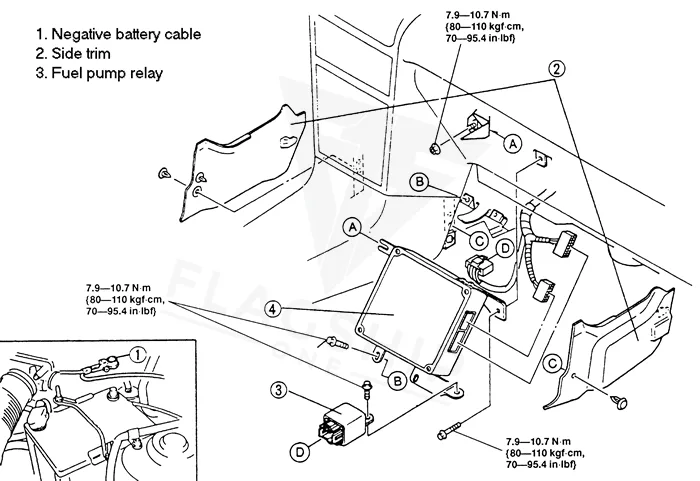
Work with the ignition off, and treat the module as static-sensitive: avoid touching the connector pins at any point.
After installing a replacement engine control module in the 1993 Mazda RX-7, the factory procedure would normally require connecting a Mazda-specific diagnostic tool to program the vehicle’s VIN, immobilizer data, and base idle settings. Without this step, the engine may not start or could run in a fail-safe mode with limited performance. However, when you order a pre-programmed plug-and-play unit from Flagship One, all necessary VIN and calibration data are already loaded into the module before it ships. This means you can install the replacement ECM and start the engine immediately, without visiting a dealership or using specialized programming equipment. The module is configured to match your 1993 RX-7’s original specifications, so the sequential turbo system, ignition timing, and fuel maps are correct from the first key turn.
A failing engine control module in the 1993 Mazda RX-7 often produces symptoms that can be mistaken for mechanical or sensor issues. The engine may crank strongly but refuse to start, with no spark or fuel injector pulse. Intermittent stalling at idle or while driving is another common sign, especially when the engine is warm. You might experience sudden power loss, backfiring, or a noticeable dead spot during acceleration as the module fails to command the secondary turbocharger to come online. The check engine light may illuminate, though on this pre-OBD-II model, retrieving codes requires a special procedure rather than a standard scan tool. In some cases, the module can cause flooding by holding the injectors open too long, making hot restarts difficult. Because the ECM also controls the electric cooling fan, a failure can lead to overheating in traffic. If you have ruled out fuel pressure, spark, and compression issues, a faulty module becomes a strong possibility.
Look for a combination of symptoms: no-start with no spark or injector pulse, intermittent stalling, or a check engine light that won’t stay off. Because the module controls the sequential turbo system, a sudden loss of boost or a non-functional secondary turbo can also point to an ECM problem. Testing the module’s power and ground circuits and checking for communication with a compatible scan tool can help confirm the diagnosis.
Yes, a new or used factory ECM must be programmed with your vehicle’s VIN and immobilizer data to start the engine. However, a pre-programmed replacement from Flagship One arrives with that information already installed, so you can simply plug it in and drive without additional programming steps.
The ECM is typically found under the front console, behind the center console area. You will need to remove the shifter surround and the console trim to access it. It is mounted on a bracket near the floor tunnel, and the wiring connectors are on the top or side of the module.
Yes, a malfunctioning ECM can hold the fuel injectors open too long, leading to an overly rich mixture that floods the rotary engine. This is especially noticeable during hot restarts. If you smell raw fuel and the engine cranks without firing, the ECM may be commanding excessive fuel delivery.
A remanufactured ECM has been disassembled, tested, and rebuilt with new components to meet original specifications, while a used unit is simply pulled from another vehicle with no internal repairs. Remanufactured modules typically undergo rigorous testing and come with a warranty, offering greater reliability than a used part of unknown history.
When the ECM in your 1993 Mazda RX-7 fails, you have a few paths forward. A used module from a salvage yard may work temporarily but carries the same age-related risks as your original unit. A dealership can supply a new or remanufactured part, though programming and availability can be challenges for a vehicle of this vintage. A pre-programmed replacement from Flagship One offers a middle ground: the module is rebuilt to factory standards, loaded with your VIN and calibration, and ready to install without special tools. This approach often saves time and gets your rotary engine running correctly on the first start.
Flagship One stocks a refurbished, VIN-programmed ECM for the 1993 Mazda RX-7 with a lifetime warranty, free shipping and no core charge. The full Mazda RX-7 module lineup covers other engine configurations as well.
The engine control module is a critical component for the 1993 Mazda RX-7, and its failure can lead to frustrating no-start conditions or poor performance. Recognizing the symptoms early and understanding the replacement process can prevent unnecessary downtime. A pre-programmed ECM eliminates the complexity of dealer-level coding, allowing you to restore your RX-7’s driveability with a straightforward swap. If you suspect your module is at fault, consider a reliable replacement to get back on the road with confidence.