
Last updated on August 25th, 2026 at 01:19 pm
The engine control module (ECM) in the 2019 Hyundai Sonata Hybrid is the primary computer that manages fuel delivery, ignition timing, and hybrid system coordination. When it fails, the vehicle may not start, run poorly, or lose communication with diagnostic tools.
When the engine control module (ECM) in your 2019 Hyundai Sonata Hybrid begins to fail, the symptoms can be confusing and the repair path uncertain. This module, sometimes referred to as the powertrain control module or PCM, is the brain behind your hybrid’s engine management. It reads data from dozens of sensors — crankshaft position, camshaft timing, throttle input, and more — and makes split-second decisions about fuel delivery and spark timing. Because the Sonata Hybrid integrates a gasoline engine with an electric motor, the ECM also communicates constantly with the hybrid control unit to ensure seamless transitions between power sources. A malfunctioning module can therefore produce a wide range of drivability problems, from a simple check-engine light to a complete no-start condition. Understanding what the ECM does, how to recognize its failure, and what a proper replacement involves can save you time and help you avoid unnecessary parts swapping. This guide walks you through the module’s role in your 2019 Sonata Hybrid, the symptoms that point to internal failure, the replacement process, and the programming steps that a quality remanufactured unit can handle before it even arrives at your door.
The engine control module in the 2019 Hyundai Sonata Hybrid is a sealed, solid-state computer that orchestrates nearly every aspect of engine operation. It receives real-time signals from the crankshaft position sensor, camshaft position sensors, mass airflow sensor, throttle position sensor, and oxygen sensors, among others. Using these inputs, the ECM calculates the precise amount of fuel to inject and the optimal ignition timing for each cylinder, adjusting continuously for temperature, altitude, and load. In a hybrid application, the module also coordinates with the hybrid powertrain control module to manage the handoff between the gasoline engine and the electric motor, ensuring smooth stop-start events and efficient energy recovery during braking. The ECM stores adaptive learning values for fuel trims and idle speed, which allow it to compensate for normal wear over time. When you choose a remanufactured unit, those adaptive memories are cleared and the module is restored to factory specifications. A critical step in any replacement is programming the vehicle’s unique VIN into the new computer; without it, the anti-theft immobilizer will prevent the engine from starting. That’s why many owners turn to pre-programmed solutions like remanufactured ECMs for the Sonata Hybrid, which arrive ready to install with the VIN already loaded. Internally, the ECM relies on a network of microprocessors and memory chips that can degrade from heat, vibration, or voltage spikes. When those components fail, the module may lose its ability to process sensor data correctly, leading to a cascade of drivability issues that are often misdiagnosed as sensor or wiring faults.
2019 Hyundai Sonata Hybrid
OEM programmed ECM for your 2019 Hyundai Sonata Hybrid — plug & play, no dealer visit.
Free shipping · Lifetime warranty
On the 2019 Hyundai Sonata Hybrid, the engine control module is positioned next to the air cleaner assembly in the engine bay. The factory removal procedure accesses the module from this location, and the book time for replacement is 0.5 hours. The same 0.5-hour labor applies to removing and reinstalling the powertrain control module, which is often integrated or closely related. Once the new module is in place, the ECM installation bolts must be tightened to a torque specification of 9.8 to 11.8 N·m, and the same torque range applies to the ECM installation nuts. These relatively low torque values reflect the delicate nature of the module’s mounting points; overtightening can crack the housing or damage internal circuit boards. The 0.5-hour relearn procedure that follows is not a physical adjustment but a software routine that allows the module to adapt to the vehicle’s specific sensors and actuators. During this relearn, the ECM establishes baseline values for idle speed, throttle position, and fuel trim. Because the module is located in the engine compartment, it is exposed to under-hood heat and vibration, which over time can contribute to internal solder joint fatigue or connector pin corrosion. A careful visual inspection of the wiring harness and connector pins during replacement can help prevent future issues.
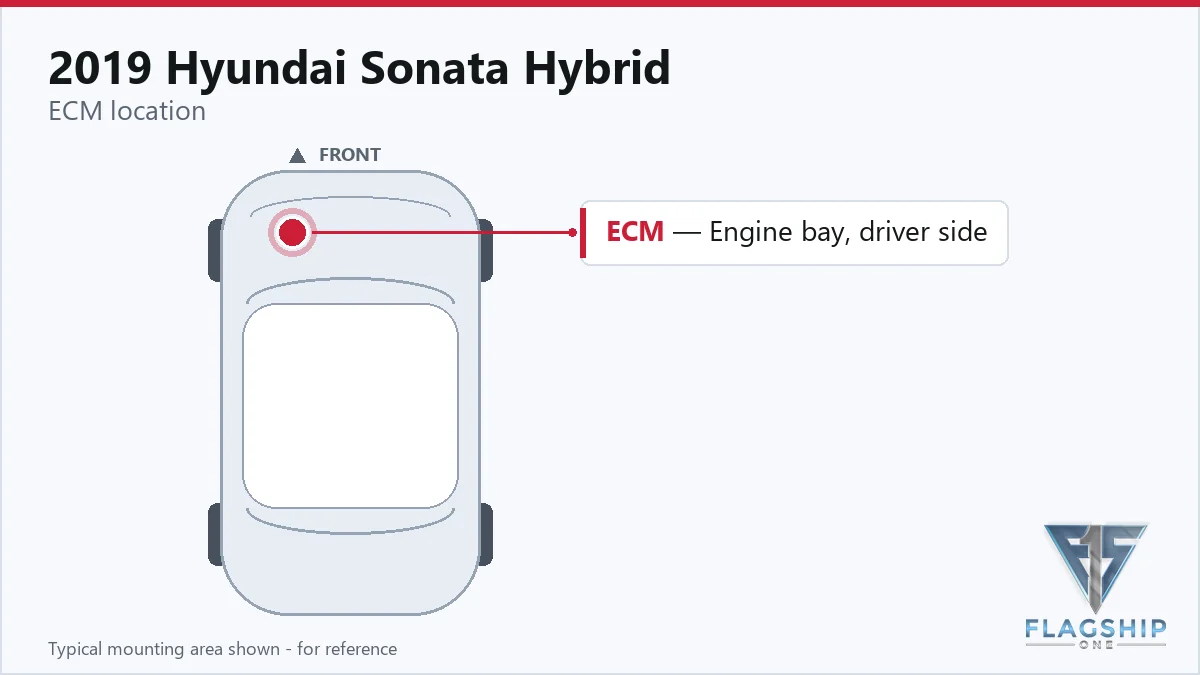
Work with the ignition off, and treat the module as static-sensitive: avoid touching the connector pins at any point.
| Operation | Configuration | Book Time |
|---|---|---|
| Engine Control Module R&R | All configurations | 0.5 hr |
| Engine Control Module Relearn | All configurations | 0.5 hr |
| Engine Control Module Reset | All configurations | 0.3 hr |
| Powertrain Control Module R&R | All configurations | 0.5 hr |
| Powertrain Control Module Relearn | All configurations | 0.5 hr |
The most critical post-installation step for the 2019 Hyundai Sonata Hybrid is programming the vehicle’s VIN into the replacement ECM. The factory procedure states that when replacing an ECM, the VIN must be programmed in the ECM. Without this, the immobilizer system will not recognize the module, and the engine will crank but not start. This programming typically requires a Hyundai-compatible diagnostic scan tool and access to the factory security software, which is why many independent shops and owners prefer to avoid the extra trip and labor. A pre-programmed solution eliminates that hurdle entirely: the VIN is written into the module before it ships, so the unit is plug-and-play upon arrival. The 0.5-hour relearn procedure still needs to be performed after installation, but that is a simple on-board routine that does not require special equipment. When you order a replacement that arrives with the VIN already loaded, like a pre-programmed ECM for your Sonata, you can complete the entire job in your own garage with basic hand tools and the specified torque values. This approach restores factory functionality without the added cost and scheduling of a dealership programming session.
A failing ECM in the 2019 Hyundai Sonata Hybrid often announces itself through a combination of engine performance problems and diagnostic trouble codes. The most direct indicator is a stored internal control module memory fault, which points to a corruption or hardware failure within the module’s processor or memory chip. However, the initial symptoms may be more subtle. You might experience an intermittent no-start condition where the engine cranks but refuses to fire, or the vehicle may start and then immediately stall. Rough idling, hesitation on acceleration, and sudden loss of power while driving are common complaints. Because the ECM manages the interaction between the gasoline engine and the hybrid system, a malfunction can also cause the hybrid warning light to illuminate or prevent the car from entering EV mode. In some cases, the transmission may exhibit harsh or erratic shifting as the module loses its ability to coordinate engine torque with gear changes. Scan tool communication can become unreliable, with the ECM intermittently dropping off the CAN bus, making diagnosis difficult. While these symptoms can also stem from faulty sensors or wiring, the presence of an internal module code like P0605 strongly suggests that the ECM itself is the root cause and should be replaced rather than attempting to repair individual circuits.
The following diagnostic trouble code is stored internally by the engine control module and indicates a fault within the module itself rather than an external sensor or actuator. When this code is present, the ECM is typically unable to recover and must be replaced.
| Code | Meaning | Full Guide |
|---|---|---|
| P0605 | Internal ROM error | Full P0605 guide → |
The most frequent signs include a no-start condition where the engine cranks but won’t fire, intermittent stalling, rough idling, and a check-engine light with an internal module code like P0605. You may also notice poor fuel economy, hesitation during acceleration, or the hybrid system failing to engage electric mode. Because the ECM controls so many functions, symptoms can mimic sensor or wiring faults, making proper diagnosis essential.
Yes, the physical replacement is straightforward. The module is located next to the air cleaner assembly, and the book time for removal and installation is only 0.5 hours. The mounting bolts and nuts should be torqued to 9.8–11.8 N·m. The main challenge is programming the VIN into the new module, but a pre-programmed unit eliminates that step and allows for a true plug-and-play installation.
Yes, the factory procedure requires that the vehicle’s VIN be programmed into the new ECM. Without this, the immobilizer system will prevent the engine from starting. A pre-programmed replacement module arrives with your VIN already loaded, so you can skip the dealer programming step and still have a fully functional vehicle after installation.
In many modern vehicles, the terms are used interchangeably, but in the Sonata Hybrid, the ECM focuses specifically on engine management while a separate hybrid control unit oversees the electric motor and battery. The labor guide lists both ECM and PCM replacement at 0.5 hours each, and the relearn procedure is the same. For replacement purposes, the module you need is typically identified by the part number on the original unit.
Maintaining a healthy electrical system is key. Keep the 12V battery terminals clean and replace the battery before it weakens significantly. Check engine grounds for corrosion and ensure the ECM connector is fully seated and free of moisture. Avoid voltage spikes by using a quality jump pack rather than traditional jumper cables when possible, and address any charging system warnings immediately.
When your 2019 Hyundai Sonata Hybrid needs a new engine control module, you have two paths: purchase a new unit from the dealer and pay for programming, or choose a remanufactured module that arrives pre-programmed with your VIN. The latter option often saves hundreds of dollars and eliminates the need for a dealership visit. A quality remanufactured ECM is thoroughly tested, updated with the latest software, and backed by a warranty, giving you a reliable repair that gets your hybrid back on the road quickly.
Flagship One stocks a refurbished, VIN-programmed PCM for the 2019 Hyundai Sonata Hybrid with a lifetime warranty, free shipping and no core charge. The full Hyundai Sonata Hybrid module lineup covers other engine configurations as well.
A failing ECM doesn’t have to sideline your 2019 Hyundai Sonata Hybrid for long. By recognizing the symptoms early and choosing a pre-programmed replacement, you can restore factory performance without the complexity of dealer programming. With the module located conveniently next to the air cleaner and a straightforward 0.5-hour swap, this repair is well within reach for a skilled DIY owner. A properly functioning engine computer will have your Sonata Hybrid delivering the smooth, efficient driving experience it was designed for.