
Last updated on August 25th, 2026 at 01:21 pm
In the 2013 Hyundai Sonata Hybrid, the powertrain and engine control modules manage fuel delivery, ignition timing, and hybrid system coordination. Failure typically stems from internal circuitry loss, leading to loss of communication and error codes that impede engine start and operation.
When a 2013 Hyundai Sonata Hybrid exhibits symptoms such as no‑start, rough idle, or persistent error codes, the powertrain control module (PCM) or engine control module (ECM) may be at fault. This guide explains what these computers do, how they are accessed, and what steps are needed to replace them correctly. You will learn the labor expectations, torque specifications, and post‑install requirements so you can assess repair options with confidence.
The PCM and ECM in the 2013 Hyundai Sonata Hybrid serve as the vehicle’s brain, processing sensor data to control fuel injection, ignition timing, and hybrid power distribution. Their operation is critical for smooth acceleration, emissions compliance, and battery management. A malfunction can cause loss of power, erratic shifting, or complete engine shutdown. Understanding their role helps you recognize why a proper 2013 Hyundai Sonata Hybrid engine computer replacement is essential for reliable performance.
2013 Hyundai Sonata Hybrid
OEM programmed ECM for your 2013 Hyundai Sonata Hybrid — plug & play, no dealer visit.
Free shipping · Lifetime warranty
Factory documentation shows the control module sits directly next to the air cleaner assembly, making it reachable once the intake components are removed. Removing the PCM or ECM typically requires 0.4 hours of labor, while reinstalling and securing the bolts calls for a torque range of 9.8 to 11.8 N·m. After placement, a relearn of the module takes an additional 0.5 hours, ensuring the vehicle’s control strategies are correctly calibrated.
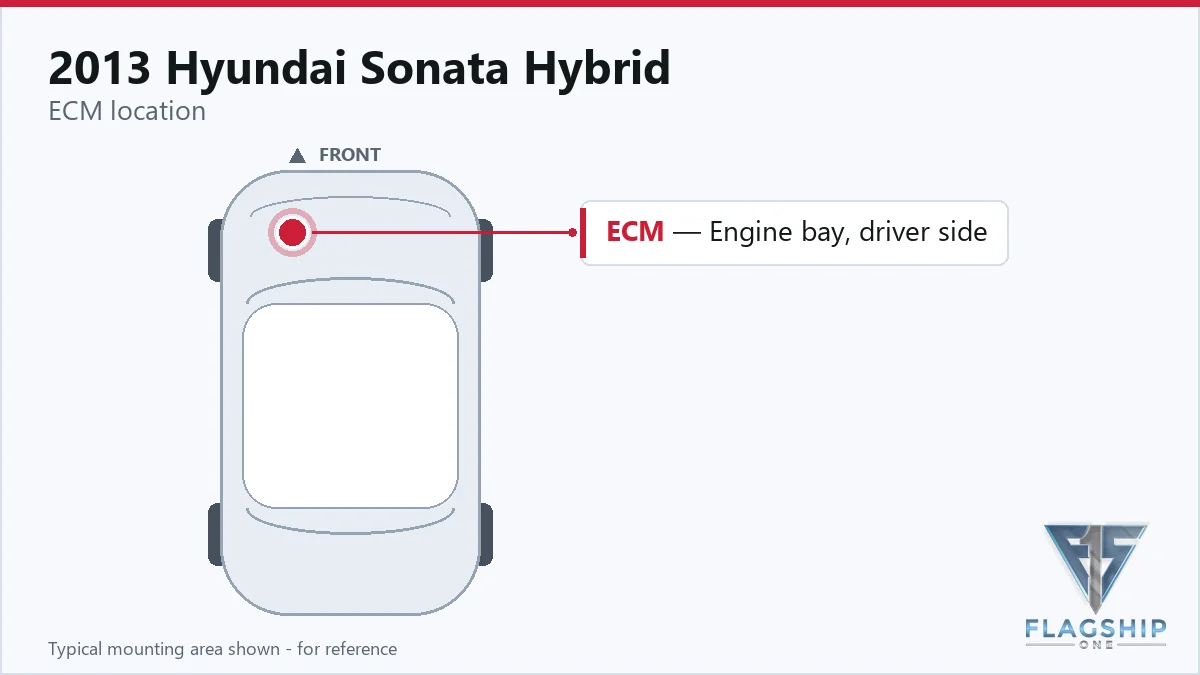
Work with the ignition off, and treat the module as static-sensitive: avoid touching the connector pins at any point.
| Operation | Configuration | Book Time |
|---|---|---|
| Powertrain Control Module R&R | All configurations | 0.4 hr |
| Powertrain Control Module Relearn | All configurations | 0.5 hr |
| Engine Control Module R&R | All configurations | 0.4 hr |
| Engine Control Module Relearn | All configurations | 0.5 hr |
| Engine Control Module Reset | All configurations | 0.3 hr |
After installing a new module, the factory procedure calls for a relearn sequence lasting about half an hour to sync the computer with existing vehicle parameters. Flagship One supplies a a VIN-programmed replacement unit that arrives already programmed, eliminating the need for on‑site coding and reducing installation time.
Typical signs of a failing PCM or ECM in this model include intermittent no‑start conditions, unexpected stalling, and loss of hybrid system engagement. Diagnostic scans often reveal the communication error code, indicating internal processor failure that prevents the modules from communicating with other vehicle systems.
The following codes are commonly reported for the 2013 Hyundai Sonata Hybrid’s control modules:
| Code | Meaning | Full Guide |
|---|---|---|
| P0605 | Internal ROM error | Full P0605 guide → |
Bulletin 04-36-019 addresses fuel system issues that can arise during ECM or PCM replacement, specifically noting VIN writing procedures. Bulletin 15-GI-001 provides general guidance for ECU updates using tablet‑based diagnostic tools.
| Bulletin | Subject | What It Addresses |
|---|---|---|
| 04-36-019 | TSB • Fuel System • [04-36-019] 2005MY ECM AND PCM VIN WRITING DURING CONTROL MODULE REPLACEMEN | — |
| — | TSB • General Information • [15-GI-001] ECU UPDATE PROCEDURE FOR TABLET-BASED GDS MOBILE | — |
The P0605 code indicates internal processor failure within the PCM or ECM, often resulting from age‑related component wear or exposure to voltage irregularities.
Standard torque wrenches are sufficient to meet the 9.8‑11.8 N·m specification; no proprietary tools are required for the bolt installation.
Factory guidelines allocate about 0.5 hours for the relearn step, which calibrates the new module to the vehicle’s existing parameters.
When the PCM or ECM in your 2013 Hyundai Sonata Hybrid needs attention, you can choose a factory‑refurbished unit or a new Flagship One replacement. Both options meet the required torque and relearn steps, but the Flagship One part arrives VIN‑programmed, streamlining the post‑install process and reducing downtime.
Flagship One stocks a refurbished, VIN-programmed PCM for the 2013 Hyundai Sonata Hybrid with a lifetime warranty, free shipping and no core charge. The full Hyundai Sonata Hybrid module lineup covers other engine configurations as well.
Replacing the powertrain or engine control module in a 2013 Hyundai Sonata Hybrid can restore reliable operation and eliminate error codes. Consider a VIN‑programmed replacement to simplify the procedure and get back on the road faster.