
Last updated on August 25th, 2026 at 01:19 pm
The Engine Control Module (ECM) in the 2018 Hyundai Sonata Hybrid manages fuel delivery, ignition timing, and hybrid system coordination. Failure may cause erratic engine behavior, poor fuel economy, or complete no-start conditions.
If your 2018 Hyundai Sonata Hybrid suddenly stalls, refuses to start, or triggers unexplained warning lights, the Engine Control Module (ECM) may be at fault. This small but critical computer oversees fuel injection, ignition timing, and hybrid system integration. When it fails, symptoms can range from subtle performance issues to complete immobilization. Understanding what the ECM does, where it’s located, and what replacement involves helps you make informed decisions about repairs. This guide covers the essentials—labor times, programming requirements, and common failure signs—so you can address the problem efficiently and avoid unnecessary delays.
In the 2018 Hyundai Sonata Hybrid, the ECM acts as the brain of the powertrain, continuously adjusting fuel delivery and ignition timing to optimize performance and efficiency. It also coordinates with the hybrid system to ensure seamless transitions between electric and gasoline power. A malfunctioning ECM may disrupt these processes, leading to poor drivability or even a no-start condition. If replacement becomes necessary, you’ll need to source replacement engine computers for the Sonata Hybrid that meet Hyundai’s specifications. The module’s role in managing both conventional and hybrid functions makes it especially critical for maintaining smooth operation in this vehicle.
2018 Hyundai Sonata Hybrid
OEM programmed ECM for your 2018 Hyundai Sonata Hybrid — plug & play, no dealer visit.
Free shipping · Lifetime warranty
The ECM in the 2018 Hyundai Sonata Hybrid is positioned next to the air cleaner assembly, making it relatively accessible for replacement. Factory procedures specify removing the module by disconnecting the electrical connector and unfastening the mounting bolts or nuts. Installation requires torquing the fasteners to 9.8–11.8 N·m to ensure proper grounding and vibration resistance. Labor estimates for removal and reinstallation are typically 0.5 hours, while a relearn or reset procedure may add another 0.3 to 0.5 hours, depending on the steps required. The location simplifies access but still demands care to avoid damaging connectors or nearby components.
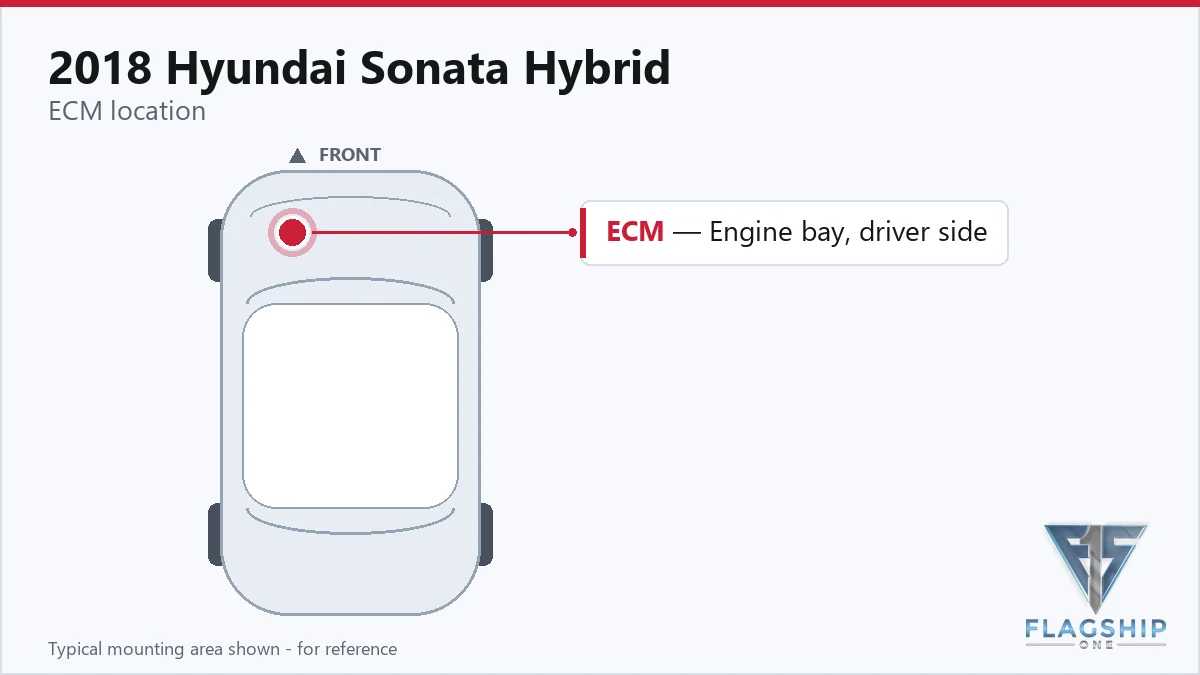
Work with the ignition off, and treat the module as static-sensitive: avoid touching the connector pins at any point.
| Operation | Configuration | Book Time |
|---|---|---|
| Engine Control Module R&R | All configurations | 0.5 hr |
| Engine Control Module Relearn | All configurations | 0.5 hr |
| Engine Control Module Reset | All configurations | 0.3 hr |
| Powertrain Control Module R&R | All configurations | 0.5 hr |
| Powertrain Control Module Relearn | All configurations | 0.5 hr |
After replacing the ECM in your 2018 Hyundai Sonata Hybrid, the factory procedure requires programming the vehicle’s VIN into the new module to ensure proper communication with other systems. This step is critical for avoiding drivability issues or fault codes. However, when you install a VIN-programmed replacement unit, this programming is already completed, saving you time and reducing the risk of errors during the process. The relearn procedure may still be necessary to synchronize the ECM with the vehicle’s sensors and hybrid components, but the initial VIN setup is handled upfront.
A failing ECM in the 2018 Hyundai Sonata Hybrid may cause a range of symptoms, from intermittent stalling to a complete no-start condition. Drivers often report rough idle, poor acceleration, or unexplained fuel economy drops. In some cases, the vehicle may enter a limp-home mode, limiting power to prevent further damage. Scan tools may fail to communicate with the ECM, or you might see a control module internal fault stored in memory. These issues can mimic other problems, such as sensor failures or fuel system faults, so proper diagnosis is essential before replacing the module.
The 2018 Hyundai Sonata Hybrid’s ECM may log specific trouble codes when internal faults occur. These codes help pinpoint issues within the module itself, rather than external sensors or wiring problems.
| Code | Meaning | Full Guide |
|---|---|---|
| P0605 | Internal ROM error | Full P0605 guide → |
Hyundai has issued service bulletins addressing ECM-related procedures for various models, including the 2018 Sonata Hybrid. Bulletin #04-36-019 outlines the correct steps for VIN programming during control module replacement, ensuring compatibility with the vehicle’s systems. Another bulletin, #15-GI-001, details the ECU update procedure using Hyundai’s tablet-based GDS Mobile tool. These bulletins provide guidance for technicians to follow factory-recommended practices, reducing the risk of post-replacement issues.
| Bulletin | Subject | What It Addresses |
|---|---|---|
| 04-36-019 | TSB • Fuel System • [04-36-019] 2005MY ECM AND PCM VIN WRITING DURING CONTROL MODULE REPLACEMEN | — |
| — | TSB • General Information • [15-GI-001] ECU UPDATE PROCEDURE FOR TABLET-BASED GDS MOBILE | — |
Common signs include stalling, rough idle, or a no-start condition. The vehicle may also trigger warning lights or log trouble codes like P0605. A scan tool can help confirm whether the ECM is the source of the problem by checking for communication errors or internal faults.
While the ECM is accessible near the air cleaner assembly, replacement requires proper torquing of fasteners and may involve programming steps. If you’re not comfortable with electrical work or using diagnostic tools, it’s best to have a professional handle the job.
The VIN ensures the ECM communicates correctly with the vehicle’s other systems, including the hybrid powertrain. Without it, the module may not function properly, leading to drivability issues or fault codes. Factory procedures require this step to maintain system integrity.
When your 2018 Hyundai Sonata Hybrid’s ECM fails, you have options for replacement. A new unit from the dealer ensures factory compatibility but may come at a higher cost. Refurbished or remanufactured modules offer a more affordable alternative, especially when pre-programmed to match your vehicle’s VIN. Either way, addressing the issue promptly can restore smooth operation and prevent further drivability problems.
Flagship One stocks a refurbished, VIN-programmed PCM for the 2018 Hyundai Sonata Hybrid with a lifetime warranty, free shipping and no core charge. The full Hyundai Sonata Hybrid module lineup covers other engine configurations as well.
The 2018 Hyundai Sonata Hybrid relies on its ECM to manage critical engine and hybrid functions. If you’re experiencing stalling, no-start conditions, or unexplained warning lights, the module may be the culprit. Understanding the replacement process, programming requirements, and common symptoms helps you make informed decisions. Whether you opt for a new or remanufactured unit, addressing the issue promptly ensures your Sonata Hybrid runs reliably for miles to come.