
Last updated on August 25th, 2026 at 12:28 pm
The Powertrain Control Module (PCM) in your 2005 Pontiac Grand Prix 3.8L manages engine and transmission functions. When it fails, you may experience no-start, stalling, or transmission issues. Replacement requires programming to match your vehicle.
If your 2005 Pontiac Grand Prix with the 3.8L engine is experiencing drivability issues, the Powertrain Control Module (PCM) or Engine Control Module (ECM) may be at fault. This guide explains what these modules do, where they are located, and what the factory procedure requires for replacement. You will learn the common symptoms, the necessary programming steps, and how a pre-programmed unit can simplify the repair. The information is based on factory service procedures and technical service bulletins for this specific vehicle.
The Powertrain Control Module (PCM) in your 2005 Pontiac Grand Prix 3.8L is the central computer that controls engine timing, fuel delivery, and transmission shift points. It receives data from sensors throughout the vehicle and adjusts operation for performance and emissions. When the PCM fails, it can cause a range of problems from a no-start condition to erratic shifting. For this vehicle, replacement PCMs for the Grand Prix are available that match the original specifications. The module also stores diagnostic trouble codes that help pinpoint internal failures. Understanding its role helps you diagnose issues accurately and avoid unnecessary part replacements.
The factory removal procedure accesses the control module next to the air cleaner assembly. For the 2005 Pontiac Grand Prix 3.8L, the Powertrain Control Module (PCM) replacement is listed at 0.7 hours of book labor, while the Engine Control Module (ECM) replacement for the 3.8L engine is 1.4 hours. A separate 0.5-hour relearn procedure is required after installation. The module is typically mounted on a bracket near the air box, making it relatively accessible. Disconnect the battery before starting, and carefully unplug the wiring harness connectors. After installing the new module, you must perform the relearn procedure to synchronize the module with the vehicle’s systems.
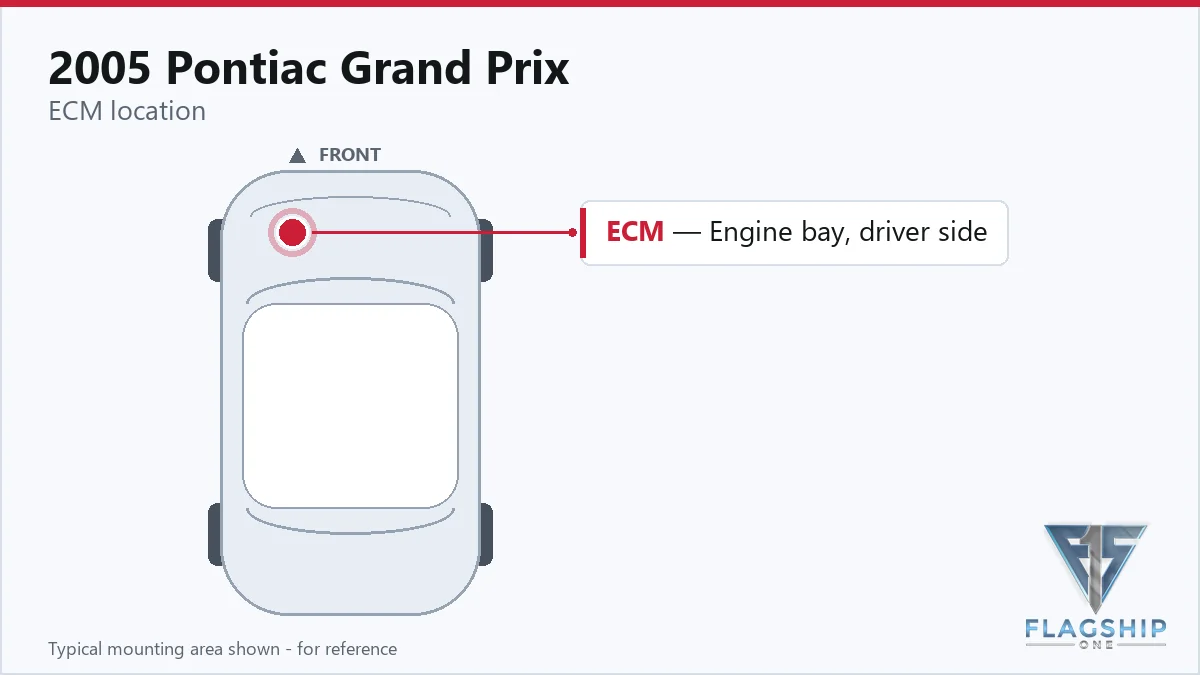
Work with the ignition off, and treat the module as static-sensitive: avoid touching the connector pins at any point.
| Operation | Configuration | Book Time |
|---|---|---|
| Powertrain Control Module Relearn | All configurations | 0.5 hr |
| Powertrain Control Module R&R | All configurations | 0.7 hr |
| Engine Control Module R&R | 3.8L | 1.4 hr |
| Engine Control Module R&R | 5.3L | 0.9 hr |
| Engine Control Module Relearn | All configurations | 0.5 hr |
2005 Pontiac Grand Prix 3.8L
OEM programmed ECM for your 2005 Pontiac Grand Prix 3.8L — plug & play, no dealer visit.
Free shipping · Lifetime warranty
The factory service information includes a critical caution: before removing the engine control module (ECM) or powertrain control module (PCM), use a scan tool to capture the module data. This captured data must then be restored into the new module after installation. This step ensures that the new module has the correct calibration and vehicle-specific settings. Flagship One provides a VIN-programmed replacement unit that arrives with the necessary programming already completed. This means you can install the module and skip the data capture and restore steps, though the 0.5-hour relearn procedure may still be required to finalize the installation.
When the PCM or ECM begins to fail in your 2005 Pontiac Grand Prix 3.8L, you may notice a no-start condition, intermittent stalling, or rough running. The check engine light may illuminate with codes such as internal control module fault. Other symptoms include transmission shifting problems, poor fuel economy, and a scan tool that cannot communicate with the module. You might also experience the engine running in a reduced power mode or failing to respond to throttle input. These issues often point to an internal module failure rather than a sensor or wiring problem.
The following diagnostic trouble codes are documented for the PCM/ECM in the 2005 Pontiac Grand Prix 3.8L. These codes indicate internal module faults that typically require module replacement rather than sensor repair.
Technical Service Bulletin #05-06-04-060, dated September 23, 2005, addresses diagnostic trouble codes P0601, P0602, P0603, P0604, and P1621 that may be shared across multiple modules including the PCM, ECM, and TCM. This bulletin applies to the 2005 Pontiac Grand Prix and provides guidance for diagnosing these internal module faults. The bulletin notes that these codes can appear in more than one control module simultaneously, which may help narrow down the root cause.
| Bulletin | Subject | What It Addresses |
|---|---|---|
| 05-06-04-060 | Powertrain Control Module (PCM), Engine Control Module (ECM), Transmission Control Module (ECM) | — |
Yes, the module is located near the air cleaner assembly and is accessible. However, you must follow the factory procedure to capture and restore module data using a scan tool. A pre-programmed unit from Flagship One eliminates that step.
The relearn procedure synchronizes the new PCM with the vehicle’s security system and throttle position. It typically requires a scan tool and may involve a specific driving cycle. The book time is 0.5 hours.
A used PCM must be programmed with your vehicle’s VIN and calibration data. Without proper programming, it may not communicate with other modules. A new or refurbished unit that is VIN-programmed is more reliable.
For your 2005 Pontiac Grand Prix 3.8L, you have two main options: repair the existing module if the fault is minor, or replace it with a refurbished unit. A refurbished PCM from Flagship One arrives pre-programmed to your VIN, saving you the data capture and restore steps. This approach is often more cost-effective than dealer replacement and gets your vehicle back on the road faster.
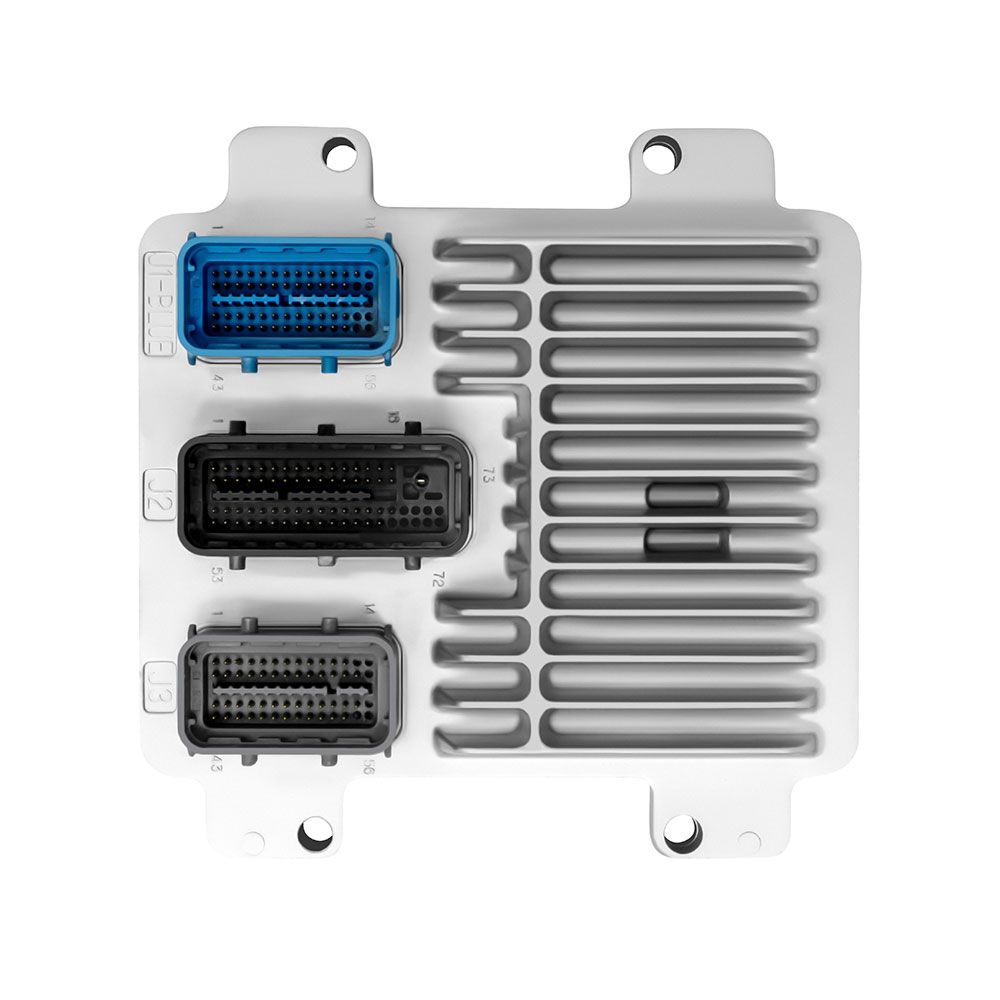
Flagship One stocks a refurbished, VIN-programmed PCM for the 2005 Pontiac Grand Prix with a lifetime warranty, free shipping and no core charge. The full Pontiac Grand Prix module lineup covers other engine configurations as well.
The 2005 Pontiac Grand Prix 3.8L relies on its PCM for engine and transmission control. When internal faults occur, replacement with a properly programmed unit is the solution. Flagship One offers VIN-programmed modules that simplify the repair and restore your vehicle’s performance.