
Last updated on August 25th, 2026 at 11:57 am
The Powertrain Control Module and Engine Control Module are the central computers governing fuel delivery, ignition timing, emissions, and transmission control on your 86. Internal memory faults from voltage spikes or heat cycling can corrupt the programming, leaving the vehicle inoperable.
If your 2017 Toyota 86 has stopped running or is showing multiple unrelated fault codes, the engine computer itself may be the root cause. Internal failures in the PCM or ECM do not always announce themselves with obvious symptoms — sometimes a car simply will not start, or a scan tool cannot communicate with the module at all. This guide explains what these control modules do, how replacement works, what symptoms to watch for, and why many owners choose remanufactured units over dealer pricing. You will learn the labor involved, the trouble codes that point to internal computer failure, and what the programming process actually requires.
The Engine Control Module and Powertrain Control Module in your 2017 Toyota 86 serve as the brain of the engine and drivetrain. The ECM monitors and adjusts fuel injection, idle speed, and emissions systems in real time, while the PCM coordinates transmission shifting, torque management, and cruise control. These two modules work together — in many vehicles they are physically combined into a single unit. When internal memory becomes corrupted or the processor fails, the module can lose the ability to communicate with sensors or actuators, leaving the engine running poorly or not at all. replacement engine computers for the 86 are available as remanufactured units that restore proper functionality without the dealer markup.
2017 Toyota 86
OEM programmed ECM for your 2017 Toyota 86 — plug & play, no dealer visit.
Free shipping · Lifetime warranty
The ECM on a 2017 Toyota 86 is located behind the glove compartment, requiring removal of several interior components to reach it. The access path begins with disconnecting the negative battery cable, then removing the right instrument side panel, the glove compartment door assembly, and finally the control unit relay assembly to expose the module. The book time for ECM R&R is 0.7 hours, with an additional 0.5 hours for the ECM relearn procedure. If the PCM is a separate unit requiring replacement, budget another 0.7 hours plus 0.5 hours for its relearn. A 0.3-hour reset procedure may also be needed depending on the factory procedure. All mounting hardware should be torqued to specification when reinstalling, and grounds must be cleaned to ensure reliable electrical contact.
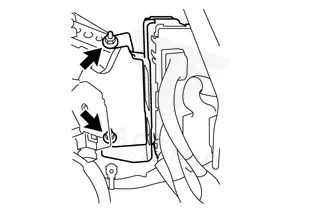
Work with the ignition off, and treat the module as static-sensitive: avoid touching the connector pins at any point.
| Operation | Configuration | Book Time |
|---|---|---|
| Powertrain Control Module R&R | All configurations | 0.7 hr |
| Powertrain Control Module Relearn | All configurations | 0.5 hr |
| Engine Control Module Relearn | All configurations | 0.5 hr |
| Engine Control Module R&R | All configurations | 0.7 hr |
| Engine Control Module Reset | All configurations | 0.3 hr |
After installing a replacement ECM or PCM in your 2017 Toyota 86, the factory procedure requires a relearn procedure to allow the new module to adapt to your specific vehicle’s sensors and actuators. The relearn process calibrates idle speed, fuel trims, and transmission shift points based on real-time data. Without completing this step, the engine may run roughly or the transmission may shift improperly. Flagship One addresses this by shipping a VIN-programmed replacement unit that arrives pre-programmed with your vehicle’s specific identification, so the relearn steps are minimized or eliminated compared to a blank dealer-ordered part.
When the ECM or PCM fails internally on a 2017 Toyota 86, the vehicle may exhibit several telltale signs. A no-start condition where the engine cranks but will not fire is common, often accompanied by a completely dead scan-tool connection — the diagnostic computer cannot communicate with any module. Stalling and rough idle frequently occur as the module loses the ability to meter fuel correctly. Misfire codes affecting multiple cylinders may appear despite new spark plugs and wires. Transmission shifting problems such as harsh shifts or failure to engage gears can also stem from a failing powertrain module. internal memory checksum failure is one of several module-internal codes that directly indicate the computer hardware has compromised itself.
The 2017 Toyota 86 is documented to have set several module-internal trouble codes that point specifically to ECM or PCM hardware failure. These codes indicate various internal faults including memory checksum errors, random access memory issues, program memory failures, and watch dog timer malfunctions. Each code represents a different aspect of the module’s internal health and helps confirm whether replacement is necessary rather than trying software repairs.
| Code | Meaning | Full Guide |
|---|---|---|
| P0601 | Internal memory checksum error | Full P0601 guide → |
| P0604 | Internal RAM error | Full P0604 guide → |
| P0605 | Internal ROM error | Full P0605 guide → |
| P0606 | Module processor failure | Full P0606 guide → |
| P060A | Module-internal fault | — |
| P060B | Module-internal fault | — |
| P062F | Internal EEPROM error | Full P062F guide → |
Driving with a compromised ECM is not recommended. The module may cause intermittent stalling, no-start conditions, or unpredictable transmission behavior that leaves you stranded. In some cases, the vehicle may run but will not pass emissions testing.
A used ECM requires dealer programming to match your specific vehicle’s VIN and configuration. This adds cost and complexity. Remanufactured units from Flagship One arrive pre-programmed with your VIN, eliminating this step.
Module-internal trouble codes beginning with P060 indicate the computer hardware itself has failed. If your scan tool shows codes like P0601, P0604, or P0606 and the vehicle exhibits multiple unrelated symptoms, the ECM is the likely culprit.
When your 2017 Toyota 86’s ECM or PCM has failed, you have two primary paths forward. A new dealer-ordered unit arrives blank and requires programming fees plus labor time. A remanufactured replacement from Flagship One arrives VIN-programmed and ready to install, reducing the overall cost and downtime. Both options restore proper engine and transmission control — the difference lies in price and convenience.
Flagship One stocks a refurbished, VIN-programmed PCM for the 2017 Toyota 86 with a lifetime warranty, free shipping and no core charge. The full Toyota 86 module lineup covers other engine configurations as well.
The ECM and PCM are the central nervous system of your 2017 Toyota 86, and when they fail internally, the vehicle simply stops functioning normally. Understanding the labor involved, the symptoms to watch for, and the programming requirements helps you make an informed repair decision. Whether you choose dealer parts or a remanufactured unit, getting the engine computer back in proper working order restores the driving experience your 86 was designed to deliver.