
Last updated on August 25th, 2026 at 12:57 pm
The Engine Control Module in a 2016 Audi Q5 manages fuel injection, ignition timing, and emission controls. A failure typically disrupts engine start, idle stability, and diagnostic communication, prompting fault codes such as P0603 or P0605.
When a 2016 Audi Q5 exhibits engine‑control issues, the ECM often becomes the focus of diagnosis. This guide explains what the module does, how it is accessed, and what steps follow a replacement. You will learn the typical labor times, the importance of the locking compound on shear bolts, and how Flagship One units simplify the post‑install process.
In the 2016 Audi Q5 the Engine Control Module interprets sensor data to regulate fuel delivery, spark timing, and emissions controls, ensuring smooth operation across all driving conditions. Its role is critical because any miscommunication can trigger a range of performance problems. Understanding this function helps when evaluating replacement options, such as 2016 Audi Q5 engine control module that meet factory specifications.
The ECM resides within the engine compartment, accessible after removing the cover and disconnecting the electrical harness. Replacement follows the listed book time of 1.4 hours, which includes unbolting the shear bolts whose threads have been coated with a locking compound. After the old unit is removed, the new module is seated, torque‑spec bolts are reinstalled, and the harness is reconnected before proceeding to the relearn step.
2016 Audi Q5
OEM programmed ECM for your 2016 Audi Q5 — plug & play, no dealer visit.
Free shipping · Lifetime warranty
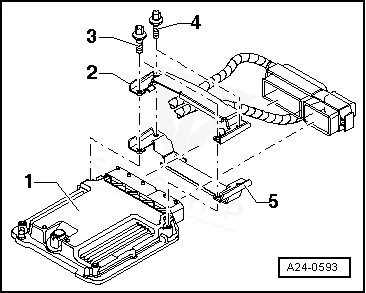
Work with the ignition off, and treat the module as static-sensitive: avoid touching the connector pins at any point.
| Operation | Configuration | Book Time |
|---|---|---|
| Powertrain Control Module R&R | Q5 | 1.4 hr |
| Powertrain Control Module R&R | SQ5 | 1.4 hr |
| Engine Control Module Relearn | Q5 | 0.5 hr |
| Engine Control Module Relearn | SQ5 | 0.5 hr |
| Engine Control Module R&R | Q5 | 1.4 hr |
| Engine Control Module R&R | SQ5 | 1.4 hr |
After installing a new ECM, the factory procedure calls for a 0.5‑hour Engine Control Module Relearn to synchronize the unit with the vehicle’s systems. Flagship One supplies a pre‑programmed component, so the required step is already completed when you receive a VIN-programmed replacement unit and can proceed directly to final verification.
Typical signs of a failing ECM in a 2016 Audi Q5 include a no‑start condition, intermittent stalling, rough idle, and loss of diagnostic communication, often accompanied by fault codes like PCM internal error P0603 on the scan tool. Drivers may also notice unexpected shifting behavior or reduced fuel efficiency as the module struggles to manage engine parameters.
The following internal trouble codes are commonly logged by the Engine Control Module in the 2016 Audi Q5:
| Code | Meaning | Full Guide |
|---|---|---|
| P0603 | Keep-alive memory (KAM) error | Full P0603 guide → |
| P0605 | Internal ROM error | Full P0605 guide → |
| P060A | Module-internal fault | — |
| P060B | Module-internal fault | — |
| P0613 | Module-internal fault | Full P0613 guide → |
| P0667 | Module-internal fault | Full P0667 guide → |
The book time for removing and installing the Engine Control Module on a 2016 Audi Q5 is listed as 1.4 hours.
Yes, the factory procedure includes a 0.5‑hour Engine Control Module Relearn to ensure the new unit communicates correctly with the vehicle.
Codes such as P0603, P0605, P060A, P060B, P0613, and P0667 are associated with internal ECM failures on this model.
When the ECM in your 2016 Audi Q5 needs attention, you can choose a professionally rebuilt unit or a new Flagship One replacement. Both options meet the required specifications, but a VIN‑programmed replacement eliminates the need for post‑install programming, streamlining the repair process.
Flagship One stocks a refurbished, VIN-programmed PCM for the 2016 Audi Q5 with a lifetime warranty, free shipping and no core charge. The full Audi Q5 module lineup covers other engine configurations as well.
Addressing ECM issues in your 2016 Audi Q5 promptly can restore reliable performance. Consider a Flagship One unit to simplify the job and ensure proper functionality.