
Last updated on August 25th, 2026 at 01:21 pm
The Engine Control Module (ECM) in the 2014 Hyundai Santa Fe manages fuel delivery, ignition timing, and emissions systems. Failure may cause drivability issues, including stalling, poor acceleration, or illuminated check-engine lights with stored trouble codes.
If your 2014 Hyundai Santa Fe hesitates, stalls, or refuses to start, the Engine Control Module (ECM) may be the culprit. This small but critical computer manages fuel injection, ignition timing, and emissions controls. When it fails, symptoms can range from subtle performance issues to complete engine shutdown. Replacing the ECM isn’t just about swapping hardware—it requires precise programming to match your vehicle’s VIN. Understanding the process helps you avoid unnecessary delays and ensures your Santa Fe runs reliably after the repair.
The ECM in your 2014 Hyundai Santa Fe acts as the brain of the engine, continuously adjusting fuel delivery and ignition timing for optimal performance. It monitors sensors throughout the engine bay, ensuring emissions stay within limits and fuel efficiency remains consistent. A failing ECM may disrupt these functions, leading to poor drivability or even preventing the engine from starting. When replacement becomes necessary, you’ll need replacement engine computers for the Santa Fe that are pre-configured for your vehicle’s specifications to avoid additional programming steps at the shop.
2014 Hyundai Santa Fe
OEM programmed ECM for your 2014 Hyundai Santa Fe — plug & play, no dealer visit.
Free shipping · Lifetime warranty
The ECM in the 2014 Santa Fe is located next to the air cleaner assembly, making it relatively accessible for replacement. The factory procedure involves removing the air cleaner housing to reach the module. Once exposed, the ECM is secured with either nuts or bolts, which must be torqued to 9.8–11.8 N·m during reinstallation. Book time for removing and reinstalling the ECM is 0.6 hours, while the relearn procedure adds another 0.5 hours. A reset may also be required, taking an additional 0.3 hours if needed.
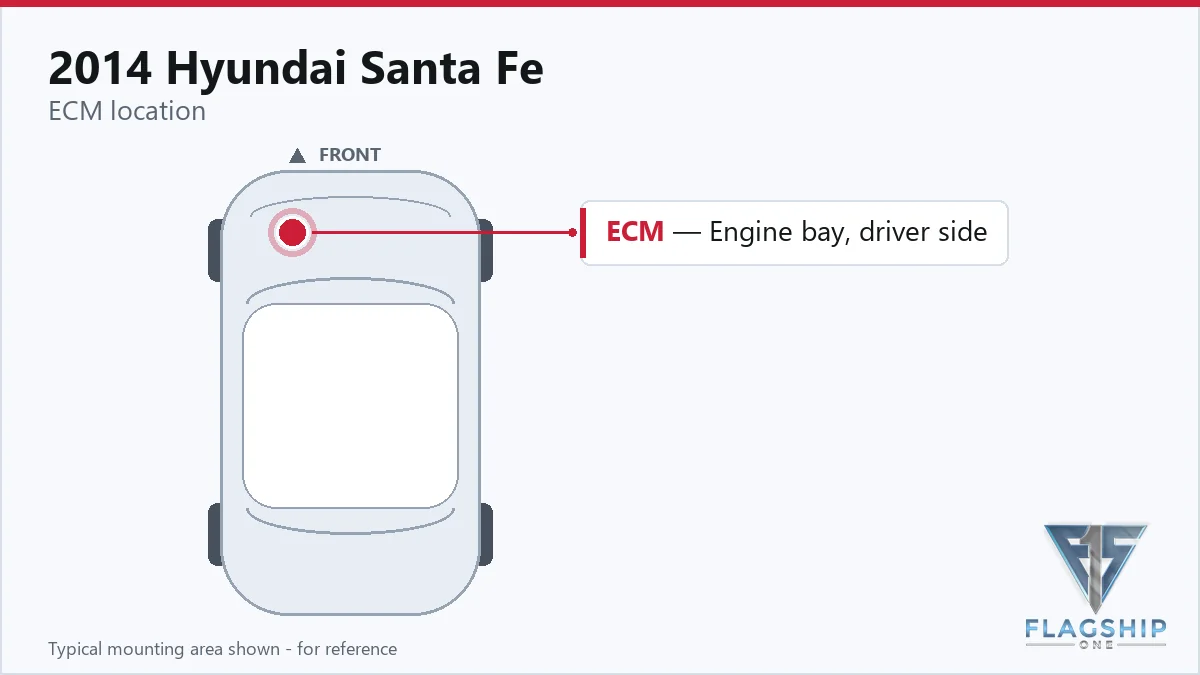
Work with the ignition off, and treat the module as static-sensitive: avoid touching the connector pins at any point.
| Operation | Configuration | Book Time |
|---|---|---|
| Powertrain Control Module R&R | All configurations | 0.6 hr |
| Powertrain Control Module Relearn | All configurations | 0.5 hr |
| Engine Control Module R&R | All configurations | 0.6 hr |
| Engine Control Module Relearn | All configurations | 0.5 hr |
| Engine Control Module Reset | All configurations | 0.3 hr |
After installing a new ECM in your 2014 Hyundai Santa Fe, the factory procedure requires programming the vehicle’s VIN into the module. This step ensures the ECM communicates correctly with the rest of the vehicle’s systems. Flagship One units arrive as a VIN-programmed replacement unit, eliminating the need for this additional step. This saves time and reduces the risk of programming errors during installation, allowing your Santa Fe to return to normal operation more quickly.
A failing ECM in the 2014 Hyundai Santa Fe may cause a variety of symptoms, including intermittent stalling, rough idle, or a no-start condition. You might also notice poor acceleration or fuel economy, along with an illuminated check-engine light. In some cases, the vehicle may enter a reduced-power mode to prevent further damage. One documented trouble code for this module is an internal control module memory error, which often indicates a need for replacement or reprogramming.
The 2014 Hyundai Santa Fe’s ECM may store specific trouble codes when internal faults occur. These codes help diagnose issues and determine whether the module needs replacement or reprogramming.
| Code | Meaning | Full Guide |
|---|---|---|
| P0605 | Internal ROM error | Full P0605 guide → |
Hyundai has issued service bulletins addressing ECM-related issues in the Santa Fe. One bulletin, 15-FL-001, covers fuel system updates for models with illuminated check-engine lights and codes P2096 or P2098. Another bulletin, #04-36-019, outlines the correct procedure for VIN programming during ECM or PCM replacement. These bulletins provide guidance for technicians to ensure proper module operation after installation.
| Bulletin | Subject | What It Addresses |
|---|---|---|
| — | TSB • Fuel System • [15-FL-001] ECM UPDATE – SANTA FE 3.3L MIL ON (DTC P2096/P2098) | — |
| 04-36-019 | TSB • Fuel System • [04-36-019] 2005MY ECM AND PCM VIN WRITING DURING CONTROL MODULE REPLACEMEN | — |
Yes, the factory procedure requires programming the VIN into the new ECM. This ensures proper communication with the vehicle’s systems. Some replacement units come pre-programmed, eliminating this step.
Common symptoms include stalling, rough idle, poor acceleration, and a no-start condition. The check-engine light may also illuminate with stored trouble codes like P0605.
Book time for ECM removal and reinstallation is 0.6 hours. A relearn procedure adds another 0.5 hours, and a reset may take an additional 0.3 hours if required.
If your 2014 Hyundai Santa Fe is experiencing ECM-related issues, you have options. A repair may be possible if the module is still partially functional, but replacement is often the most reliable solution. Pre-programmed units save time and ensure your vehicle returns to the road without additional delays.
Flagship One stocks a refurbished, VIN-programmed PCM for the 2014 Hyundai Santa Fe with a lifetime warranty, free shipping and no core charge. The full Hyundai Santa Fe module lineup covers other engine configurations as well.
The 2014 Hyundai Santa Fe relies on its ECM for smooth engine operation. If you’re facing drivability issues or stored trouble codes, replacement may be necessary. Understanding the process—from location to programming—helps you make informed decisions and get your Santa Fe running reliably again.