
Last updated on August 25th, 2026 at 01:21 pm
The Engine Control Module (ECM) in your 2013 Hyundai Santa Fe 2.4L manages fuel injection, ignition timing, and emissions. Failure can cause drivability problems, check engine light, and stored trouble codes like P0605. The module is located next to the air cleaner assembly and requires VIN programming after replacement.
If your 2013 Hyundai Santa Fe 2.4L is experiencing drivability issues or a check engine light, the Engine Control Module (ECM) or Powertrain Control Module (PCM) may be at fault. This guide explains what these modules do, where they are located, and what replacement involves. You will learn the factory labor times, torque specifications, and the critical step of VIN programming. Understanding these details helps you make informed decisions about repair or replacement.
The ECM in your 2013 Hyundai Santa Fe 2.4L is the brain that controls engine functions like fuel delivery and ignition timing. It receives sensor inputs and adjusts actuators to maintain performance and emissions. When it fails, you may notice poor running or warning lights. For a reliable fix, consider replacement ECMs for Santa Fe that come pre-programmed. The PCM integrates additional transmission control, but both modules share similar replacement procedures. Knowing the role of each helps you diagnose issues accurately.
2013 Hyundai Santa Fe 2.4L
OEM programmed ECM for your 2013 Hyundai Santa Fe 2.4L — plug & play, no dealer visit.
Free shipping · Lifetime warranty
The ECM on your 2013 Hyundai Santa Fe 2.4L is located next to the air cleaner assembly, accessible by following the factory removal procedure. Replacement involves disconnecting the battery, removing the module, and installing the new one. The book time for removal and installation is 0.6 hours. After installation, a relearn procedure takes 0.5 hours, and a reset takes 0.3 hours. The ECM mounting nuts and bolts must be torqued to 9.8 to 11.8 N·m.
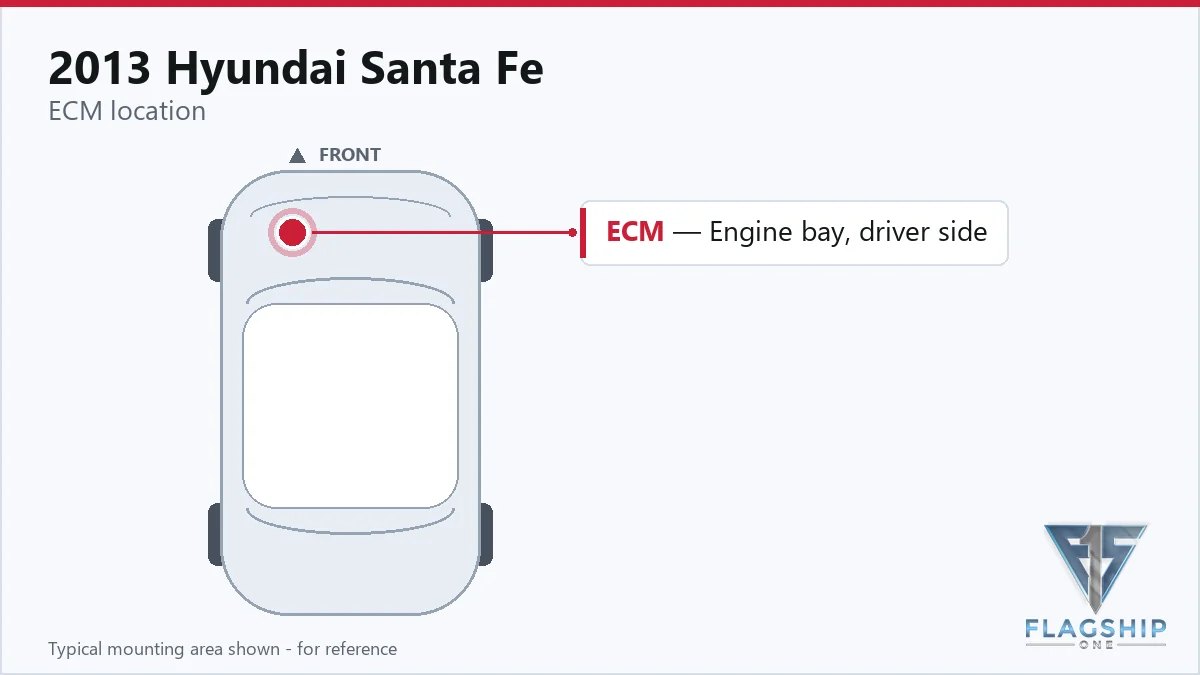
Work with the ignition off, and treat the module as static-sensitive: avoid touching the connector pins at any point.
| Operation | Configuration | Book Time |
|---|---|---|
| Powertrain Control Module R&R | All configurations | 0.6 hr |
| Powertrain Control Module Relearn | All configurations | 0.5 hr |
| Engine Control Module R&R | All configurations | 0.6 hr |
| Engine Control Module Relearn | All configurations | 0.5 hr |
| Engine Control Module Reset | All configurations | 0.3 hr |
When replacing the ECM on a 2013 Hyundai Santa Fe 2.4L, the factory procedure requires that the vehicle’s VIN be programmed into the new module. This step is essential for proper communication with other systems. Flagship One provides a VIN-programmed replacement unit that arrives ready to install, eliminating the need for dealer programming. This saves time and ensures the module is correctly configured for your vehicle.
Common symptoms of a failing ECM in the 2013 Hyundai Santa Fe 2.4L include no-start, stalling, misfire codes, and loss of communication with a scan tool. You may also experience shifting issues if the PCM is affected. One documented trouble code is internal ECM fault code, which indicates an internal module error. Addressing these symptoms promptly can prevent further damage.
The following trouble codes are documented for the ECM in the 2013 Hyundai Santa Fe 2.4L. These codes indicate internal module faults that may require replacement rather than repair.
| Code | Meaning | Full Guide |
|---|---|---|
| P0605 | Internal ROM error | Full P0605 guide → |
Two service bulletins apply to this vehicle. TSB 15-FL-001 covers an ECM update for the Santa Fe 3.3L with check engine light and DTC P2096 or P2098. TSB 04-36-019 addresses VIN writing procedures during ECM and PCM replacement for 2005 model year vehicles. These bulletins provide guidance for technicians.
| Bulletin | Subject | What It Addresses |
|---|---|---|
| — | TSB • Fuel System • [15-FL-001] ECM UPDATE – SANTA FE 3.3L MIL ON (DTC P2096/P2098) | — |
| 04-36-019 | TSB • Fuel System • [04-36-019] 2005MY ECM AND PCM VIN WRITING DURING CONTROL MODULE REPLACEMEN | — |
The book time for removal and installation is 0.6 hours. An additional 0.5 hours is required for a relearn procedure, and a reset takes 0.3 hours.
Yes, the factory procedure requires the VIN to be programmed into the new ECM. Flagship One offers pre-programmed units that eliminate this step.
The nuts and bolts should be torqued to 9.8 to 11.8 N·m.
When your 2013 Hyundai Santa Fe 2.4L needs a new ECM, you have options. Repair may be possible for some faults, but replacement is often more reliable. A refurbished or new ECM from Flagship One arrives with the VIN already programmed, saving you a trip to the dealer. Consider the labor time and torque specifications when planning the job.
Flagship One stocks a refurbished, VIN-programmed PCM for the 2013 Hyundai Santa Fe with a lifetime warranty, free shipping and no core charge. The full Hyundai Santa Fe module lineup covers other engine configurations as well.
The 2013 Hyundai Santa Fe 2.4L relies on its ECM for proper engine operation. If you suspect a failure, understanding the replacement process and programming requirements helps you choose the right solution. Flagship One provides pre-programmed units that simplify the repair.