
Last updated on August 25th, 2026 at 01:55 pm
The Powertrain Control Module (PCM) in the 1994 Mitsubishi Diamante manages engine and transmission functions. Failures may cause stalling, poor performance, or electrical issues, disrupting drivability.
If your 1994 Mitsubishi Diamante hesitates, stalls, or refuses to start, the Powertrain Control Module (PCM) may be the culprit. This small but critical computer oversees engine and transmission operations, ensuring smooth performance. Replacing it isn’t just about swapping parts—it involves proper installation and, in some cases, a relearn procedure. Understanding the process helps you avoid unnecessary delays and ensures your vehicle runs reliably. Whether you’re diagnosing symptoms or preparing for a replacement, knowing the steps and requirements can save time and frustration.
The PCM in the 1994 Mitsubishi Diamante acts as the brain for both the engine and transmission. It processes sensor data to adjust fuel delivery, ignition timing, and shift points, optimizing performance and efficiency. A malfunctioning PCM may disrupt these functions, leading to poor drivability or even a no-start condition. Since this vehicle predates OBD-II, diagnostics rely on manual checks rather than standardized trouble codes. When replacement becomes necessary, replacement engine computers for the Diamante are available to restore proper operation without extensive reprogramming.
1994 Mitsubishi Diamante
OEM programmed replacements — plug & play, no dealer visit.
Find yours by year, make & model →
Free shipping · Lifetime warranty
The PCM in the 1994 Mitsubishi Diamante is mounted inside the vehicle, near the driver’s side footwell. Accessing it requires removing interior panels, which adds minimal complexity to the job. Labor estimates for removal and reinstallation (R&R) range from 0.8 to 1.0 hours, depending on whether the focus is solely on the PCM or includes related components. No special tools are required beyond basic hand tools, but care should be taken to avoid damaging connectors during disassembly. Once removed, the new unit can be installed in the same location, securing it with the original fasteners.
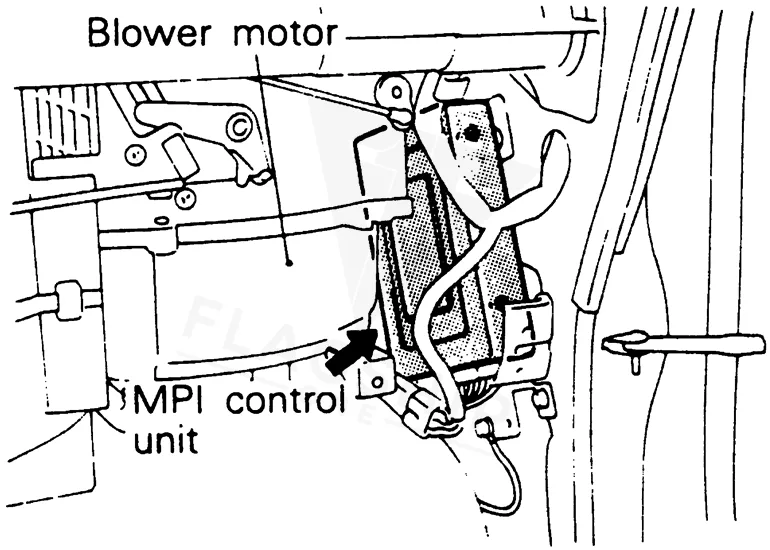
Work with the ignition off, and treat the module as static-sensitive: avoid touching the connector pins at any point.
| Operation | Configuration | Book Time |
|---|---|---|
| Powertrain Control Module R&R | All configurations | 1.0 hr |
| Powertrain Control Module Relearn | All configurations | 0.5 hr |
| Engine Control Module Relearn | All configurations | 0.5 hr |
| Engine Control Module R&R | All configurations | 0.8 hr |
After installing a new PCM in the 1994 Mitsubishi Diamante, a relearn procedure is typically required to synchronize the module with the vehicle’s systems. This step ensures proper communication between the PCM and sensors, preventing drivability issues. However, a VIN-programmed replacement unit from Flagship One arrives pre-configured, eliminating the need for manual relearn steps. This saves time and reduces the risk of errors during setup, allowing you to complete the job efficiently.
A failing PCM in the 1994 Mitsubishi Diamante may cause a range of symptoms, including intermittent stalling, rough idle, or a complete no-start condition. You might also notice erratic shifting, poor fuel economy, or the engine running too rich or lean. In some cases, the vehicle may exhibit electrical gremlins, such as flickering dashboard lights or unresponsive sensors. While pre-OBD-II vehicles don’t generate standardized codes, a scan tool may still detect module-related faults like internal control module memory check sum error, indicating a need for further inspection.
Common signs include stalling, no-start conditions, or erratic shifting. You may also notice poor engine performance or electrical issues. Since this vehicle lacks OBD-II, diagnostics rely on symptom observation and manual checks. A scan tool may detect module-related faults, but physical inspection is often necessary.
Replacement is straightforward if you’re comfortable removing interior panels and handling electrical connectors. The PCM is located near the driver’s side footwell, and labor estimates range from 0.8 to 1.0 hours. However, a relearn procedure may be required unless you use a pre-programmed unit.
Stalling after replacement often indicates a need for a relearn procedure. The PCM must synchronize with the vehicle’s sensors to function correctly. Using a pre-programmed unit eliminates this step, ensuring immediate compatibility and reducing the risk of post-install issues.
If your 1994 Mitsubishi Diamante is experiencing PCM-related issues, you have options. A repair may address minor faults, but a replacement ensures long-term reliability. Flagship One provides pre-programmed units designed for the Diamante, eliminating the need for post-install setup. This streamlines the process, allowing you to restore your vehicle’s performance quickly and confidently.
Flagship One stocks a refurbished, VIN-programmed PCM for the 1994 Mitsubishi Diamante with a lifetime warranty, free shipping and no core charge. The full Mitsubishi Diamante module lineup covers other engine configurations as well.
The 1994 Mitsubishi Diamante relies on its PCM for smooth engine and transmission operation. If you’re facing stalling, no-start conditions, or erratic shifting, a replacement may be the solution. With a pre-programmed unit, you can avoid unnecessary relearn steps and get back on the road with minimal downtime.