
Last updated on August 25th, 2026 at 12:22 pm
The Powertrain Control Module (PCM) in your 2020 Dodge Challenger manages engine and transmission operations. Failures may cause drivability issues, including stalling, misfires, or communication errors with diagnostic tools.
If your 2020 Dodge Challenger has been stalling, refusing to start, or throwing cryptic engine codes, the Powertrain Control Module (PCM) may be the culprit. This small but critical computer oversees everything from fuel injection to transmission shifts, and when it fails, your vehicle’s performance can suffer in noticeable ways. Replacing it isn’t just about swapping hardware—it involves precise programming to match your Challenger’s original specifications. Understanding the process, from identifying symptoms to completing the installation, can save you time and frustration. This guide explains what the PCM does, where it’s located, and what to expect during replacement and programming, so you can make informed decisions about your vehicle’s repair.
The Powertrain Control Module in your 2020 Dodge Challenger acts as the brain of the engine and transmission systems. It continuously monitors sensors for data like air intake, throttle position, and engine speed, then adjusts fuel delivery, ignition timing, and shift points in real time. Without a functioning PCM, your Challenger may struggle to start, run roughly, or even enter a limp-home mode to prevent further damage. The module also communicates with other onboard computers, ensuring seamless operation between systems like traction control and stability management. When it fails, you might notice symptoms ranging from poor fuel economy to complete drivability loss. Replacing it requires not just mechanical skill but also adherence to factory programming procedures to ensure compatibility with your vehicle’s replacement engine computers for the Challenger. A mismatched or improperly programmed unit can lead to further issues, so precision matters.
2020 Dodge Challenger
OEM programmed ECM for your 2020 Dodge Challenger — plug & play, no dealer visit.
Free shipping · Lifetime warranty
In the 2020 Dodge Challenger, the PCM is typically mounted in the engine bay, often near the firewall or strut tower. Accessing it involves removing a protective cover or air intake components, depending on the engine configuration. Replacement is straightforward but requires care to avoid damaging connectors or wiring. According to factory labor estimates, removing and reinstalling the PCM takes about 0.6 hours. After installation, a relearn procedure is necessary to synchronize the module with your vehicle’s systems, which adds another 0.5 hours of labor. While the physical swap is relatively quick, ensuring the module is properly secured and connected is critical to avoid intermittent electrical issues. Always disconnect the battery before beginning work to prevent voltage spikes that could damage the new unit.
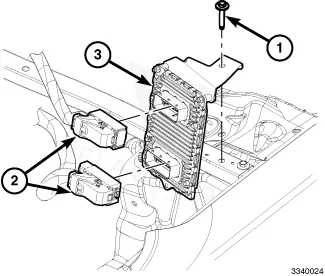
Work with the ignition off, and treat the module as static-sensitive: avoid touching the connector pins at any point.
| Operation | Configuration | Book Time |
|---|---|---|
| Powertrain Control Module Relearn | All configurations | 0.5 hr |
| Powertrain Control Module R&R | All configurations | 0.6 hr |
| Engine Control Module Relearn | All configurations | 0.5 hr |
| Engine Control Module Reset | All configurations | 0.3 hr |
| Engine Control Module R&R | All configurations | 0.6 hr |
After installing a new PCM in your 2020 Dodge Challenger, the factory procedure requires programming the module with your vehicle’s original VIN and mileage. This step ensures the module communicates correctly with other onboard systems and prevents issues like incorrect fuel trim or transmission shifting problems. The process typically involves using a dealership-level scan tool to input the data, which can add time and cost to the repair. However, a VIN-programmed replacement unit from Flagship One arrives ready to install, eliminating the need for additional programming. This not only simplifies the repair but also reduces the risk of errors during the setup process. Once installed, the module may still require a relearn procedure to adapt to your Challenger’s specific operating conditions, but the initial programming is already handled.
A failing PCM in your 2020 Dodge Challenger can manifest in several ways, often mimicking other mechanical or electrical issues. One of the most common signs is a no-start condition, where the engine cranks but refuses to fire. You may also experience stalling at idle or during acceleration, as the module struggles to maintain proper fuel and ignition timing. Erratic shifting, particularly in automatic transmissions, is another red flag, as the PCM controls shift points and torque converter lockup. Some drivers report poor fuel economy or a noticeable drop in engine performance, while others notice the check engine light illuminating with codes like internal control module memory check sum error. In severe cases, the vehicle may enter a limp-home mode, limiting speed and power to prevent further damage. If your Challenger exhibits any of these symptoms, a diagnostic scan can help pinpoint whether the PCM is the root cause.
The codes below point to the PCM itself rather than to a sensor or circuit it monitors. Each one links through to its full diagnostic guide.
| Code | Meaning | Full Guide |
|---|---|---|
| P0601 | Internal memory checksum error | Full P0601 guide → |
Common signs include a no-start condition, stalling, erratic shifting, or the check engine light illuminating with codes like P0601. A diagnostic scan can confirm whether the PCM is the issue or if another component is at fault. Symptoms may also include poor fuel economy or reduced engine performance.
A reset clears temporary data from the module, often resolving minor glitches. A relearn procedure, however, recalibrates the PCM to your vehicle’s specific operating conditions, such as fuel trim and shift points. The relearn is typically required after replacing the module or performing major engine work.
Driving with a failing PCM is risky, as it may cause stalling, misfires, or transmission issues. In some cases, the vehicle may enter limp-home mode, limiting speed and power. If you suspect PCM problems, have the vehicle diagnosed promptly to avoid further damage.
The VIN programming ensures the module communicates correctly with your vehicle’s other systems, such as the transmission and body control modules. Without it, the PCM may not function properly, leading to drivability issues or even a no-start condition. Mileage programming is also required to maintain accurate vehicle data.
Replacing the PCM typically takes 0.6 hours of labor, while the relearn procedure adds another 0.5 hours. If programming is required, it may extend the total time, depending on the shop’s equipment and expertise. Using a pre-programmed unit can reduce the overall repair time.
If your 2020 Dodge Challenger is experiencing PCM-related issues, you have options for repair. A dealership can provide a new module with factory programming, though this may come at a higher cost. Alternatively, a refurbished or remanufactured unit from Flagship One arrives pre-programmed with your Challenger’s VIN, simplifying the installation process. Consider your budget, timeline, and the severity of the issue when deciding between repair and replacement. A professional diagnostic scan can help determine the best course of action for your vehicle.
Flagship One stocks a refurbished, VIN-programmed PCM for the 2020 Dodge Challenger with a lifetime warranty, free shipping and no core charge. The full Dodge Challenger module lineup covers other engine configurations as well.
The PCM in your 2020 Dodge Challenger plays a critical role in engine and transmission performance. If you’re dealing with symptoms like stalling, no-start conditions, or trouble codes, addressing the module promptly can restore your vehicle’s reliability. Whether you opt for a new or remanufactured unit, ensuring proper programming and installation is key to avoiding further issues. With the right approach, your Challenger can return to smooth, dependable operation.