
Last updated on August 25th, 2026 at 12:44 pm
The Powertrain Control Module (PCM) in your 2019 Dodge Challenger manages engine and transmission functions. A failure may cause erratic performance, no-start conditions, or stored trouble codes related to internal memory errors.
If your 2019 Dodge Challenger 3.6L is experiencing unexplained stalling, rough idling, or a no-start condition, the Powertrain Control Module (PCM) may be the culprit. This critical component oversees engine and transmission performance, and when it fails, symptoms can range from subtle drivability issues to complete immobilization. Understanding the role of the PCM, how to identify potential failures, and what replacement entails can help you make informed decisions about repairs. Whether you’re diagnosing a stored trouble code or considering a replacement, knowing the steps involved—from labor times to programming requirements—ensures a smoother process and avoids unnecessary delays.
In your 2019 Dodge Challenger, the Powertrain Control Module (PCM) acts as the brain for both the engine and transmission. It continuously monitors sensor inputs and adjusts fuel delivery, ignition timing, and shift points to optimize performance and efficiency. A malfunctioning PCM may disrupt these processes, leading to poor throttle response, erratic shifting, or even a vehicle that won’t start. Because it integrates multiple control functions, a failure here often triggers a cascade of symptoms that can be mistaken for mechanical issues. When replacement becomes necessary, sourcing replacement PCMs for the Challenger ensures compatibility with your vehicle’s specific calibration and hardware requirements.
2019 Dodge Challenger 3.6L
OEM programmed ECM for your 2019 Dodge Challenger 3.6L — plug & play, no dealer visit.
Free shipping · Lifetime warranty
The PCM in the 2019 Dodge Challenger is located in the engine bay, typically mounted near the firewall or on the driver’s side inner fender. Accessing it involves removing a protective cover and disconnecting the wiring harness, which may require basic hand tools. According to factory labor estimates, removing and replacing the PCM takes approximately 0.6 hours. After installation, the module must be securely fastened, and all electrical connections should be inspected for corrosion or damage to prevent future issues. If the original PCM is being reused, a relearn procedure of 0.5 hours may be required to synchronize it with the vehicle’s systems.
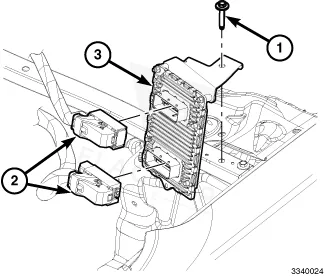
Work with the ignition off, and treat the module as static-sensitive: avoid touching the connector pins at any point.
| Operation | Configuration | Book Time |
|---|---|---|
| Powertrain Control Module Relearn | All configurations | 0.5 hr |
| Powertrain Control Module R&R | All configurations | 0.6 hr |
| Engine Control Module Relearn | All configurations | 0.5 hr |
| Engine Control Module Reset | All configurations | 0.3 hr |
| Engine Control Module R&R | All configurations | 0.6 hr |
After installing a new PCM in your 2019 Dodge Challenger, the factory procedure mandates programming the module with the vehicle’s original VIN and mileage. This step ensures the module communicates correctly with other onboard systems and prevents calibration mismatches. However, when you opt for a VIN-programmed replacement unit, these steps are already completed, saving time and reducing the risk of programming errors. A relearn or reset procedure, which may take up to 0.5 hours, is still recommended to finalize the installation and confirm proper operation.
A failing PCM in your 2019 Dodge Challenger may cause a variety of symptoms, often mimicking other mechanical or electrical problems. You might experience intermittent stalling, especially at idle or during deceleration, or notice the engine hesitating under acceleration. In some cases, the vehicle may refuse to start altogether, or the transmission could shift erratically. Scan tool communication issues are also common, where the PCM fails to respond or returns incomplete data. If the module’s internal memory is corrupted, you may see a control module memory fault stored in the system, indicating a need for further diagnosis or replacement.
The 2019 Dodge Challenger 3.6L may store specific trouble codes when the PCM experiences internal faults. These codes help pinpoint the issue and guide repair decisions.
| Code | Meaning | Full Guide |
|---|---|---|
| P0601 | Internal memory checksum error | Full P0601 guide → |
Not necessarily. While P0601 often indicates an internal PCM fault, it’s important to rule out wiring issues or poor connections first. A thorough diagnosis, including checking power and ground circuits, can confirm whether the module itself is the problem or if another issue is triggering the code.
Removing and replacing the PCM typically takes 0.6 hours of labor, according to factory estimates. If a relearn or reset procedure is required afterward, an additional 0.5 hours may be needed to complete the process and verify proper operation.
Installing a used PCM is possible, but it must be programmed with your vehicle’s original VIN and mileage to function correctly. Without proper programming, the module may not communicate with other systems, leading to drivability issues or failure to start.
When your 2019 Dodge Challenger requires a PCM replacement, you have options. A new or refurbished module can restore functionality, but programming is critical for proper operation. Flagship One provides units pre-programmed with your vehicle’s VIN, eliminating the need for additional programming steps and reducing downtime. Whether you’re addressing a no-start condition or resolving persistent drivability issues, choosing the right replacement ensures a smoother repair process.
Flagship One stocks a refurbished, VIN-programmed PCM for the 2019 Dodge Challenger with a lifetime warranty, free shipping and no core charge. The full Dodge Challenger module lineup covers other engine configurations as well.
A failing PCM in your 2019 Dodge Challenger can lead to frustrating symptoms, from stalling to no-start conditions. Understanding the role of this module, recognizing common failure signs, and knowing the steps for replacement can help you address issues efficiently. Whether you opt for a new or refurbished unit, ensuring proper programming and installation will get your Challenger back on the road with confidence.