
Last updated on August 25th, 2026 at 12:16 pm
The Powertrain Control Module in the 2017 Dodge Challenger 6.2L is the central computer that coordinates engine timing, fuel delivery, and shift logic. Failure often results in poor acceleration, hesitation, or engine misfires.
When a 2017 Dodge Challenger 6.2L presents symptoms such as sudden stalling, hesitation, or erratic shifting, the Powertrain Control Module (PCM) is a prime suspect. The PCM is the brain that synchronizes engine functions and transmission behavior. Understanding how to reset, relearn, or replace this unit can help you restore smooth operation without unnecessary downtime. This guide explains the module’s role, outlines the replacement process, and highlights key precautions, so you know exactly what steps to take and why they matter for your vehicle.
The Powertrain Control Module in a 2017 Dodge Challenger 6.2L orchestrates the engine’s timing, fuel injection, and transmission shift logic. It receives inputs from sensors such as throttle position, crankshaft speed, and engine temperature, then calculates the optimal ignition timing and fuel mix. If the PCM’s internal memory becomes corrupted or its software version is incompatible, the engine may misfire, stall, or shift unpredictably. replacement engine computers for the Challenger The module’s health is critical because any loss of communication or incorrect calculations directly affects performance and emissions. Regular updates and timely resets are part of maintaining the vehicle’s reliability.
2017 Dodge Challenger 6.2L
OEM programmed ECM for your 2017 Dodge Challenger 6.2L — plug & play, no dealer visit.
Free shipping · Lifetime warranty
The PCM is located beneath the driver’s seat, behind a protective cover. Accessing it requires removing the seat cushion and the panel beneath the dash. Once exposed, the unit is secured with a single mounting bolt that must be removed to extract the PCM. After replacement, the new unit is reinstalled and the bolt is tightened to the manufacturer’s torque specification. The book time for removal and installation is typically 0.6 hours for a replacement or 0.5 hours for a relearn, depending on the chosen procedure. This relatively quick job can be performed by a qualified technician with the correct diagnostic tools.
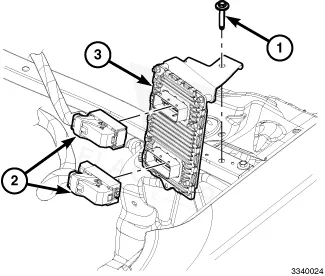
Work with the ignition off, and treat the module as static-sensitive: avoid touching the connector pins at any point.
| Operation | Configuration | Book Time |
|---|---|---|
| Powertrain Control Module Relearn | All configurations | 0.5 hr |
| Powertrain Control Module R&R | All configurations | 0.6 hr |
| Engine Control Module Relearn | All configurations | 0.5 hr |
| Engine Control Module Reset | All configurations | 0.3 hr |
| Engine Control Module R&R | All configurations | 0.6 hr |
After a PCM swap, the factory requires the module to be programmed with the vehicle’s VIN and mileage. Flagship One units arrive pre‑programmed with these values, so the technician does not need to perform any additional coding steps. This eliminates the need for a separate VIN‑programming session and ensures the new PCM immediately matches the vehicle’s data set. The process is streamlined by the factory’s original configuration, allowing the replacement to be completed in the standard 0.6‑hour window for a full reset.
Every VIN-programmed replacement unit from Flagship One arrives with these steps already completed.
Drivers of a 2017 Dodge Challenger 6.2L may notice the engine stalling mid‑drive, a sudden loss of power, or irregular shifting patterns that do not match the vehicle’s normal behavior. These issues often surface after a jump‑start or when a sudden voltage spike occurs. If the PCM’s internal memory is compromised, the vehicle may also emit codes such as Powertrain Control Module Failure or P0606, indicating a fault within the module itself. A dead scan‑tool connection or an inability to read other engine codes may also suggest PCM communication problems.
The 2017 Dodge Challenger 6.2L’s Powertrain Control Module can generate specific internal trouble codes that signal issues within the module’s logic or memory.
| Code | Meaning | Full Guide |
|---|---|---|
| P0601 | Internal memory checksum error | Full P0601 guide → |
| P0606 | Module processor failure | Full P0606 guide → |
| Bulletin | Subject | What It Addresses |
|---|---|---|
| — | Service Bulletins/Recalls • 30 – Canadian Recalls • Safety Recall U60 – Reprogram Powertrain Co | — |
A reset typically requires about 0.5 hours. The technician will clear stored data and allow the module to relearn operating parameters during normal driving.
Yes. The recall mandates reprogramming to update the PCM’s software. With a Flagship One unit, the programming is already complete, so the recall process is simplified.
Verify that the new PCM is correctly wired and that the vehicle’s VIN and mileage match the module’s data. If the code persists, further diagnostic testing of the engine control system may be required.
No. The PCM must match the exact year, make, and engine configuration. Using an incompatible module can cause communication failures.
Yes. Once the unit is installed and the reset procedure completes, the vehicle should operate normally. Monitoring for any abnormal behavior during the first few drives is advised.
Whether you choose a repair that simply resets the existing PCM or opt for a refurbished replacement, both options keep your 2017 Dodge Challenger 6.2L running reliably. The choice depends on the severity of the fault and your maintenance budget. A quick reset may suffice for minor glitches, while a replacement can address deeper memory corruption.
Flagship One stocks a refurbished, VIN-programmed PCM for the 2017 Dodge Challenger with a lifetime warranty, free shipping and no core charge. The full Dodge Challenger module lineup covers other engine configurations as well.
For the 2017 Dodge Challenger 6.2L, maintaining a healthy PCM is essential for performance and reliability. By understanding the reset process and recognizing early warning signs, you can keep your vehicle running smoothly and avoid costly downtime.