
Last updated on August 25th, 2026 at 01:06 pm
In the 2009 Mazda MX-5 Miata, the Powertrain Control Module and Engine Control Module manage engine timing, fuel delivery and communication with the transmission. Failure typically results from internal circuit loss, causing loss of control and diagnostic trouble codes.
When a 2009 Mazda MX-5 Miata exhibits a no‑start condition, erratic idle or loss of power, the electronic control modules are often a prime suspect. Understanding how the Powertrain Control Module (PCM) and Engine Control Module (ECM) operate in this model helps you diagnose the issue accurately and decide whether a repair or a replacement is warranted. This guide walks you through the function of each module, where they reside, the labor involved in removal and installation, the factory‑required programming steps, common symptoms and codes, and practical steps to keep the modules healthy. By the end, you should feel confident evaluating a PCM or ECM problem on your Miata and know what to expect from a professional service.
The PCM in the 2009 Mazda MX-5 Miata acts as the central command for engine and transmission coordination, interpreting sensor data to adjust fuel injection, ignition timing and gear shifts. The ECM focuses specifically on engine management, handling spark timing, air‑fuel mixture and emissions controls. Together they ensure smooth power delivery and compliance with emissions standards. Because the Miata’s lightweight chassis relies on precise throttle response, any discrepancy in module output can noticeably affect drivability. Maintaining accurate module operation is essential for performance and fuel economy. replacement engine computer for MX-5 often shares the same physical connector and mounting points, simplifying the swap when a unit fails.
2009 Mazda MX-5 Miata
OEM programmed ECM for your 2009 Mazda MX-5 Miata — plug & play, no dealer visit.
Free shipping · Lifetime warranty
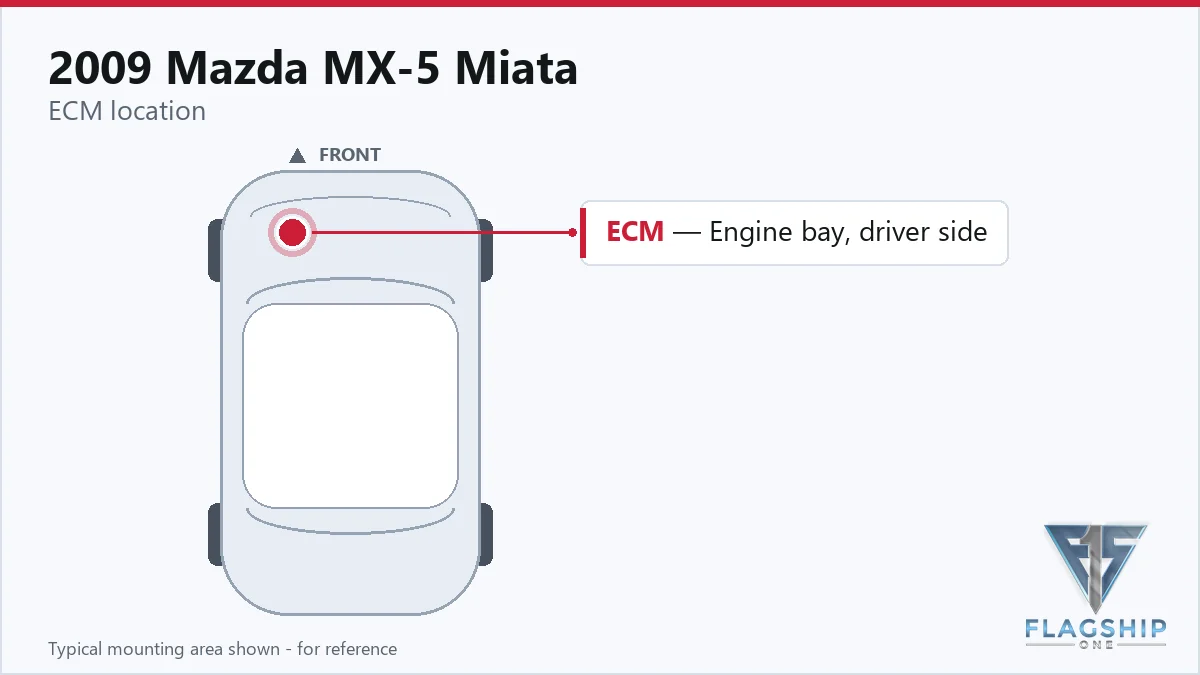
Factory service information indicates that the control modules are positioned next to the air cleaner assembly, making them reachable once the intake housing is removed. To replace the PCM, a technician typically spends about 0.7 hours removing the unit, followed by a 0.5 hour relearn cycle to sync the new module with the vehicle’s systems. The ECM follows the same pattern, with 0.7 hours for removal and 0.5 hours for relearn. No torque specifications were provided, so the focus remains on the documented labor times and the access route through the air‑cleaner area.
Work with the ignition off, and treat the module as static-sensitive: avoid touching the connector pins at any point.
| Operation | Configuration | Book Time |
|---|---|---|
| Powertrain Control Module R&R | All configurations | 0.7 hr |
| Powertrain Control Module Relearn | All configurations | 0.5 hr |
| Engine Control Module R&R | All configurations | 0.7 hr |
| Engine Control Module Relearn | All configurations | 0.5 hr |
After installing a new PCM or ECM, the factory procedure requires a specific relearn sequence to register the module with the vehicle’s network and calibrate sensor baselines. This includes a 0.5 hour PCM relearn and a separate 0.5 hour ECM relearn. Flagship One units arrive pre‑programmed to the vehicle’s VIN, so those steps are already completed. a VIN-programmed replacement unit eliminates the need for the technician to perform the relearn steps manually, reducing shop time and potential for error.
Owners of a 2009 Mazda MX-5 Miata may notice a complete lack of engine cranking, intermittent stalling, rough idle, or an inability to shift smoothly when a module fails. Diagnostic scanners often report loss of communication with the control unit, and trouble codes such as P0603 or U0100 can appear. A common fault is indicated by PCM timing error, which points to internal timing circuit failure within the PCM. These symptoms typically emerge gradually as the module’s internal components degrade, but they can also appear suddenly if a power surge damages the circuitry.
The following diagnostic trouble codes are documented for the 2009 Mazda MX-5 Miata’s control modules:
Yes, the PCM controls fuel and ignition timing, so internal failures can lead to stalling, especially under load or at idle.
Both modules share a similar removal path and labor time, but each requires its own relearn step after installation.
U0100 signals a loss of communication with the vehicle’s network, often pointing to a PCM or wiring issue.
Standard hand tools are sufficient; the modules are accessed by removing the air‑cleaner housing as described in the factory procedure.
A VIN‑programmed unit arrives pre‑calibrated, so the factory relearn step is already satisfied, saving shop time.
When a 2009 Mazda MX-5 Miata’s PCM or ECM needs attention, you can choose a repair that restores the original hardware or opt for a refurbished replacement that matches factory specifications. Both paths aim to return your Miata to reliable operation, with the refurbished unit offering a cost‑effective solution that includes VIN programming.
Flagship One stocks a refurbished, VIN-programmed PCM for the 2009 Mazda MX-5 Miata with a lifetime warranty, free shipping and no core charge. The full Mazda MX-5 Miata module lineup covers other engine configurations as well.
If your 2009 Mazda MX-5 Miata shows control‑module symptoms, consider the labor and programming details outlined here before deciding on repair or replacement. A properly installed, VIN‑programmed unit can get you back on the road with confidence.