
Last updated on August 25th, 2026 at 02:37 pm
The DME (Digital Motor Electronics) in your 2006 BMW 6 Series is the primary computer managing engine functions including fuel injection, ignition timing, and emissions controls. When this module fails internally, it can store fault codes, illuminate the check engine light, or leave the engine unable to run.
If your 2006 BMW 6 Series is running rough, stalling, or refuses to start, the engine control module may be at fault. The DME/ECM on this model sits in a dedicated electronics box in the engine compartment, and accessing it involves releasing the cover and mounting bolts according to the factory procedure. Replacement requires careful handling to avoid electrostatic damage, and the post-install relearn process is a documented step in the official service information.
This guide walks you through what the module does in the 2006 BMW 6 Series, where it is located, what the replacement process involves, and what you need to know about programming. Whether you are evaluating repair options or comparing new versus refurbished control units, understanding the role of this computer and the service steps involved will help you make a more informed decision. The information is drawn from factory service documentation and field experience with BMW drivetrain electronics.
The Digital Motor Electronics unit in your 2006 BMW 6 Series serves as the brain of the engine management system. This computer processes input from dozens of sensors throughout the engine, including the mass airflow sensor, oxygen sensors, throttle position sensor, and crankshaft position sensor, to calculate the precise fuel delivery and spark advance required for any given driving condition. Every injection event and every ignition firing is commanded by this module in real time.
Beyond basic engine running functions, the DME on the 2006 BMW 6 Series also manages the VANOS variable valve timing system, controls the secondary air pump for cold-start emissions compliance, and monitors the evaporative emissions system through integral self-tests. The module communicates with other vehicle networks, including the transmission control unit, to coordinate shift quality and torque management. When the DME detects a fault, it stores a specific diagnostic trouble code and may activate a limp-home mode to protect the engine from further damage.
Internal module failures in this generation of BMW can occur without an obvious external cause. Common failure modes include failed output driver stages inside the circuit board, corrupted calibration data, or compromised solder joints on the processor. The result can range from an illuminated MIL with specific stored fault codes to a completely unresponsive engine that will not crank. Whether you are diagnosing a persistent check engine light or evaluating replacement engine computers for the 2006 BMW 6 Series, understanding the DME’s central role in vehicle operation is the first step toward a correct repair.
Flagship One keeps BMW 6 Series replacement engine computers in stock for exactly this failure pattern.
2006 BMW 6 Series
OEM programmed ECM for your 2006 BMW 6 Series — plug & play, no dealer visit.
Free shipping · Lifetime warranty
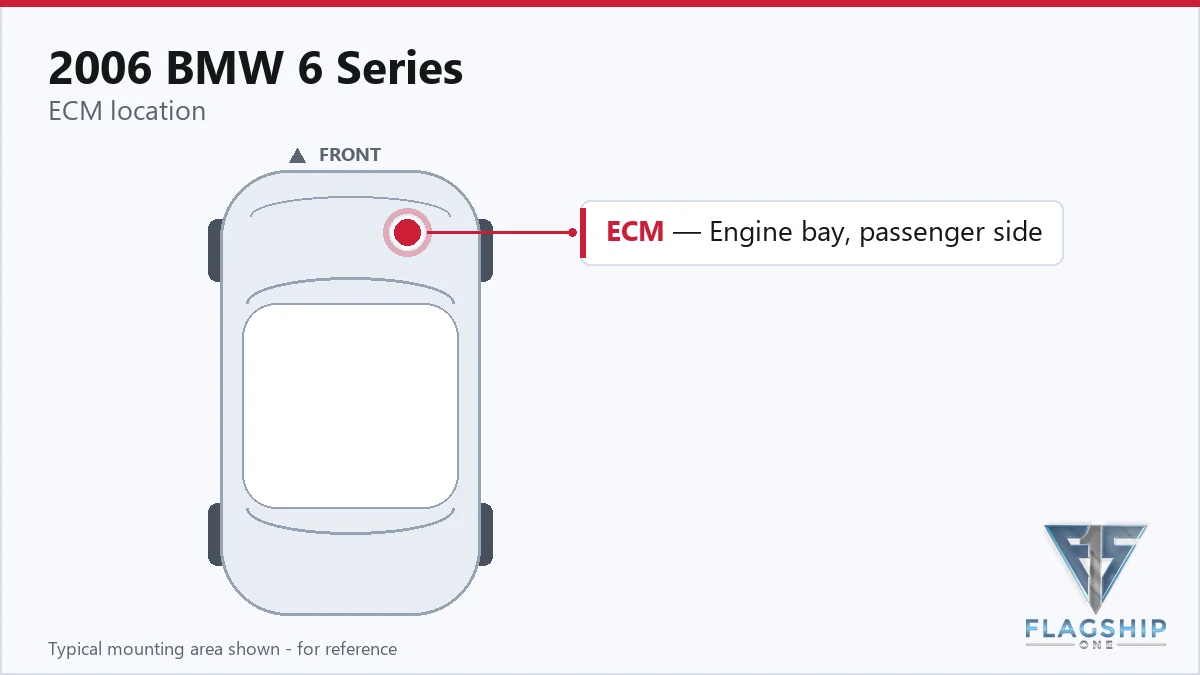
Work with the ignition off, and treat the module as static-sensitive: avoid touching the connector pins at any point.
| Operation | Configuration | Book Time |
|---|---|---|
| Engine Control Module R&R | All configurations | 0.6 hr |
| Engine Control Module Relearn | All configurations | 0.5 hr |
| Powertrain Control Module R&R | All configurations | 0.6 hr |
| Powertrain Control Module Relearn | All configurations | 0.5 hr |
After installing a replacement module in the 2006 BMW 6 Series, the factory procedure requires performing a relearn procedure to synchronize the new module with your vehicle’s specific engine and transmission hardware. The documented book time for this relearn step is 0.5 hours, and it must be completed before the vehicle will operate normally. Without the relearn, the new module may not correctly adapt to the fuel trims, idle control, and transmission shift characteristics specific to your engine.
Flagship One addresses this requirement by shipping replacement units pre-programmed with your vehicle identification number, so the relearn process has already been performed at the factory before the module arrives. This means your replacement unit is ready to install and should communicate with the rest of the drivetrain on first startup without requiring a dealership visit for programming. The original fault memory should still be retrieved after installation to confirm that the new module is communicating properly and to clear any fault codes that were set before the repair.
Every VIN-programmed replacement unit from Flagship One arrives with these steps already completed.
A failing engine control module on the 2006 BMW 6 Series typically announces itself through one or more drivability symptoms. The most common early warning is an illuminated check engine light, which may be accompanied by stored fault codes indicating internal module problems. You may also experience hard starting or a no-start condition, where the engine cranks but receives no fuel or spark commands from the module. Stalling and loss of power under load are frequent complaints because the DME can drop out of communication with the injectors or ignition drivers without notice.
Misfire codes pointing to individual cylinders often appear when output driver stages inside the module begin to fail. In some cases, the scan tool may be unable to establish communication with the module at all, which can be mistaken for a broken data link. Transmission shifting may become harsh or erratic because the powertrain control module and engine module share data over the CAN bus, and an unhealthy DME can send corrupted messages to the transmission controller. If your 2006 BMW 6 Series displays any combination of these symptoms and fault memory points toward the DME, the control module should be high on your list of suspected components.
Factory service documentation for the 2006 BMW 6 Series identifies the DME and ECM as components that may experience internal failures leading to stored fault codes and illuminated warning lights. The official guidance directs technicians to retrieve fault memory as a preliminary step before performing any replacement, ensuring that the correct module is identified as the source of the concern rather than a related sensor or wiring fault. Technicians are also reminded to observe ESD protection requirements throughout the removal and installation process to prevent damaging the replacement module during handling.
| Bulletin | Subject | What It Addresses |
|---|---|---|
| — | Check Engine Light Illuminated, Faults Stored in DME/ECM | — |
| — | OBD II Fault Codes List in TIS | — |
The DME (Digital Motor Electronics) and the PCM (Powertrain Control Module) on the 2006 BMW 6 Series are separate control units. The DME manages engine functions such as fuel injection and ignition, while the PCM handles transmission operation and torque management. Both are mounted in the engine compartment and have their own removal and relearn procedures.
Physical removal and installation of the DME from the E-box is within the capability of a skilled DIY technician, but the post-install relearn procedure requires either a BMW-compatible diagnostic tool or a trip to a repair facility. If you purchase a replacement module that is not pre-programmed, you will also need to have it coded to your vehicle at a dealership or independent shop with the proper equipment.
Internal module failures on the 2006 BMW 6 Series often occur without any prior symptoms or external event. Common causes include failed solder joints on the circuit board, degraded memory cells, or failed output driver transistors. These are typically age-related or thermally induced failures that cannot be predicted through visual inspection or routine maintenance.
A used or new unprogrammed module will not communicate with your vehicle’s CAN bus or correctly control engine functions without the proper calibration data for your specific vehicle. The factory relearn procedure synchronizes the new module to your engine’s fuel trims, idle characteristics, and transmission settings. A pre-programmed replacement from Flagship One eliminates this step by arriving with your VIN already flashed in.
The factory procedure directs technicians to read fault memory before replacing the module, which helps determine whether codes are pointing to the DME itself or to external sensors. Codes that indicate internal failures, complete loss of communication with the module, or multiple unrelated fault codes appearing simultaneously are strong indicators that the DME requires replacement rather than further sensor diagnosis.
Deciding between a new dealership-ordered module and a pre-programmed replacement from Flagship One is a practical cost-versus-convenience choice. The dealership route typically involves waiting for the module to arrive, scheduling an appointment for programming, and paying separate fees for that step. A pre-programmed unit installs like the original, arrives ready to communicate with your 2006 BMW 6 Series, and eliminates the post-install programming visit entirely. Whether you choose repair or replacement, the information in this guide helps you understand the process and ask the right questions before committing to a service provider.
Flagship One stocks a refurbished, VIN-programmed PCM for the 2006 BMW 6 Series with a lifetime warranty, free shipping and no core charge. The full BMW 6 Series module lineup covers other engine configurations as well.
The engine control module is the central nervous system of your 2006 BMW 6 Series, and its failure affects virtually every aspect of drivetrain operation. Understanding its location in the E-box, the factory-required handling precautions, and the relearn procedure that follows replacement gives you a solid foundation for making repair decisions. Flagship One’s VIN-programmed replacement modules are designed to install directly and start communicating immediately, so you can focus on getting your BMW back on the road rather than navigating a complicated programming process.