
Last updated on August 25th, 2026 at 02:43 pm
The engine control module (ECM or DME) in the 2010 BMW 6 Series manages fuel delivery, ignition timing, and emissions systems. Failures may cause stalling, misfires, or a complete no-start condition, often triggered by voltage spikes or corrosion.
If your 2010 BMW 6 Series suddenly refuses to start or throws a check engine light with no clear cause, the engine computer (DME) may be at fault. This compact module acts as the brain of your vehicle’s powertrain, controlling everything from fuel injection to ignition timing. When it fails, symptoms can range from subtle drivability issues to a complete loss of engine function. Replacing it involves accessing the electronics box in the engine bay, a task that typically requires less than an hour of labor—but the real challenge lies in the programming and relearn steps that follow. Understanding where the module is, how to handle it safely, and what to expect during replacement can save you time and frustration. Whether you’re diagnosing a persistent fault code or preparing for a repair, knowing these details helps you make informed decisions about your vehicle’s needs.
The engine control module (DME) in the 2010 BMW 6 Series is responsible for managing critical engine functions, including fuel mixture, ignition timing, and emissions controls. It constantly adjusts these parameters based on sensor inputs to optimize performance, efficiency, and drivability. Without a properly functioning DME, your vehicle may struggle to start, run erratically, or even enter a limp-home mode to prevent further damage. This module also communicates with other onboard systems, such as the transmission control unit, to ensure smooth gear shifts and overall powertrain harmony. Over time, exposure to voltage fluctuations, moisture, or heat can degrade the DME’s internal components, leading to intermittent or permanent failures. When replacement becomes necessary, replacement engine computers for the BMW 6 Series are designed to restore full functionality, but proper installation and programming are essential to avoid recurring issues.
2010 BMW 6 Series
OEM programmed ECM for your 2010 BMW 6 Series — plug & play, no dealer visit.
Free shipping · Lifetime warranty
In the 2010 BMW 6 Series, the engine control module (DME) is housed in the electronics box (E-box) located in the engine compartment. Accessing it requires removing a protective cover secured by a slide mechanism and bolts. The factory procedure specifies unlocking the cover with the slide (marked as part 3) and releasing the bolts (marked as part 2) to gain access to the module. Once exposed, the DME can be disconnected and removed. Labor estimates for this process are typically 0.6 hours for removal and reinstallation. Due to the module’s sensitivity to static electricity, technicians must follow electrostatic discharge (ESD) protection protocols, such as using grounded wrist straps or mats, to prevent damage during handling. After installation, the new module must be properly secured, and all connectors should be inspected for corrosion or damage before reassembly.
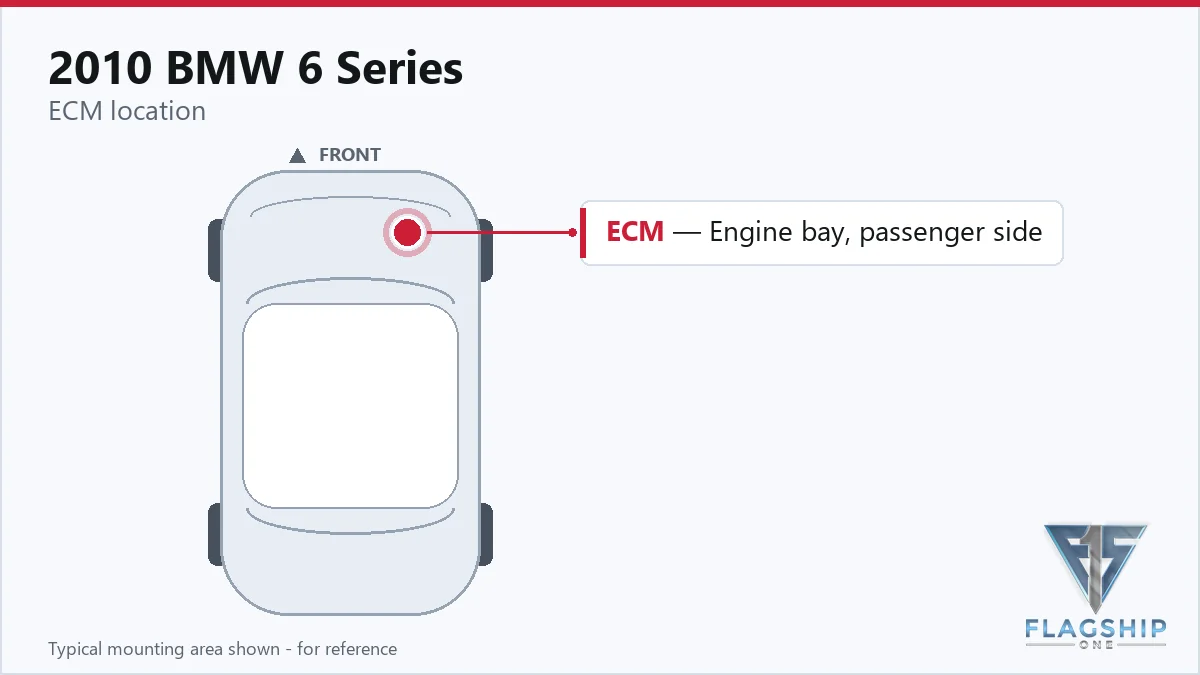
Work with the ignition off, and treat the module as static-sensitive: avoid touching the connector pins at any point.
| Operation | Configuration | Book Time |
|---|---|---|
| Powertrain Control Module R&R | All configurations | 0.6 hr |
| Engine Control Module R&R | All configurations | 0.6 hr |
| Engine Control Module Relearn | All configurations | 0.5 hr |
After replacing the engine control module in a 2010 BMW 6 Series, the factory procedure requires a relearn process to synchronize the new module with the vehicle’s systems. This typically involves a 0.5-hour labor step to reset adaptive values, recalibrate sensors, and ensure proper communication with the onboard diagnostics. However, if you install a VIN-programmed replacement unit, these steps are already completed, saving you time and potential dealer programming fees. The pre-programmed unit arrives ready to plug in and drive, eliminating the need for additional software updates or relearn procedures. This not only simplifies the installation process but also reduces the risk of compatibility issues that can arise from improper programming. Always verify that the replacement unit matches your vehicle’s specifications before installation to avoid drivability or emissions-related problems.
When the engine control module (DME) in a 2010 BMW 6 Series begins to fail, symptoms can vary widely but often include a check engine light accompanied by fault codes related to engine performance. Common issues may involve rough idling, hesitation during acceleration, or stalling, particularly when the engine is warm. In some cases, the vehicle may fail to start altogether, leaving you with a cranking engine that refuses to fire. Another telltale sign is poor communication with scan tools, where the DME either fails to respond or provides incomplete data. Drivers might also notice erratic shifting patterns from the transmission, as the DME plays a role in coordinating gear changes. Fault codes such as internal control module memory check sum error may appear, indicating corruption within the module’s memory. These symptoms can be intermittent at first but often worsen over time, making prompt diagnosis and replacement critical to maintaining reliable operation.
Factory service bulletins for the 2010 BMW 6 Series address common issues related to the engine control module, including illuminated check engine lights and stored fault codes in the DME. These bulletins provide guidance on diagnosing and resolving specific faults, often referencing a list of OBD II codes available in the technical information system (TIS). While the bulletins do not detail every possible scenario, they offer a structured approach to troubleshooting module-related problems, ensuring technicians follow standardized procedures for accurate repairs.
| Bulletin | Subject | What It Addresses |
|---|---|---|
| — | Check Engine Light Illuminated, Faults Stored in DME/ECM | — |
| — | OBD II Fault Codes List in TIS | — |
A cranking but non-starting condition after battery replacement may indicate a DME relearn issue. The module may need to reset adaptive values, especially if the battery was disconnected for an extended period. In some cases, a VIN-programmed replacement unit can resolve this without additional programming.
While the vehicle may still run with a P0601 code, it often signals internal memory corruption in the DME. Driving with this fault can lead to erratic performance or a no-start condition. It’s advisable to address the issue promptly to avoid further complications.
DME failures typically produce multiple fault codes or communication errors, while sensor issues usually trigger isolated codes. If scan tools struggle to communicate with the DME or if symptoms persist after sensor replacement, the module itself may be at fault.
Always follow electrostatic discharge (ESD) protection protocols, such as using a grounded wrist strap or mat, to prevent static damage. Avoid touching the module’s circuit board or connectors directly, and store it in an anti-static bag if removed from the vehicle.
A used DME may physically fit, but it requires programming to match your vehicle’s VIN and system configurations. Without proper programming, it may cause drivability issues or fail to communicate with other onboard systems. A VIN-programmed replacement unit is often a more reliable solution.
When your 2010 BMW 6 Series requires a new engine control module, you have two primary options: a dealer-installed unit with programming or a refurbished replacement that arrives ready to install. A VIN-programmed unit eliminates the need for post-installation programming, reducing labor time and potential compatibility issues. Whether you’re addressing a no-start condition or persistent fault codes, choosing the right replacement ensures your vehicle returns to optimal performance without unnecessary delays.
Flagship One stocks a refurbished, VIN-programmed PCM for the 2010 BMW 6 Series with a lifetime warranty, free shipping and no core charge. The full BMW 6 Series module lineup covers other engine configurations as well.
The 2010 BMW 6 Series relies on its engine control module to manage critical engine functions, and when it fails, symptoms can range from subtle drivability issues to a complete loss of operation. Understanding the module’s location, replacement steps, and programming requirements helps you make informed decisions about repairs. Whether you opt for a dealer-installed unit or a pre-programmed replacement, addressing DME issues promptly ensures your vehicle remains reliable and responsive on the road.