
Last updated on August 25th, 2026 at 02:44 pm
The engine control module (ECM) or powertrain control module (PCM) in your 2005 BMW 6 Series manages fuel delivery, ignition timing, and emissions systems. Failures may cause rough idling, stalling, or failure to start.
If your 2005 BMW 6 Series is experiencing intermittent stalling, a no-start condition, or an illuminated check engine light, the engine control module (ECM) or powertrain control module (PCM) may be at fault. These components act as the brain of your vehicle’s engine management system, regulating critical functions like fuel injection and ignition timing. Replacing the module involves accessing the electronics box in the engine compartment, following precise steps to avoid damage, and ensuring proper relearn procedures. Understanding the process and symptoms can help you diagnose issues efficiently and avoid unnecessary repairs.
2005 BMW 6 Series
OEM programmed ECM for your 2005 BMW 6 Series — plug & play, no dealer visit.
Free shipping · Lifetime warranty
The ECM or PCM in your 2005 BMW 6 Series controls essential engine and transmission functions, ensuring optimal performance and emissions compliance. This module processes data from sensors to adjust fuel delivery, ignition timing, and other parameters in real time. A faulty module may lead to poor drivability, reduced fuel efficiency, or even a complete no-start condition. When replacement is necessary, selecting replacement engine computers for the 6 Series ensures compatibility and reliability. The module’s role is critical, as it directly impacts how your vehicle responds to driving conditions.
The ECM/PCM in the 2005 BMW 6 Series is housed in the electronics box (E-box) located in the engine compartment. To access it, you’ll need to slide and release the cover latch, then remove the securing bolts. The factory procedure specifies 0.6 hours for removal and reinstallation. During this process, it’s important to follow ESD protection guidelines to prevent static damage to sensitive electronics. Once the old module is removed, the new unit can be installed in the same location, securing it with the bolts and reattaching the cover.
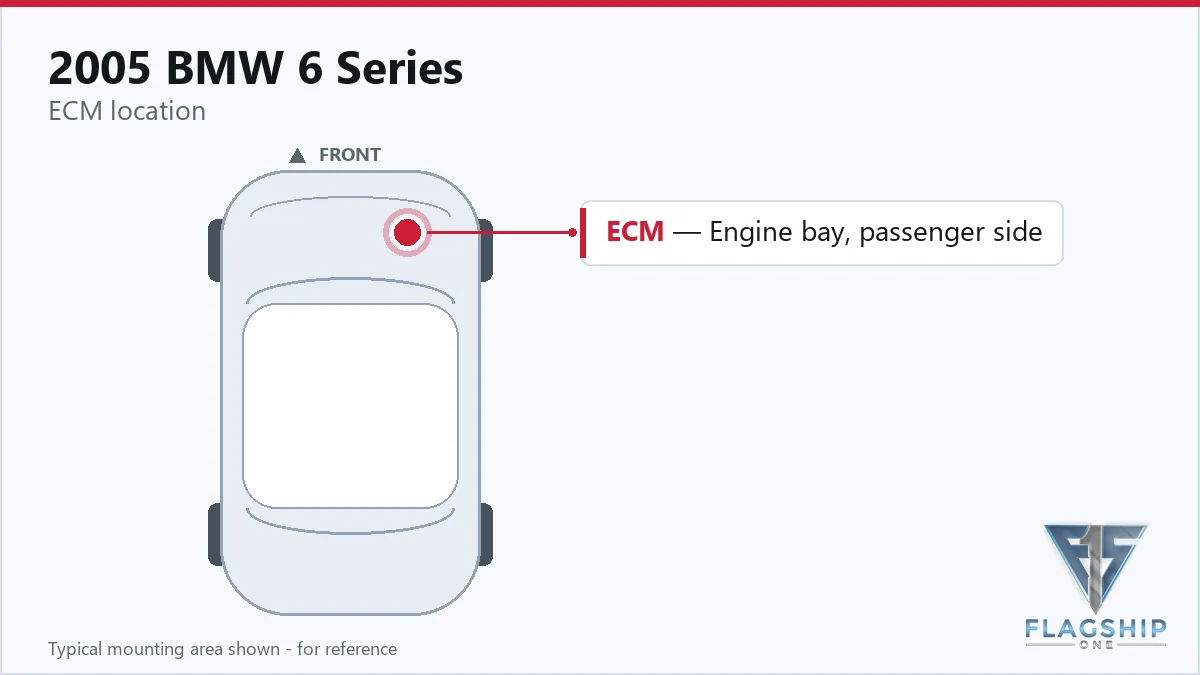
Work with the ignition off, and treat the module as static-sensitive: avoid touching the connector pins at any point.
| Operation | Configuration | Book Time |
|---|---|---|
| Engine Control Module R&R | All configurations | 0.6 hr |
| Engine Control Module Relearn | All configurations | 0.5 hr |
| Powertrain Control Module R&R | All configurations | 0.6 hr |
| Powertrain Control Module Relearn | All configurations | 0.5 hr |
After replacing the ECM/PCM in your 2005 BMW 6 Series, the factory procedure requires a 0.5-hour relearn process to synchronize the module with the vehicle’s systems. This step ensures proper communication with sensors and other control units. However, a VIN-programmed replacement unit from Flagship One arrives pre-configured, eliminating the need for additional programming. This saves time and reduces the risk of calibration errors, allowing your vehicle to return to normal operation more quickly.
A failing ECM/PCM in your 2005 BMW 6 Series may cause a range of symptoms, including intermittent stalling, rough idling, or a no-start condition. You might also notice the check engine light illuminated, often accompanied by fault codes like internal control module memory check sum error. Other signs include poor throttle response, misfires, or communication failures when attempting to scan the vehicle. If the module is unable to process sensor data correctly, it may also trigger transmission shifting issues or reduced fuel efficiency.
Factory service bulletins for the 2005 BMW 6 Series address issues such as the check engine light illuminating with faults stored in the DME/ECM. These bulletins provide diagnostic steps and potential solutions, including checking for stored OBD II fault codes. Following the recommended procedures can help identify whether the ECM/PCM is the root cause of drivability issues.
| Bulletin | Subject | What It Addresses |
|---|---|---|
| — | Check Engine Light Illuminated, Faults Stored in DME/ECM | — |
| — | OBD II Fault Codes List in TIS | — |
Common signs include a no-start condition, intermittent stalling, or an illuminated check engine light. You may also experience rough idling, misfires, or communication errors when using a scan tool. If these symptoms persist, the module may need replacement.
The factory labor time for removal and installation is 0.6 hours, with an additional 0.5 hours required for the relearn procedure. This time may vary depending on the technician’s familiarity with the vehicle.
Yes, the factory procedure requires a relearn process after replacement. However, Flagship One units arrive VIN-programmed, so no additional programming is needed. This ensures the module is ready for immediate installation.
If your 2005 BMW 6 Series is exhibiting symptoms of ECM/PCM failure, you have options for repair or replacement. While a dealership may recommend a new module, a refurbished replacement can offer a cost-effective solution without sacrificing reliability. Flagship One provides VIN-programmed units designed to restore your vehicle’s performance quickly and efficiently.
Flagship One stocks a refurbished, VIN-programmed PCM for the 2005 BMW 6 Series with a lifetime warranty, free shipping and no core charge. The full BMW 6 Series module lineup covers other engine configurations as well.
The ECM/PCM in your 2005 BMW 6 Series plays a critical role in engine management and drivability. If you’re experiencing symptoms like stalling, misfires, or a no-start condition, addressing the module promptly can prevent further issues. Whether you choose a new or refurbished replacement, ensuring proper installation and programming will keep your vehicle running smoothly.