
Last updated on August 25th, 2026 at 02:44 pm
The Engine Control Module (ECM), also called the Digital Motor Electronics (DME) control unit in BMW terminology, is the primary computer managing engine functions including fuel injection, ignition timing, and emissions systems in your 2004 BMW 6 Series.
If your 2004 BMW 6 Series is displaying a Check Engine Light, experiencing starting difficulties, or running roughly, the Engine Control Module may be the culprit. The ECM (Engine Control Module)—known in BMW terminology as the DME (Digital Motor Electronics)—serves as the brain of your vehicle’s powertrain, managing critical engine functions from fuel delivery to emission controls. This guide walks you through understanding ECM failure in your specific vehicle, recognizing the symptoms, and evaluating your repair options whether you pursue a new replacement, a refurbished unit, or a used module with programming requirements. You’ll learn where the module is located, what the factory service procedure involves, and how modern VIN-programmed replacements can streamline the repair process. The information presented here draws on BMW factory service documentation and general mechanical principle to help you make informed decisions about your 2004 BMW 6 Series powertrain electronics.
2004 BMW 6 Series
OEM programmed ECM for your 2004 BMW 6 Series — plug & play, no dealer visit.
Free shipping · Lifetime warranty
The Engine Control Module in your 2004 BMW 6 Series is the central processing unit responsible for managing the engine’s operational parameters. In BMW’s nomenclature, this unit is referred to as the DME (Digital Motor Electronics) control module, which serves as the primary computer governing fuel injection, ignition timing, idle speed control, emission monitoring, and various sensor inputs throughout the powertrain. The module receives data from numerous sensors including the mass airflow sensor, coolant temperature sensor, oxygen sensors, and throttle position sensor, then processes this information to optimize engine performance for power, efficiency, and emissions compliance.
When this replacement engine computers for the 6 Series fails or develops internal faults, the vehicle may enter a limited-operation mode or fail to start altogether. The module stores trouble codes internally, and these codes can be retrieved using a BMW-compatible scan tool. Common internal failure modes include corrupted memory sectors, failed internal transistors, or voltage supply irregularities that damage the module’s circuitry. Because the ECM interfaces with virtually every major engine system, a failing module can manifest as drivability concerns that seem unrelated to the electronics themselves—this often leads to misdiagnosis if the technician does not begin by checking for ECM fault codes.
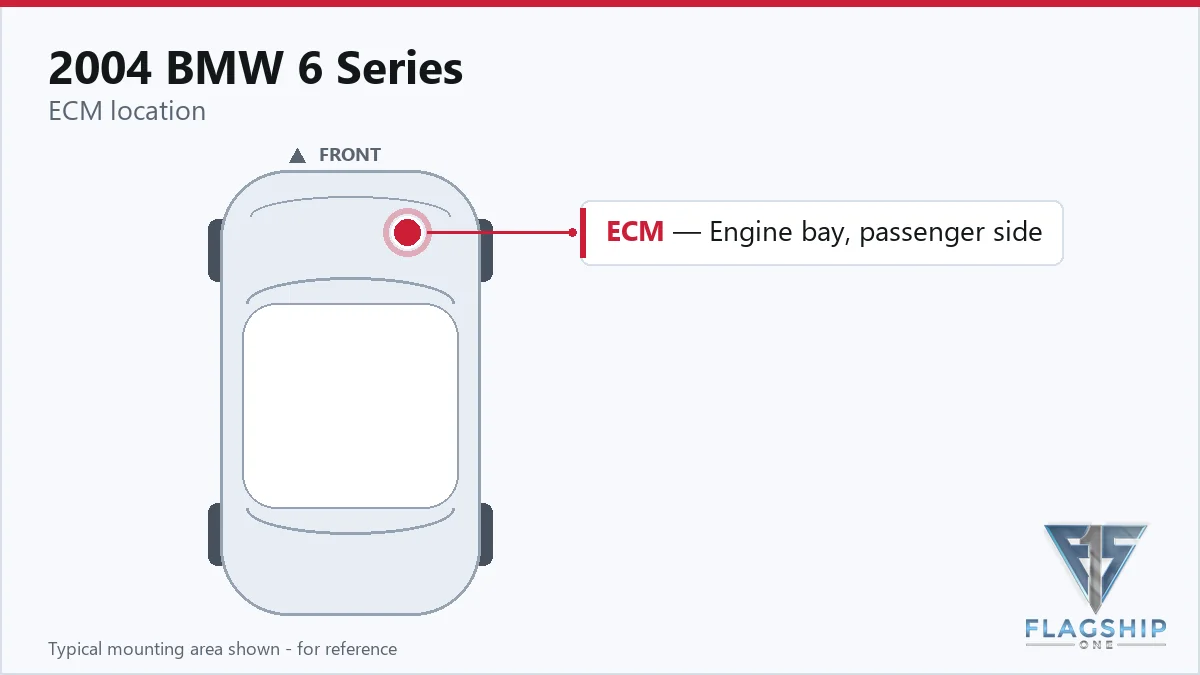
Work with the ignition off, and treat the module as static-sensitive: avoid touching the connector pins at any point.
| Operation | Configuration | Book Time |
|---|---|---|
| Engine Control Module R&R | All configurations | 0.6 hr |
| Engine Control Module Relearn | All configurations | 0.5 hr |
| Powertrain Control Module R&R | All configurations | 0.6 hr |
| Powertrain Control Module Relearn | All configurations | 0.5 hr |
Following the physical replacement of the Engine Control Module in your 2004 BMW 6 Series, the factory service procedure requires reading the fault memory as a preliminary task and then performing a relearn procedure to calibrate the new module to your specific vehicle. This relearn process, which requires 0.5 hours according to BMW labor guides, synchronizes the new ECM with the existing sensors and establishes proper communication with other control units on the vehicle’s CAN bus network.
When you purchase a VIN-programmed replacement unit from Flagship One, the module arrives pre-programmed with your specific vehicle’s Vehicle Identification Number already configured. This means the relearn procedure that would normally require dealer-grade equipment and specialized software may be significantly simplified or, in many cases, completed automatically as the module and vehicle establish communication during the first startup cycle. The advantage of receiving a VIN-programmed unit is that it eliminates the need for external programming equipment that most independent shops do not possess, potentially reducing your overall repair cost and turnaround time.
Recognizing ECM failure symptoms in your 2004 BMW 6 Series can save you from being stranded or incurring unnecessary repair costs on other components. The most common indicator of ECM trouble is illumination of the Check Engine Light, often accompanied by stored fault codes in the DME memory. A failing ECM may prevent the engine from starting entirely, or the vehicle may start but run poorly, demonstrating symptoms such as rough idle, hesitation under acceleration, or intermittent stalling. These drivability issues can mimic problems with the fuel system, ignition components, or sensors, which is why proper diagnostic trouble code retrieval is essential before replacing the module.
Additional symptoms include an inability to communicate with the ECM using a scan tool, which often points to an internal internal control module memory check fault. Transmission shifting irregularities may also occur because the ECM often shares data with the transmission control module, and communication errors can affect shift quality. In some cases, the vehicle may run normally for a period before suddenly stalling or failing to restart, suggesting an intermittent electrical connection or progressive internal failure within the module itself. If multiple attempts to start the vehicle result in no injector operation or no spark, and all basic ignition and fuel supply components test properly, the ECM warrants inspection as the likely source of the no-start condition.
BMW has issued service bulletins addressing Check Engine Light illumination and fault codes stored in the DME/ECM for various 6 Series models. These bulletins provide guidance to dealers and independent technicians on proper diagnostic procedures and, when applicable, ECM replacement protocols. The bulletins emphasize the importance of retrieving complete fault memory information before proceeding with repairs, as internal ECM faults may coexist with or be mistaken for sensor and wiring issues. Following the factory-recommended diagnostic sequence helps ensure that the true root cause is addressed and prevents unnecessary component replacement.
| Bulletin | Subject | What It Addresses |
|---|---|---|
| — | Check Engine Light Illuminated, Faults Stored in DME/ECM | — |
When your 2004 BMW 6 Series requires Engine Control Module service, you have several paths forward. You may choose a new replacement from a BMW dealer, which ensures correct programming but carries a premium price and may require dealer visits for VIN configuration. A refurbished unit from a reputable supplier can offer savings, though you should verify the warranty and whether programming is included. Alternatively, a VIN-programmed replacement unit from Flagship One arrives pre-configured to your vehicle, potentially saving you the cost and inconvenience of post-installation programming at a dealership or tuning shop. Consider your budget, timeline, and comfort with the repair process when selecting your approach.
Flagship One stocks a refurbished, VIN-programmed PCM for the 2004 BMW 6 Series with a lifetime warranty, free shipping and no core charge. The full BMW 6 Series module lineup covers other engine configurations as well.
The Engine Control Module in your 2004 BMW 6 Series is a critical component that manages your vehicle’s core engine functions, and failure typically manifests as Check Engine Light illumination, starting difficulties, or drivability concerns. While the factory procedure involves accessing the E-box in the engine compartment and performing a relearn procedure, VIN-programmed replacement units can simplify the repair process significantly. Whether you decide on dealer replacement, a refurbished module, or a pre-programmed unit from Flagship One, addressing ECM issues promptly helps prevent being stranded and maintains your 6 Series’s performance and reliability.