
Last updated on August 25th, 2026 at 01:59 pm
The powertrain control module (PCM) or engine control module (ECM) in your 2004 Mazda Mazdaspeed MX-5 Miata 1.8L is the main computer that manages fuel injection, ignition timing, and emissions. Failure often causes drivability issues, no-start conditions, or diagnostic trouble codes.
If your 2004 Mazda Mazdaspeed MX-5 Miata 1.8L is experiencing intermittent stalling, a no-start condition, or an illuminated check engine light, the powertrain control module (PCM) or engine control module (ECM) may be at fault. These computers are the brain of the engine management system, processing sensor data and commanding fuel injectors, ignition coils, and other actuators. A failing module can produce a range of symptoms that mimic other problems, making diagnosis tricky. This article explains what the PCM/ECM does in your specific Miata, where it is located, what replacement involves, and how to interpret common trouble codes. You will also learn about relevant factory service bulletins and how a pre-programmed replacement unit can simplify the repair. Understanding these details helps you make an informed decision about repairing or replacing the module.
In your 2004 Mazda Mazdaspeed MX-5 Miata 1.8L, the powertrain control module (PCM) and engine control module (ECM) are essentially the same component—a single computer that governs engine operation. This module receives input from sensors such as the crankshaft position sensor, mass airflow sensor, and oxygen sensors. It then calculates the correct fuel mixture, spark timing, and idle speed. The Mazdaspeed version of the Miata uses a turbocharged 1.8L engine, so the PCM also controls boost pressure and intercooler functions. A failure in this module can lead to poor performance, reduced fuel economy, or a complete no-start. Because the module is integrated with the vehicle’s immobilizer system on some models, replacement may require programming to match the keys. When searching for a replacement, look for replacement engine computers for the 2004 Mazda Mazdaspeed MX-5 Miata that are specifically calibrated for the turbocharged engine. Using the wrong module can cause drivability issues or trigger fault codes.
Flagship One keeps Mazda Mazdaspeed MX-5 Miata replacement engine computers in stock for exactly this failure pattern.
2004 Mazda Mazdaspeed MX-5 Miata
OEM programmed ECM for your 2004 Mazda Mazdaspeed MX-5 Miata — plug & play, no dealer visit.
Free shipping · Lifetime warranty
The PCM/ECM in the 2004 Mazda Mazdaspeed MX-5 Miata 1.8L is located behind the passenger-side kick panel, near the footwell. To access it, you typically remove the interior trim panel and possibly a metal bracket. The module is secured with bolts or screws. According to factory labor times, replacement of the powertrain control module without an immobilizer system takes 0.5 hours. If your vehicle has the immobilizer system, the book time increases to 0.8 hours. After installation, a 0.5-hour relearn procedure is required to synchronize the module with the engine and transmission. This relearn may involve a specific driving cycle or scan tool commands. Ensure the battery is disconnected before unplugging connectors to avoid short circuits.
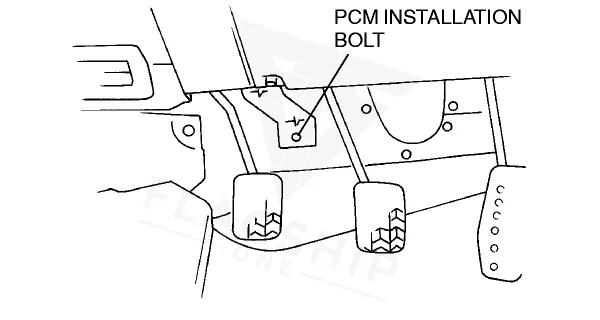
Work with the ignition off, and treat the module as static-sensitive: avoid touching the connector pins at any point.
| Operation | Configuration | Book Time |
|---|---|---|
| Powertrain Control Module R&R | Without Immobilize System | 0.5 hr |
| Powertrain Control Module R&R | With Immobilize System | 0.8 hr |
| Powertrain Control Module Relearn | All configurations | 0.5 hr |
| Engine Control Module R&R | Without Immobilize System | 0.5 hr |
| Engine Control Module R&R | With Immobilize System | 0.8 hr |
| Engine Control Module Relearn | All configurations | 0.5 hr |
After installing a new PCM or ECM in your 2004 Mazda Mazdaspeed MX-5 Miata 1.8L, the factory procedure requires a 0.5-hour relearn process. This step is necessary for the module to adapt to the engine’s idle, fuel trims, and transmission shift points. If your vehicle has the immobilizer system, additional programming may be needed to pair the module with the key transponders. Flagship One provides a VIN-programmed replacement unit that arrives ready to install. Because the module is already programmed with your vehicle’s specific calibration and immobilizer data, the dealer-level programming steps are eliminated. You still need to perform the basic relearn procedure, but the complex VIN and key coding is already complete. This saves time and avoids the need for specialized scan tools.
A failing PCM or ECM in the 2004 Mazda Mazdaspeed MX-5 Miata 1.8L can cause a variety of symptoms. The engine may crank but not start, or it may start and stall shortly after. You might notice rough idling, hesitation during acceleration, or a sudden loss of power. The check engine light may illuminate with codes such as intake runner control stuck open which relates to the variable intake system. Other common issues include intermittent misfires, poor fuel economy, and the inability to communicate with a scan tool. In some cases, the cooling fan may run continuously or the fuel pump may not prime. Because the module controls ignition timing, a failure can also cause backfiring or excessive exhaust smoke. If you experience multiple electrical gremlins that seem unrelated, the PCM/ECM should be considered a suspect.
Two factory service bulletins apply to the 2004 Mazda Mazdaspeed MX-5 Miata 1.8L. Bulletin 07 002/09 addresses a musty or mildew odor from the air conditioning system, which is unrelated to the PCM/ECM but may be encountered during diagnosis. Bulletin 01 055/06 covers 2004–2005 Miata and Mazdaspeed MX-5 models that set a MIL on with code P2004 after starting the engine. This bulletin likely involves reprogramming the PCM or replacing the intake runner control actuator. If your vehicle exhibits this symptom, check with a dealer for the specific repair procedure.
| Bulletin | Subject | What It Addresses |
|---|---|---|
| — | 07 002/09 Multi Model Air Conditioning Musty / Mildew Odor | — |
| — | 01 055/06 2004 2005 Miata, 2004 2005 Mazdaspeed Mx 5 MIL On / P2004 Sets After Starting Engine | — |
Common signs include no-start, stalling, misfires, and trouble codes like P2004. A scan tool that cannot communicate with the module is a strong indicator of failure. However, other issues such as a bad crankshaft sensor can mimic PCM failure, so proper diagnosis is important.
Yes, the module is accessible behind the passenger kick panel. The labor time is 0.5 to 0.8 hours. You will need basic hand tools. After installation, a 0.5-hour relearn procedure is required. If your vehicle has an immobilizer, a pre-programmed unit from Flagship One avoids the need for dealer key coding.
The relearn typically requires a specific driving cycle that includes idling, acceleration, and deceleration to allow the module to adapt fuel trims and idle speed. Some shops use a scan tool to perform the relearn. The exact steps may vary, but it is a standard post-replacement procedure.
A used module may work, but it must be from the same model and engine type. It will likely need to be reprogrammed with your VIN and immobilizer data. Flagship One offers pre-programmed units that are ready to install, saving the hassle of finding a compatible used module and programming it.
This bulletin addresses a MIL on with code P2004 after starting the engine. It applies to 2004–2005 Miata and Mazdaspeed models. The fix may involve reprogramming the PCM or replacing the intake runner control actuator. If you have this code, consult a dealer for the specific repair.
When your 2004 Mazda Mazdaspeed MX-5 Miata 1.8L needs a new PCM or ECM, you have options: repair the existing module, buy a used one, or install a refurbished replacement. A refurbished unit from Flagship One is pre-programmed with your VIN, eliminating the need for dealer programming. This saves time and ensures the module is calibrated for your turbocharged engine.
Flagship One stocks a refurbished, VIN-programmed PCM for the 2004 Mazda Mazdaspeed MX-5 Miata with a lifetime warranty, free shipping and no core charge.
The PCM/ECM in your 2004 Mazda Mazdaspeed MX-5 Miata 1.8L is critical for engine performance and reliability. Recognizing symptoms like no-start, stalling, or code P2004 can help you diagnose a failing module. Replacement is straightforward with book times of 0.5–0.8 hours plus a 0.5-hour relearn. Consider a pre-programmed unit to simplify the repair.