
Last updated on August 25th, 2026 at 12:05 pm
The Engine Control Module (ECM) in your 2001 Toyota Solara manages fuel injection, ignition timing, and emissions systems. Failure may cause erratic engine behavior, poor performance, or a complete no-start condition.
If your 2001 Toyota Solara suddenly refuses to start, stalls unexpectedly, or throws cryptic engine codes, the Engine Control Module (ECM) may be at fault. This small but critical computer oversees nearly every aspect of your engine’s operation, from fuel delivery to spark timing. When it fails, your vehicle may exhibit a range of symptoms, from subtle performance issues to complete immobilization. Understanding the role of the ECM, where it’s located, and what’s involved in replacing it can save you time and frustration. This guide explains the process, labor expectations, and why opting for a pre-programmed replacement unit can streamline the repair. Whether you’re diagnosing an existing problem or preparing for potential future issues, knowing these details helps you make informed decisions about your Solara’s maintenance.
The Engine Control Module in your 2001 Toyota Solara acts as the brain of the engine, continuously monitoring sensors and adjusting fuel injection, ignition timing, and idle speed to optimize performance and emissions. It ensures the engine runs smoothly under varying conditions, from cold starts to highway cruising. Without a properly functioning ECM, your Solara may struggle with poor fuel economy, rough idling, or even fail to start. This module also communicates with the transmission control system to manage shifting, which is why some drivability issues may stem from ECM-related faults. If the module fails, you’ll likely notice symptoms like hesitation, stalling, or warning lights on the dashboard. Replacing it involves installing one of the replacement engine computers for the Solara, which must be programmed to match your vehicle’s specifications for seamless operation.
2001 Toyota Solara
OEM programmed ECM for your 2001 Toyota Solara — plug & play, no dealer visit.
Free shipping · Lifetime warranty
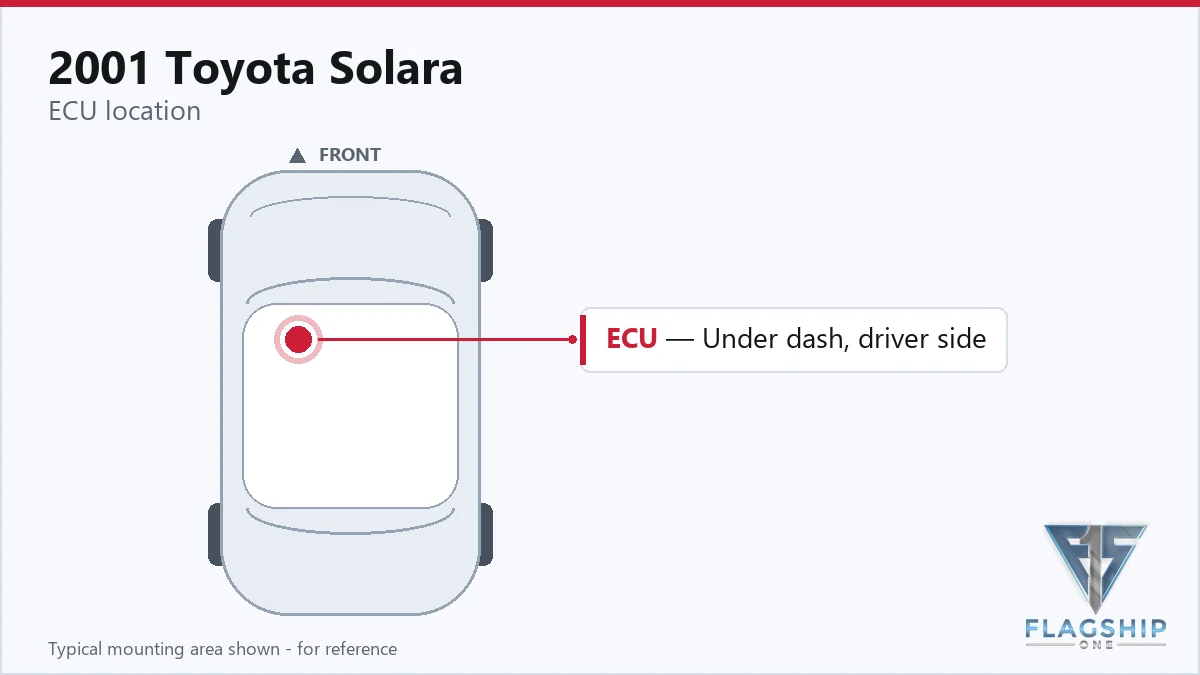
In the 2001 Toyota Solara, the ECM is tucked behind the instrument panel, making access a bit more involved than in some vehicles where the module is mounted near the engine bay. To replace it, a technician typically removes the lower dashboard trim to reach the module’s mounting location. The process involves disconnecting the wiring harness, removing the securing bolts, and carefully extracting the unit. Installation follows the reverse steps: securing the new ECM, reconnecting the harness, and ensuring all connections are tight and free of corrosion. The factory labor guide allocates 0.5 hours for both removal and reinstallation, assuming no complications like seized fasteners or damaged wiring. While the location isn’t the most convenient, the straightforward labor time reflects the relative simplicity of the physical replacement once access is gained.
| Operation | Configuration | Book Time |
|---|---|---|
| Engine Control Module Relearn | All configurations | 0.5 hr |
| Engine Control Module R&R | All configurations | 0.5 hr |
| Powertrain Control Module R&R | All configurations | 0.5 hr |
| Powertrain Control Module Relearn | All configurations | 0.5 hr |
After installing a new ECM in your 2001 Toyota Solara, the factory procedure requires a relearn process to synchronize the module with the engine’s sensors and systems. This step, which typically takes 0.5 hours, ensures the ECM correctly interprets data from components like the crankshaft position sensor and oxygen sensors. Without this relearn, the engine may run poorly or fail to start. However, when you opt for a VIN-programmed replacement unit, these steps are already completed at the factory. The module arrives pre-configured to your Solara’s specifications, so you can skip the relearn procedure and drive the vehicle immediately after installation. This not only saves time but also reduces the risk of errors during the programming process, which can occur if the relearn isn’t performed correctly.
When the ECM in your 2001 Toyota Solara begins to fail, you may notice a range of symptoms that can vary in severity. One of the most common signs is a no-start condition, where the engine cranks but refuses to fire. This often occurs because the ECM isn’t sending the correct signals to the fuel injectors or ignition system. Stalling is another frequent issue, particularly at idle or during low-speed driving, as the module struggles to maintain stable engine operation. Misfires may also appear, sometimes accompanied by a rough idle or hesitation under acceleration. If the ECM loses communication with the vehicle’s sensors, you might see warning lights on the dashboard, such as the check engine light, and your scan tool may fail to retrieve data from the module. In some cases, the transmission may shift erratically or fail to engage gears properly, as the ECM plays a role in managing shift points. A common trouble code associated with ECM failure is an internal control module memory check sum error, which indicates the module’s memory has been corrupted or is malfunctioning.
Diagnosing an ECM failure typically involves checking for trouble codes, testing sensor inputs, and verifying power and ground connections to the module. If the ECM isn’t communicating with a scan tool or if multiple unrelated sensors are reporting faults, the module itself may be the problem. However, issues like a dead battery, corroded wiring, or a faulty crankshaft position sensor can mimic ECM failure, so thorough testing is essential.
Driving with a failing ECM is risky, as the engine may stall unexpectedly or run poorly, potentially leaving you stranded. In some cases, the vehicle may not start at all. If you suspect ECM issues, it’s best to address them promptly to avoid further complications or unsafe driving conditions.
In your Solara, the terms ECM (Engine Control Module) and PCM (Powertrain Control Module) are often used interchangeably, as the vehicle’s engine and transmission functions are managed by a single module. Unlike some vehicles that separate these systems, your Solara’s ECM handles both engine and transmission control, simplifying diagnostics and replacement.
Yes, a used ECM from another vehicle will need to be reprogrammed to match your Solara’s VIN and engine specifications. Without reprogramming, the module may not communicate correctly with your vehicle’s sensors, leading to poor performance or a no-start condition. This process typically requires specialized equipment and should be performed by a professional.
Repeated ECM failures are often caused by underlying electrical issues, such as voltage spikes from a faulty alternator, poor grounding, or corroded wiring. Moisture intrusion, particularly in the connector or module housing, can also lead to short circuits. Addressing these root causes is crucial to preventing future ECM problems.
If your 2001 Toyota Solara is experiencing ECM-related issues, you have a few options for resolution. A repair shop can attempt to diagnose and reprogram the existing module, though this may not always be successful if the unit is internally damaged. Alternatively, replacing the ECM with a new or refurbished unit is a more reliable solution. Opting for a pre-programmed replacement ensures the module is ready to install, saving you time and eliminating the need for post-install programming.
Flagship One stocks a refurbished, VIN-programmed PCM for the 2001 Toyota Solara with a lifetime warranty, free shipping and no core charge. The full Toyota Solara module lineup covers other engine configurations as well.
The ECM in your 2001 Toyota Solara plays a vital role in keeping your engine running smoothly. If you’re dealing with symptoms like stalling, misfires, or a no-start condition, the module may be the culprit. Understanding its location, replacement process, and programming requirements can help you navigate the repair with confidence. Whether you choose to tackle the job yourself or leave it to a professional, addressing ECM issues promptly ensures your Solara remains reliable on the road.