
Last updated on August 25th, 2026 at 12:03 pm
The Engine Control Module (ECM) or Powertrain Control Module (PCM) is the central computer governing fuel delivery, ignition timing, emissions controls, and transmission shifting on your 2004 Toyota Solara with the 2.4L four-cylinder engine. When this module fails, the vehicle may not start, run poorly, or fail emissions testing due to incomplete monitoring of engine and transmission functions.
If your 2004 Toyota Solara with the 2.4L engine is experiencing starting problems, running rough, or failing emissions inspections, the Engine Control Module (ECM) or Powertrain Control Module (PCM) may be the culprit. This comprehensive guide explains what these critical engine computers do, where they are located, how replacement works, and the essential programming steps required by the factory. Understanding these procedures helps you make informed decisions about repair options, whether you pursue dealer service or a quality aftermarket replacement. The information covers module functions specific to this vehicle, common failure symptoms, factory service bulletin requirements, and practical prevention measures to protect your investment. Whether you are a DIY mechanic or seeking to understand what a repair shop will perform, this guide provides the technical details needed for successful resolution of ECM/PCM-related issues on your 2004 Toyota Solara.
The Engine Control Module in your 2004 Toyota Solara functions as the primary electronic brain managing the 2.4L four-cylinder engine’s operation. This sophisticated computer receives input from numerous sensors throughout the engine compartment and uses that data to calculate optimal fuel injection quantity, determine correct ignition timing, control emissions equipment operation, and communicate with the automatic transmission control unit. The PCM integrates these functions, managing both engine and transmission operations as a unified system. When functioning properly, the ECM continuously adjusts air-fuel ratios, monitors catalytic converter efficiency, and ensures smooth transmission shifts. However, when the internal memory becomes corrupted or the processor fails, the entire vehicle operation degrades. Common failure modes include internal processor errors, memory corruption from voltage spikes, and connector pin corrosion. The consequences of ECM failure extend beyond simple inconvenience—the module directly controls emissions systems, so a failed or malfunctioning unit will cause your 2004 Toyota Solara to fail state emissions inspections. Additionally, without proper VIN programming recorded in the module, many state inspection programs will automatically fail the vehicle regardless of actual emissions performance. Replacement engine computers for the 2004 Toyota Solara must be properly matched to the vehicle’s specific configuration to ensure all factory functions operate correctly.
Flagship One keeps Toyota Solara replacement engine computers in stock for exactly this failure pattern.
2004 Toyota Solara
OEM programmed ECM for your 2004 Toyota Solara — plug & play, no dealer visit.
Free shipping · Lifetime warranty
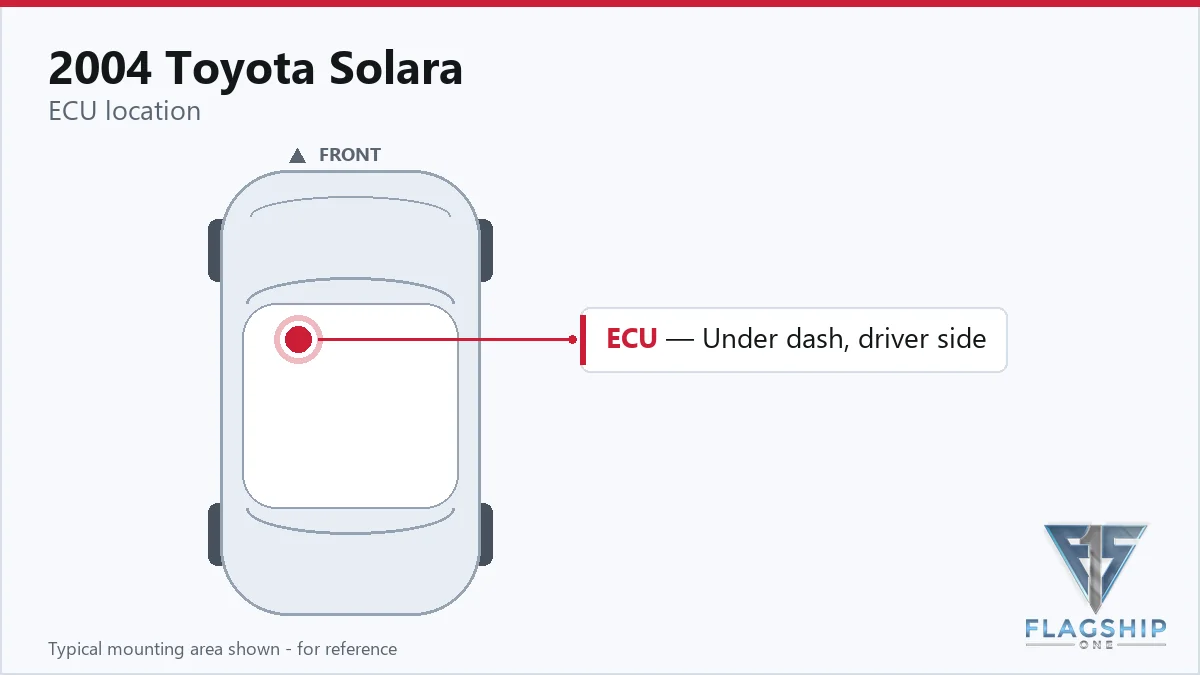
The factory service documentation places the engine ECU for your 2004 Toyota Solara inside the instrument panel, requiring removal of dashboard trim components to access the unit. This location behind the driver’s side dashboard provides protection from engine compartment heat and moisture while maintaining convenient access for service procedures. The replacement process involves disconnecting the battery negative terminal, removing necessary trim pieces, unplugging the existing module, and installing the new unit. According to standard labor guides, the Engine Control Module R&R requires 0.4 book hours, while the subsequent relearn procedure adds 0.5 additional hours. These times reflect the straightforward nature of the physical replacement once access is gained, though the relearn procedure is mandatory to allow the new module to adapt to your specific engine’s characteristics. After installation, the new ECM must initialize sensors and learn idle characteristics, throttle position, and other calibration data specific to your vehicle. Skipping the relearn procedure may result in rough idle, poor throttle response, or transmission shifting complaints until the adaptation process completes.
| Operation | Configuration | Book Time |
|---|---|---|
| Engine Control Module Relearn | All configurations | 0.5 hr |
| Engine Control Module R&R | All configurations | 0.4 hr |
| Powertrain Control Module R&R | All configurations | 0.4 hr |
| Powertrain Control Module Relearn | All configurations | 0.5 hr |
The factory procedure for your 2004 Toyota Solara requires writing the VIN to the replacement ECM after installation using a diagnostic tester. This critical step stores your vehicle’s unique identification in the module’s permanent memory, linking the computer to your specific car. The technician must enter the VIN following the diagnostic tester display prompts, then verify that the written VIN matches your vehicle’s actual identification number. If the numbers do not match exactly, the procedure must be repeated until verification succeeds. This VIN programming requirement exists because vehicles with missing or incorrect VINs in the ECM will fail state and local emissions Inspection and Maintenance programs. The factory caution specifically reminds technicians to enter the VIN on these vehicles, as enforcement of this requirement has increased across multiple states. However, when you purchase a VIN-programmed replacement unit from Flagship One, the unit arrives with your specific VIN already written, eliminating the need for dealer programming software and the associated labor costs. Your replacement arrives ready to install with all factory programming completed, requiring only the standard relearn procedure to complete the installation.
Every VIN-programmed replacement unit from Flagship One arrives with these steps already completed.
When the Engine Control Module on your 2004 Toyota Solara begins to fail, several distinct symptoms typically emerge. The most common complaint is a no-start condition or intermittent starting where the engine cranks normally but fails to fire, often accompanied by a check engine light that may illuminate continuously or only during the fault episode. Engine stalling represents another frequent failure mode, where the vehicle unexpectedly stops running while driving or at idle, particularly when the module’s internal circuits overheat. Misfire codes such as P0300 (random/multiple cylinder misfire) or specific cylinder misfire codes frequently set when the ECM cannot properly control fuel delivery or ignition timing. In some cases, the scan tool cannot communicate with the ECM at all, indicating a complete module failure rather than a sensor or wiring issue. Automatic transmission shifting problems may also manifest, including harsh shifts, failure to shift into gear, or the transmission staying in limp mode. These symptoms occur because the ECM/PCM controls both engine and transmission functions, so internal module failures affect multiple vehicle systems simultaneously. Addressing these symptoms promptly prevents secondary damage and ensures your 2004 Solara remains reliable transportation.
The factory service information received on June 3, 2005 includes updates affecting your 2004 Toyota Solara. This bulletin added 2004 and 2006 model year vehicles to existing procedures, indicating the manufacturer recognized specific programming requirements that needed clarification across multiple model years. Additionally, the Highlander Hybrid was added to step 4 of the VIN Write Procedure, suggesting that the VIN programming process for hybrid vehicles required special handling. While this bulletin primarily addresses procedural updates rather than specific mechanical defects, it demonstrates the importance of proper VIN programming for emissions compliance. The factory caution emphasizes that vehicles with missing VINs in the ECM are subject to failing state and local vehicle emissions Inspection and Maintenance programs, making correct programming essential for vehicle registration in many jurisdictions.
A used ECM may physically fit, but it will likely be locked to the original vehicle’s VIN and cannot be reprogrammed without manufacturer-level software. Additionally, used units carry unknown history and may fail soon after installation. Purchasing a refurbished unit with a warranty provides better reliability than a salvage yard part.
Driving with a failing ECM is not recommended. Depending on the failure mode, your vehicle may stall unexpectedly, fail to start leaving you stranded, or operate in a reduced-power limp mode. Additionally, driving with a malfunctioning ECM will likely cause your vehicle to fail emissions testing, creating registration complications.
Federal regulations require the Vehicle Identification Number to be stored in the engine computer for emissions monitoring purposes. Without the VIN programmed, state inspection systems cannot identify the vehicle, resulting in automatic failure regardless of actual emissions performance. This is a legal requirement, not an arbitrary dealer policy.
The relearn procedure allows the new ECM to calibrate to your specific engine’s characteristics. The module learns idle speed, throttle position sensor readings, fuel trims, and transmission shift points. This process typically takes 0.5 hours using the diagnostic scanner and is necessary for optimal vehicle operation.
Yes, disconnecting the battery negative terminal before ECM replacement is standard procedure. This prevents voltage spikes from damaging the new module during installation and protects sensitive electronics. Wait at least 5 minutes after disconnecting to allow residual capacitance to discharge before handling the old or new ECM.
When your 2004 Toyota Solara requires ECM replacement, you have two primary repair paths. Dealer replacement ensures proper programming but typically costs significantly more due to expensive software and labor charges. Quality refurbished replacements from Flagship One arrive pre-programmed with your specific VIN, eliminating dealer programming fees while maintaining emissions compliance. Both options require the 0.5-hour relearn procedure to complete the installation. Consider your budget, timeline, and warranty preferences when selecting the best approach for your situation.

Flagship One stocks a refurbished, VIN-programmed PCM for the 2004 Toyota Solara with a lifetime warranty, free shipping and no core charge. The full Toyota Solara module lineup covers other engine configurations as well.
The Engine Control Module in your 2004 Toyota Solara is a critical component that manages engine operation, emissions controls, and transmission functions. Understanding its location in the instrument panel, the programming requirements, and the consequences of failure helps you make informed repair decisions. Whether you choose dealer service or a quality refurbished replacement from Flagship One, ensuring proper VIN programming and completing the relearn procedure will restore your vehicle’s reliability and emissions compliance. Address ECM symptoms promptly to avoid being stranded and to maintain your vehicle’s value.