
Last updated on August 25th, 2026 at 12:06 pm
In the 1999 Toyota Solara equipped with the 3.0L V6, the engine control module governs fuel injection, ignition timing, and automatic transmission shift points. Failure of this computer can cause sudden stalling, a no-start condition, or erratic gear changes because the processor loses its ability to execute the calibrated strategies.
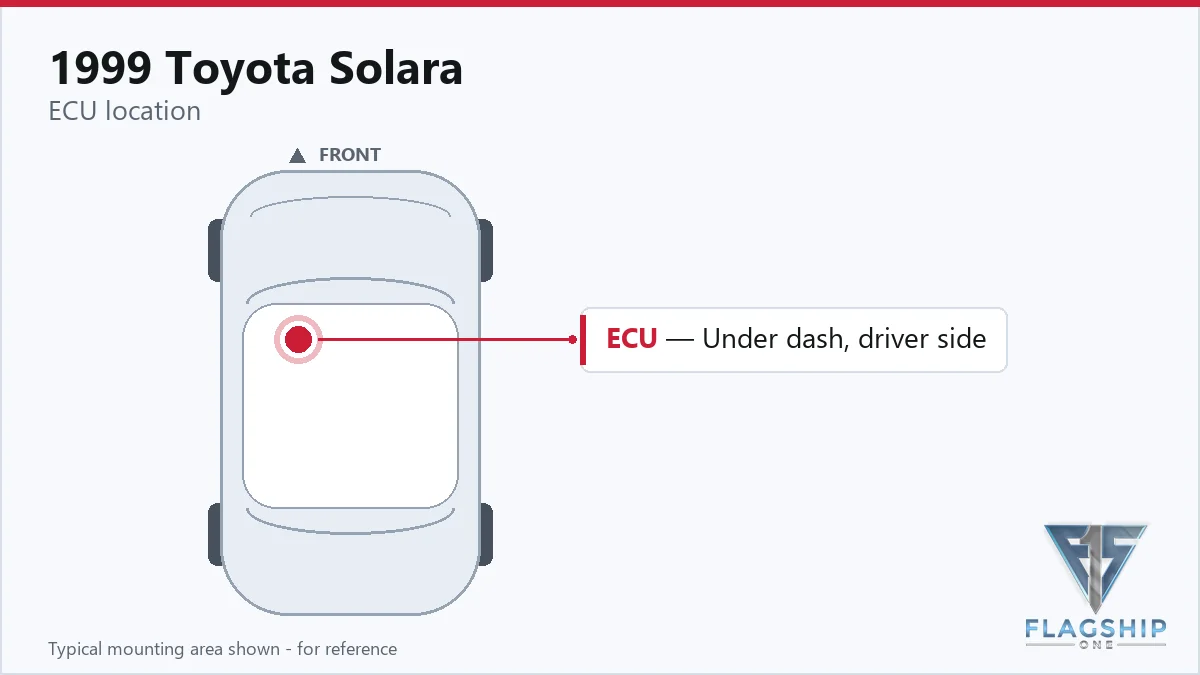
When the check engine light stays on or the 1999 Toyota Solara 3.0L refuses to start, the engine control module often becomes the focus of diagnosis. This computer, sometimes called the powertrain control module on this model, coordinates fuel delivery, spark timing, and transmission shift logic for the V6 engine. A failure can mimic many other problems, so understanding what the module does and how it is serviced helps you avoid unnecessary parts swaps. The following guide explains where the unit lives, what the factory labor times look like, what symptoms typically appear, and what programming steps the dealer performs after a replacement. You will also learn how a pre-programmed replacement can simplify the repair and what maintenance habits protect the module from early failure. Because the module sits behind the instrument panel, reaching it requires removing trim, which contributes to the labor time. The factory manual lists 0.5 hours for removal and 0.5 hours for the relearn, with identical times for a combined powertrain control module. These figures help you assess a shop estimate. The module also coordinates with the transmission controller, so shifting issues may originate here. This article outlines the diagnostic path, replacement steps, and sourcing options.
1999 Toyota Solara 3.0L
OEM programmed ECM for your 1999 Toyota Solara 3.0L — plug & play, no dealer visit.
Free shipping · Lifetime warranty
The engine control module in the 1999 Toyota Solara 3.0L is the central processor that reads sensor inputs such as crankshaft position, throttle angle, and coolant temperature, then calculates injector pulse width and ignition advance for each cylinder. On this model the same housing often contains the powertrain control functions, meaning the unit also determines shift timing for the automatic transmission based on load and speed signals. When the internal processor or its memory fails, the engine may lose all spark and fuel command, resulting in a crank-no-start condition, or it may produce intermittent misfires that set random cylinder codes. Voltage spikes from a weak alternator or improper jump‑starting can damage the delicate circuitry, and corrosion at the connector pins can introduce communication errors that mimic a module failure. Because the module stores adaptive learning values for idle quality and fuel trim, a replacement must either undergo a relearn procedure or arrive with the vehicle identification number already programmed into its memory. Shops that source replacement engine computers for the Solara often find that pre‑programmed units eliminate the need for the dealer scan tool session, saving both time and the risk of an incomplete relearn. Understanding these functions helps you recognize whether a no‑start, stalling, or shifting complaint is likely rooted in the computer rather than a sensor or wiring fault.
The factory wiring guide places the engine control module behind the instrument panel, so access requires removing the lower dash trim and possibly the knee bolster. The labor guide lists 0.5 hours for engine control module removal and installation, and an additional 0.5 hours for the required relearn procedure. If the vehicle is equipped with a combined powertrain control module, the same 0.5‑hour removal time and 0.5‑hour relearn time apply. No torque specifications are published for the mounting fasteners, but the fasteners are typically small screws that should be snugged to avoid vibration damage. When reinstalling, ensure the connector locks seat fully and that the wiring harness is routed clear of moving pedal components. Because the module sits in a relatively protected cabin location, it is less exposed to moisture than under‑hood units, but heat from the heater core can accelerate connector aging over time.
| Operation | Configuration | Book Time |
|---|---|---|
| Engine Control Module Relearn | All configurations | 0.5 hr |
| Engine Control Module R&R | All configurations | 0.5 hr |
| Powertrain Control Module R&R | All configurations | 0.5 hr |
| Powertrain Control Module Relearn | All configurations | 0.5 hr |
After a new engine control module is installed, the factory service procedure requires a relearn sequence that allows the computer to recalibrate idle speed, fuel trim, and transmission shift points. The labor guide allocates 0.5 hours for this relearn on the engine control module and another 0.5 hours if a separate powertrain control module is present. During the relearn, a scan tool commands the module to run its internal self‑tests and to store the current sensor baselines. If the replacement module arrives a VIN-programmed replacement unit the vehicle identification number and the factory calibration are already loaded, so the relearn step can be skipped and the vehicle is ready to drive immediately. This eliminates the need for a dealer‑level scan tool and reduces the chance that an incomplete relearn leaves a rough idle or harsh shift. Technicians should still verify that the module communicates on the data bus and that no pending codes remain after installation.
Common signs that the engine control module in a 1999 Toyota Solara 3.0L may be failing include a sudden no‑start condition where the engine cranks but never fires, intermittent stalling at idle or while driving, and a check engine light that illuminates with misfire codes for multiple cylinders. Because the module also governs the automatic transmission, drivers may notice harsh or delayed shifts, the transmission locking in a single gear, or a complete loss of communication between the scan tool and the vehicle data bus. In some cases the module will still power up but produce erratic sensor readings, causing the fuel trim to swing wildly and the idle to hunt. Voltage spikes from a failing alternator or an improper jump start can accelerate the failure, so these symptoms often appear after electrical system stress. Corrosion at the module connector can mimic the same issues by interrupting the ground or reference voltage circuits. When the scan tool cannot establish a connection with the engine computer, that is a strong indicator the module itself is not responding. A thorough diagnosis should verify power and ground at the connector before condemning the unit, because a wiring fault can produce identical symptoms. Intermittent loss of power steering assist or erratic instrument cluster readings may also accompany a failing module due to shared data lines.
Typical symptoms include a crank‑no‑start condition, intermittent stalling, multiple cylinder misfire codes, harsh or delayed transmission shifts, and a scan tool that cannot communicate with the engine computer. These issues often appear after electrical system stress such as a weak alternator or improper jump start.
The factory wiring guide places the module behind the instrument panel, requiring removal of the lower dash trim and knee bolster for access. The labor guide estimates 0.5 hours for removal and installation.
The factory procedure calls for a 0.5‑hour relearn to recalibrate idle, fuel trim, and shift points. However, a unit that arrives pre‑programmed to the vehicle identification number eliminates this step, allowing immediate operation.
Yes, because the module also contains the powertrain control functions, a failure can result in harsh shifts, gear lockup, or a complete loss of shift control. Diagnosing the module should include verifying communication with the transmission controller.
Maintaining a healthy charging system, keeping ground connections clean, avoiding voltage spikes during jump starts, addressing diagnostic codes quickly, preserving connector seals, and using a quality battery all reduce the risk of module damage.
When the engine control module in your 1999 Toyota Solara 3.0L fails, you can choose between repairing the original unit, which may involve component‑level soldering and no guarantee of longevity, or installing a refurbished replacement that carries a warranty. A pre‑programmed refurbished unit matches the factory calibration and skips the dealer relearn, often making it the more cost‑effective and reliable path for a vehicle of this age.
Flagship One stocks a refurbished, VIN-programmed PCM for the 1999 Toyota Solara with a lifetime warranty, free shipping and no core charge. The full Toyota Solara module lineup covers other engine configurations as well.
Your 1999 Toyota Solara 3.0L depends on a healthy engine control module for smooth starts, stable idle, and proper transmission operation. By recognizing the warning signs early and understanding the replacement process, you can make an informed decision that keeps the vehicle running reliably. If a replacement becomes necessary, a VIN‑programmed unit offers a straightforward solution that avoids additional shop time.