
Last updated on August 25th, 2026 at 12:06 pm
The engine control module (ECM) in the 1999 Toyota Celica 2.2L manages fuel delivery, ignition timing, and emissions. When it fails, the engine may crank without starting, stall unexpectedly, or trigger warning lights, often due to internal circuit degradation or voltage spikes.
When a 1999 Toyota Celica with the 2.2L engine begins to exhibit erratic behavior—hard starts, sudden stalling, or an unresponsive throttle—the engine control module often becomes a prime suspect. This compact computer orchestrates nearly every aspect of engine operation, and its failure can leave you stranded or facing an expensive diagnostic bill. Understanding what the ECM does, where it lives, and what a replacement entails can turn a frustrating situation into a manageable repair. This guide walks you through the module’s role in your Celica, the labor involved in swapping it out, and the programming steps that a factory-fresh unit would demand. You will also learn how a pre-programmed replacement can dramatically simplify the process, getting you back on the road without a trip to the dealership or specialized scan tools. By the end, you will have a clear picture of your options and the confidence to make an informed decision about restoring your Celica’s driveability.
1999 Toyota Celica 2.2L
OEM programmed replacements — plug & play, no dealer visit.
Find yours by year, make & model →
Free shipping · Lifetime warranty
The engine control module in the 1999 Toyota Celica 2.2L is the central processor that governs fuel injection, spark advance, idle speed, and emission controls. It reads data from sensors such as the mass airflow meter, coolant temperature sensor, and oxygen sensors, then adjusts actuator outputs in real time to maintain optimal combustion. Without a functioning ECM, the engine cannot interpret these inputs, leading to poor performance or a complete no-start. The module also monitors itself and the wiring harness for faults, storing diagnostic trouble codes when something goes awry. In this Celica, the ECM is sometimes referred to interchangeably with the powertrain control module, as it handles both engine and certain transmission functions. Over two decades of heat cycles, vibration, and electrical stress, the internal circuit board can develop micro-cracks or component failures. When that happens, many owners turn to replacement ECMs for the 1999 Celica to restore proper function. A quality replacement not only revives engine management but also preserves the factory driving characteristics that make this generation of Celica enjoyable. Because the module is VIN-specific, a used unit from a salvage yard will not simply plug in and work without extensive reprogramming, making a pre-configured solution particularly valuable.
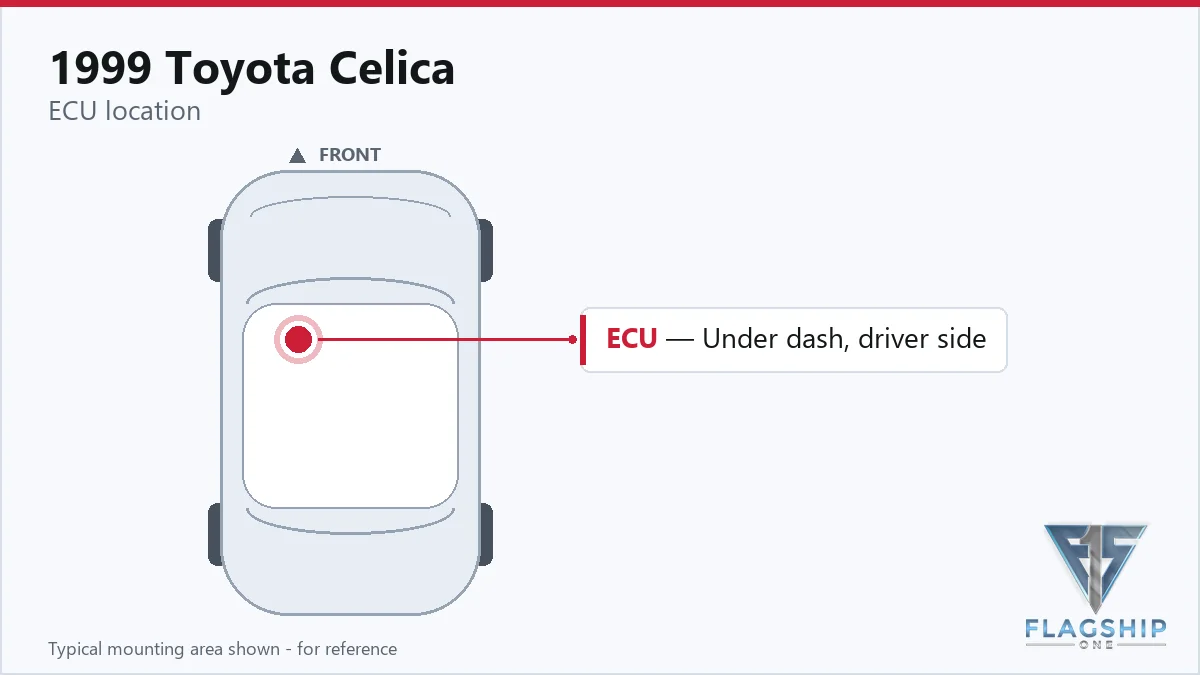
The factory wiring guide places the engine ECU in the instrument panel. This means the module is tucked behind the dashboard, typically near the center stack or behind the glove box area. Accessing it involves removing trim panels, possibly the radio or climate control bezels, and disconnecting several electrical connectors. The book time for removal and replacement of the engine control module is 1.5 hours. If the powertrain control module is being serviced, the same 1.5-hour allowance applies. Once the new module is physically installed, the factory service procedure calls for a relearn process that takes 0.5 hours. This relearn allows the ECM to adapt to the engine’s sensors and actuators, setting baseline idle and fuel trim values. No special torque specifications or additional access steps are noted in the standard labor guide, but working in the instrument panel requires care to avoid damaging plastic clips or wiring. A service manual for the 1999 Celica can provide detailed trim removal sequences to prevent broken tabs.
| Operation | Configuration | Book Time |
|---|---|---|
| Engine Control Module Relearn | All configurations | 0.5 hr |
| Engine Control Module R&R | All configurations | 1.5 hr |
| Powertrain Control Module R&R | All configurations | 1.5 hr |
| Powertrain Control Module Relearn | All configurations | 0.5 hr |
After a replacement engine control module is installed in the 1999 Toyota Celica 2.2L, the factory repair manual specifies a relearn procedure lasting 0.5 hours. This process typically involves starting the engine, allowing it to reach operating temperature, and then holding specific RPM levels so the ECM can calibrate the idle air control and throttle position. Some vehicles may also require a road test to complete adaptive learning. Without this step, the engine may idle roughly or hesitate. However, when you order a VIN-programmed replacement unit from Flagship One, the module arrives with your vehicle’s specific calibration and VIN already loaded. That means the critical programming and initialization are done before the part reaches your doorstep. In most cases, the 0.5-hour relearn is no longer necessary, and the engine will start and run correctly right away. This eliminates the need for a factory scan tool or a visit to a dealership, saving both time and the expense of a separate programming service.
A failing engine control module in the 1999 Toyota Celica 2.2L can produce a range of symptoms that often mimic other problems. The engine may crank strongly but refuse to start, or it may start and then stall after a few seconds. Intermittent stalling while driving is another common sign, especially when the engine is warm. You might notice a lack of power, hesitation on acceleration, or a sudden drop in fuel economy. The check engine light may illuminate, and a scan tool might fail to communicate with the ECM at all—a strong indicator of module failure. Because the ECM also influences transmission shift points in some configurations, harsh or erratic shifting can occur. Misfire codes for multiple cylinders may appear without any actual ignition or fuel system faults, pointing to a module that is sending incorrect signals. In older vehicles like this Celica, cracked solder joints on the circuit board are a frequent culprit, often triggered by heat expansion and contraction over the years. If you experience several of these issues simultaneously and basic checks of the battery, grounds, and sensors come up clean, the ECM should be high on your suspect list.
Common symptoms include a no-start condition, stalling after starting, intermittent engine cut-out while driving, and a check engine light that may not communicate with a scan tool. You may also experience poor fuel economy, misfires, or erratic transmission shifting.
The book time for removal and replacement of the engine control module is 1.5 hours. An additional 0.5 hours is allotted for the relearn procedure if the module is not pre-programmed.
A new or used ECM typically requires VIN programming and a relearn procedure to match your vehicle. However, a VIN-programmed unit from Flagship One arrives ready to install, eliminating the need for dealer-level programming.
The factory wiring guide places the engine ECU in the instrument panel, behind the dashboard. Access usually involves removing trim pieces around the center stack or glove box area.
Driving with a failing ECM is not recommended. The engine may stall unexpectedly, leaving you in a dangerous situation. Continued operation can also cause damage to other components due to incorrect fuel or ignition timing.
For a 1999 Toyota Celica 2.2L, a failing ECM does not have to mean an expensive dealership repair or a lengthy search for a used part. While some electronics repair services can rework a damaged circuit board, a refurbished, VIN-programmed replacement offers a plug-and-play alternative that restores factory performance immediately. This approach eliminates the guesswork of programming and the risk of inheriting someone else’s unresolved issues, making it a practical choice for a vehicle of this age.
Flagship One stocks a refurbished, VIN-programmed PCM for the 1999 Toyota Celica with a lifetime warranty, free shipping and no core charge. The full Toyota Celica module lineup covers other engine configurations as well.
The engine control module is the brain of your 1999 Toyota Celica 2.2L, and when it falters, the entire driving experience suffers. Replacing it with a VIN-programmed unit removes the uncertainty of programming and gets you back on the road quickly. With the right information and a quality replacement, your Celica can continue to deliver the reliable, enjoyable performance it was designed for.