
Last updated on August 25th, 2026 at 12:06 pm
The engine control module in the 1998 Toyota Celica manages fuel delivery, ignition timing, and emissions functions for the 2.2L engine. When this computer fails, it typically causes starting difficulties, erratic idling, or complete engine shutdown, requiring replacement to restore proper vehicle operation.
When the engine control module in your 1998 Toyota Celica begins to malfunction, the ripple effects can disrupt your daily commute and leave you searching for answers. You might notice rough idling, a stubborn check engine light, or even a vehicle that refuses to start altogether. Understanding the role of this critical component is the first step toward getting your car back on the road reliably. The engine computer acts as the brain of your 2.2L engine, constantly adjusting fuel trims and ignition timing to keep everything running smoothly. When this brain loses its ability to process sensor data correctly, the performance of your vehicle suffers significantly. This guide walks you through the specifics of what this module does, where you can find it inside the car, and what it takes to swap it out properly. By learning about the common symptoms of failure and the installation requirements, you gain the confidence to make informed decisions about repairing your 1998 Toyota Celica. Whether you are troubleshooting an elusive misfire or dealing with a complete no-start condition, having accurate, vehicle-specific information helps you approach the repair with clarity and precision, avoiding unnecessary parts swapping.
1998 Toyota Celica
OEM programmed replacements — plug & play, no dealer visit.
Find yours by year, make & model →
Free shipping · Lifetime warranty
The engine control module in the 1998 Toyota Celica serves as the central processing unit for the entire engine management system. It continuously receives input from various sensors scattered throughout the vehicle, including the mass airflow sensor, throttle position sensor, and crankshaft position sensor. Using this data, the computer calculates the precise amount of fuel to inject and determines the exact moment to fire the spark plugs. This constant adjustment ensures your 2.2L engine operates at peak efficiency while minimizing harmful exhaust emissions. Beyond basic fuel and ignition management, the module also oversees the evaporative emission control system and actively monitors the health of the catalytic converter. When this component functions correctly, your Celica delivers smooth, responsive power and achieves optimal fuel economy under varying driving conditions. However, internal circuit board degradation or software corruption can severely compromise these calculations, leading to drivability issues that often mimic mechanical failures. Recognizing the importance of this unit helps you understand why selecting 1998 Toyota Celica engine computers requires careful attention to match the exact calibration required by your specific vehicle. A mismatched unit may fail to communicate with the immobilizer or trigger false fault codes. Because the module controls such a wide array of vital functions, any deviation from its programmed parameters can quickly cascade into broader performance concerns, making timely diagnosis and replacement essential for maintaining the reliability of your 1998 Toyota Celica over the long term.
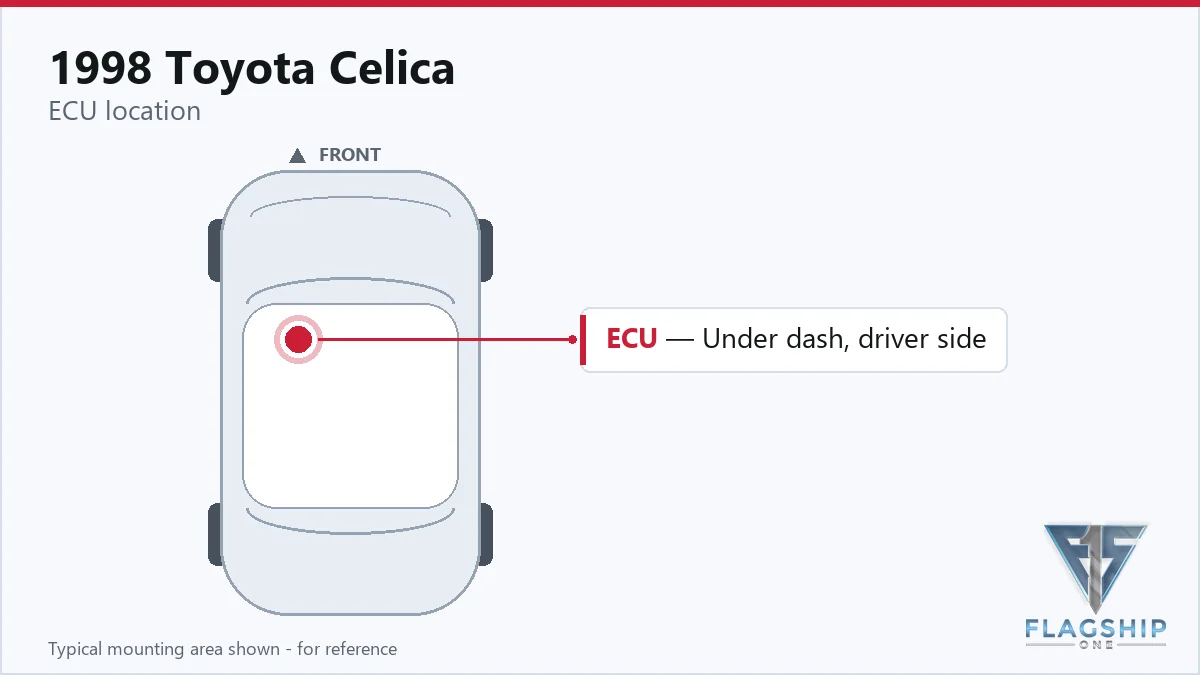
Locating the engine control unit in your 1998 Toyota Celica requires looking inside the passenger compartment. According to the factory wiring guide’s component grid, the engine ECU sits within the instrument panel. Accessing it typically involves removing sections of the dashboard trim and lowering the steering column cover to reach the mounting bracket. Once you disconnect the vehicle battery, you can unplug the large electrical connectors from the module. The labor guide allocates 1.5 hours for the engine control module removal and reinstallation process. This timeframe accounts for the careful disassembly required to reach the unit behind the instrument panel. If you are replacing a powertrain control module, the book time is also 1.5 hours for the R&R procedure. Because the module is tucked away inside the dash, taking care not to stress the wiring harness during removal is crucial. Proper reassembly ensures no rattling panels or loose connectors, keeping the interior of your 1998 Toyota Celica functioning just as the manufacturer intended.
| Operation | Configuration | Book Time |
|---|---|---|
| Engine Control Module Relearn | All configurations | 0.5 hr |
| Engine Control Module R&R | All configurations | 1.5 hr |
| Powertrain Control Module R&R | All configurations | 1.5 hr |
| Powertrain Control Module Relearn | All configurations | 0.5 hr |
After installing a new or used engine computer in the 1998 Toyota Celica, the factory service procedure mandates a relearn process to synchronize the module with the vehicle. The official labor guide allocates 0.5 hours specifically for the engine control module relearn procedure. Similarly, a powertrain control module relearn requires 0.5 hours. During this step, the computer re-establishes its idle parameters and fuel trim baselines, ensuring the engine runs correctly without surging or stalling. Skipping this step often leads to poor idle quality and potential drivability issues. Choosing a VIN-programmed replacement unit from Flagship One eliminates the need for these extensive post-installation programming steps at a local dealership. Because the necessary vehicle identification number data and immobilizer information are already flashed into the unit before it ships, you avoid the 0.5-hour relearn labor entirely. You simply install the computer, connect the battery, and start the engine, allowing the pre-loaded calibration to take over immediately and restore normal operation.
When the engine control module in the 1998 Toyota Celica begins to fail, the symptoms often appear gradually before escalating into severe drivability problems. One of the most common indicators is a persistent no-start condition, where the engine cranks vigorously but refuses to fire due to a lack of fuel injector pulse or spark command from the computer. You may also experience random stalling while idling at a traffic light or cruising at steady highway speeds, which creates a significant safety hazard for you and other drivers. Misfire codes frequently accompany these stalling events, as the failing computer struggles to coordinate the ignition timing properly across all cylinders. In some cases, the check engine light may illuminate on the dash, but when you connect a diagnostic scanner to the data link connector, you encounter dead scan-tool communication, preventing you from retrieving the stored fault codes entirely. This communication failure strongly points to an internal processor malfunction within the module itself rather than a simple sensor issue. Drivers of the 1998 Toyota Celica might also notice harsh or erratic automatic transmission shifting, as the powertrain control unit also governs the shift solenoids for the automatic transmission. If the unit suffers from internal voltage regulator failures or corrupted memory, the engine may enter a restrictive limp mode, severely limiting engine RPMs and vehicle speed. Recognizing these diverse patterns early helps differentiate between a failing sensor and a defective engine computer.
The factory wiring guide places the engine ECU inside the instrument panel. You typically need to remove dashboard trim pieces to access the module for replacement.
The standard labor guide allocates 1.5 hours for the removal and installation of the engine control module. This accounts for the disassembly of the instrument panel area to reach the unit.
Yes, the factory procedure requires a relearn process after installation, which typically takes 0.5 hours. This step allows the new module to synchronize its idle and fuel parameters with the vehicle.
Yes, the powertrain control module also manages the automatic transmission shift solenoids. An internal failure in the computer may result in harsh, erratic, or delayed shifting patterns.
Common symptoms include a no-start condition, random stalling, misfire codes, and dead scan-tool communication. These issues occur when the processor can no longer manage fuel or ignition timing properly.
Deciding between repairing or replacing the engine computer in your 1998 Toyota Celica depends on the severity of the internal damage. While some specialized shops offer repair services for burnt circuit boards, a refurbished replacement unit often provides a more reliable long-term solution with a warranty. Choosing a pre-programmed option tailored to the 2.2L engine ensures you get back on the road quickly without the hassle of additional dealership programming.
Flagship One stocks a refurbished, VIN-programmed PCM for the 1998 Toyota Celica with a lifetime warranty, free shipping and no core charge. The full Toyota Celica module lineup covers other engine configurations as well.
Addressing engine computer issues in your 1998 Toyota Celica promptly prevents minor drivability annoyances from becoming major safety concerns. Understanding the module location behind the instrument panel, the expected replacement labor times, and the relearn requirements gives you the knowledge to navigate the repair process confidently. When you are ready to restore your vehicle’s performance and eliminate those frustrating stalling or no-start conditions, explore quality replacement options designed specifically for your exact model to ensure proper fitment.