
Last updated on August 25th, 2026 at 12:06 pm
The engine control module in the 1999 Toyota Avalon manages fuel delivery, ignition timing, and emissions functions for the 3.0L V6. When this unit fails, drivers often experience stalling, no-start conditions, or illuminated warning lamps. A faulty module may also prevent diagnostic scan-tool communication.
When your 1999 Toyota Avalon begins exhibiting drivability problems that point toward the engine computer, understanding what that module does and how replacement works can save time and frustration. The Avalon’s 3.0L V6 relies on a central control unit to coordinate fuel injection, ignition timing, and emissions monitoring. If that unit fails, the symptoms can range from intermittent stalling to a complete no-start condition, often leaving drivers unsure whether the problem lies in the computer or elsewhere in the powertrain. This guide walks through the role of the engine control module in your specific Avalon, where it is physically located, and what the factory labor times look like for removal and reinstallation. You will also learn what happens after a new unit is installed and why a pre-programmed replacement may eliminate several steps from the process. Whether you are diagnosing a stubborn check-engine light or planning a module swap, having the right information helps you make confident repair decisions and avoid unnecessary parts replacement. The goal is to give you a clear, practical understanding of how this component fits into your vehicle’s overall operation.
1999 Toyota Avalon 3.0L
OEM programmed ECM for your 1999 Toyota Avalon 3.0L — plug & play, no dealer visit.
Free shipping · Lifetime warranty
The engine control module in the 1999 Toyota Avalon serves as the central processor that manages the 3.0L V6 engine’s operating parameters. It continuously reads input from sensors monitoring airflow, coolant temperature, throttle position, oxygen content in the exhaust, and crankshaft position. Using that data, the module calculates optimal fuel injector pulse width, ignition advance, and idle speed to keep the engine running efficiently across different loads and conditions. In this particular Avalon, the module also oversees evaporative emissions control and communicates with the transmission control system to coordinate shift behavior. Because the 3.0L V6 uses sequential multi-port fuel injection, the computer must time each injector pulse precisely to its corresponding cylinder’s intake stroke. A malfunction in the module can disrupt that timing, leading to rough running, reduced fuel economy, or elevated tailpipe emissions. The module stores adaptive fuel trims and idle-air learning values, which allow it to compensate for normal wear in components like oxygen sensors and throttle bodies over time. When the unit loses those learned values or its internal memory becomes corrupted, the engine may idle poorly or stall until a relearn procedure restores proper calibration. For owners facing these issues, sourcing replacement engine computers for the Avalon that arrive already configured for your specific VIN can simplify the repair significantly. The module also runs continuous self-diagnostic checks, storing trouble codes when it detects out-of-range signals from sensors or actuators. Those codes help technicians pinpoint whether the computer itself has failed or whether an external component is sending erroneous data.
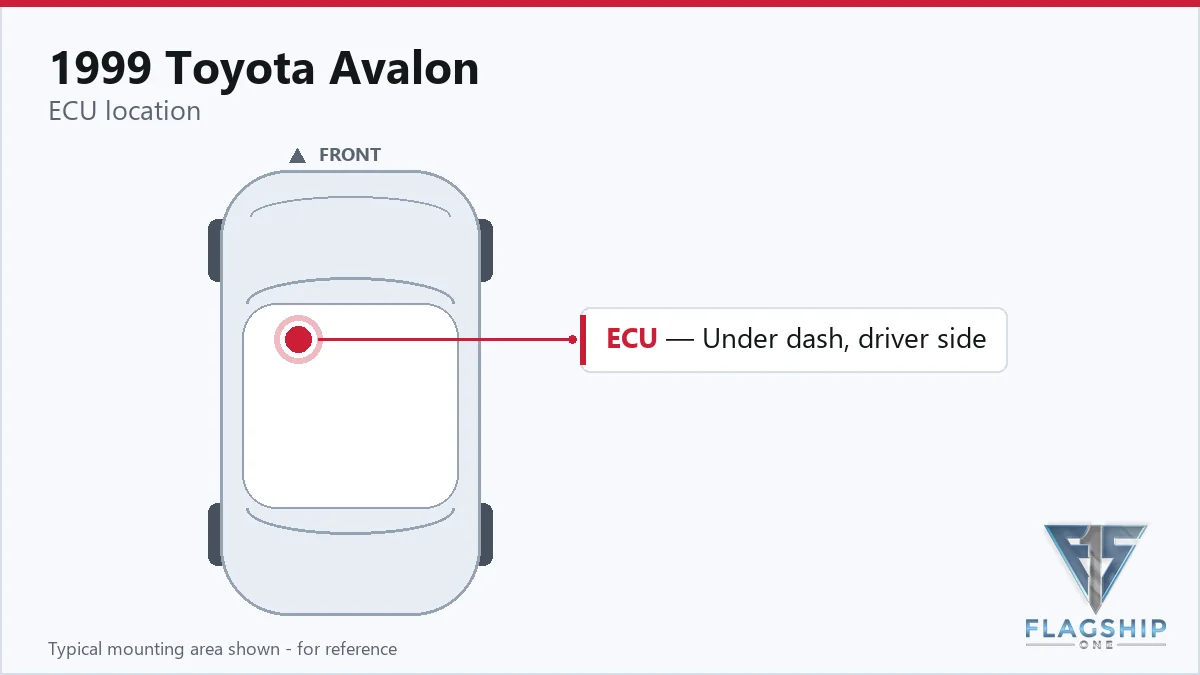
According to the factory wiring guide’s component grid for the 1999 Toyota Avalon, the engine ECU is located within the instrument panel area. Accessing it typically involves working behind or beneath the dashboard on the driver’s side, where the module is mounted to a bracket or support structure. The exact access path may require removing trim panels or lower dash covers to expose the unit. The published labor time for engine control module removal and installation is 0.8 hours. The same book time applies to powertrain control module removal and installation. After the physical swap is complete, a factory relearn procedure is listed at 0.5 hours for both the ECM and PCM. This relearn step allows the replacement unit to calibrate idle parameters and fuel trims to your specific engine. Because the module sits inside the cabin rather than underhood, it is somewhat shielded from heat and moisture, though connector corrosion can still develop over years of service.
| Operation | Configuration | Book Time |
|---|---|---|
| Engine Control Module Relearn | All configurations | 0.5 hr |
| Engine Control Module R&R | All configurations | 0.8 hr |
| Powertrain Control Module R&R | All configurations | 0.8 hr |
| Powertrain Control Module Relearn | All configurations | 0.5 hr |
After the engine control module is physically installed in the 1999 Toyota Avalon, the factory procedure calls for a relearn process that takes approximately 0.5 hours. This step allows the replacement unit to establish baseline idle parameters, fuel trim values, and throttle position learning specific to your 3.0L V6. Without completing this calibration, the engine may idle erratically, stall at stops, or set codes related to idle air control and fuel adaptation. The relearn typically requires a compatible scan tool to initiate the procedure and clear any residual adaptive data. Some shops perform this by following a specific key-cycle and idle sequence outlined in the factory service manual. When you choose a VIN-programmed replacement unit from Flagship One, the critical programming and calibration data for your vehicle’s identification number is already loaded onto the module before it ships. This means the relearn and initialization steps that the factory manual describes are already completed, allowing your vehicle to start and run properly once the unit is plugged in and connected.
When the engine control module in the 1999 Toyota Avalon begins to fail, several drivability symptoms may appear, often progressively worsening over time. One of the most common signs is a no-start condition where the engine cranks but does not fire, or fires briefly and stalls immediately. This can occur when the module stops delivering proper fuel injector or ignition coil commands. Intermittent stalling is another frequent complaint, particularly at idle or when coming to a stop. The engine may run fine for a period and then suddenly cut out without warning. Rough idle, hesitation during acceleration, and misfire codes can also surface when the module’s internal processing becomes unreliable or when it loses stored adaptive fuel trims. In some cases, the check-engine lamp illuminates and the vehicle enters a reduced-power or limp-home mode, limiting throttle response and transmission behavior. Diagnostic scan tools may fail to communicate with the module entirely, which is a strong indicator that the computer itself has lost internal power or ground continuity. Shifting irregularities can also appear if the module’s communication with the transmission control system is disrupted. Additional warning signs include unexplained fuel consumption increases, failed emissions inspections due to incomplete readiness monitors, and intermittent electrical symptoms that do not match any single sensor failure pattern. Because these symptoms can overlap with failures in sensors, wiring, or fuel system components, a thorough diagnostic evaluation is important before concluding the module itself has failed.
The published labor time for removing and installing the module is 0.8 hours. An additional 0.5 hours is listed for the factory relearn procedure. Actual repair times may vary depending on shop conditions and access to diagnostic equipment.
The factory wiring guide’s component grid places the engine ECU within the instrument panel area. Access typically involves working behind the driver’s side dashboard, which may require removing trim panels or lower covers to reach the module.
The factory procedure calls for a relearn process after replacement to calibrate idle and fuel trim values. Flagship One units arrive already VIN-programmed, which means those calibration steps are completed before the part ships to you.
Common signs include no-start conditions, intermittent stalling, rough idle, misfire codes, and loss of scan-tool communication. Because these symptoms overlap with sensor and wiring failures, professional diagnosis is recommended before replacing the module.
Voltage spikes from a failing alternator or improper jump-starting can stress the module’s internal circuitry. Maintaining a healthy charging system and clean ground connections helps protect the computer from electrical damage over time.
If your 1999 Toyota Avalon’s engine computer has been professionally diagnosed as faulty, you generally have two paths: a factory relearn procedure with a new or used module, or a pre-programmed replacement unit. Flagship One offers VIN-programmed options for the Avalon’s 3.0L V6 that arrive ready for installation, eliminating the relearn step and getting your vehicle back on the road with less downtime.
Flagship One stocks a refurbished, VIN-programmed PCM for the 1999 Toyota Avalon with a lifetime warranty, free shipping and no core charge. The full Toyota Avalon module lineup covers other engine configurations as well.
The engine control module in your 1999 Toyota Avalon plays a central role in managing the 3.0L V6’s fuel, ignition, and emissions systems. Understanding its location, replacement labor times, and post-install requirements helps you make informed repair decisions. If diagnosis confirms module failure, a VIN-programmed replacement from Flagship One can simplify the process and reduce time spent in the shop.