
Last updated on August 25th, 2026 at 12:07 pm
The engine control module in the 1996 Toyota Tacoma manages fuel delivery and ignition timing. When this computer fails, your vehicle may experience rough idling, stalling, or a complete no-start condition, requiring replacement to restore engine function.
When your 1996 Toyota Tacoma begins to exhibit drivability issues or fails to start altogether, the engine control module often becomes a primary suspect. This critical computer serves as the central brain of your vehicle, dictating essential engine functions. Understanding how this module operates, where it is situated inside the truck, and what signs indicate a fault can save you significant time during the diagnosis process. You will gain clarity on what replacement entails, from the physical location within the dashboard to the necessary programming steps required by the factory. By learning about common failure symptoms and relevant service bulletins, you can approach the repair process with confidence, ensuring your vehicle receives the correct fix to restore performance.
1996 Toyota Tacoma
OEM programmed ECM for your 1996 Toyota Tacoma — plug & play, no dealer visit.
Free shipping · Lifetime warranty
In the 1996 Toyota Tacoma, the engine control module monitors an array of sensors to precisely adjust fuel injection and ignition timing. It processes inputs regarding airflow, coolant temperature, and oxygen content to maintain optimal combustion and efficiency. When this unit functions correctly, your truck runs smoothly and meets emissions standards. However, internal circuitry can degrade over time, leading to erratic engine behavior or complete shutdown. Replacing a faulty unit with 1996 Toyota Tacoma replacement engine computers ensures your vehicle regains its intended drivability and fuel economy. Because the module controls vital functions, a malfunction often leaves you stranded or causes poor performance that worsens over time. Addressing the issue promptly prevents secondary damage to components like the catalytic converter, which may suffer from improper fuel mixture caused by a failing computer.
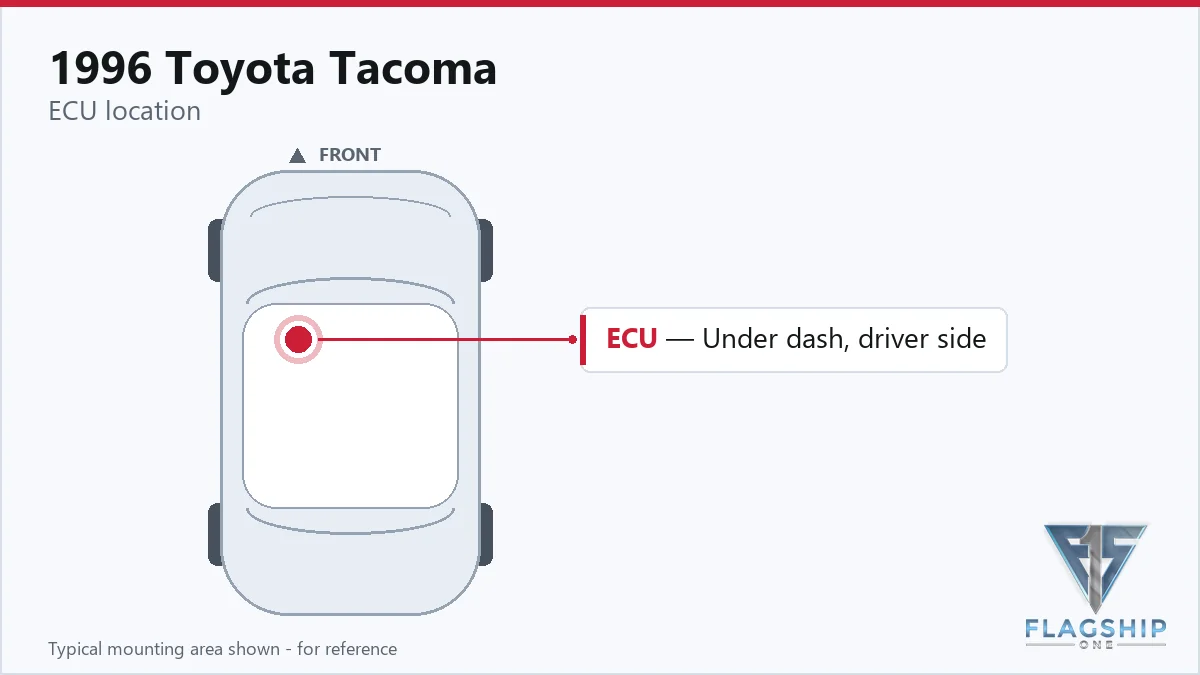
According to the factory wiring guide, the engine control unit in the 1996 Toyota Tacoma is situated within the instrument panel. Accessing it requires careful removal of dashboard trim panels to reach the mounting bracket. Once you locate the unit, disconnect the battery, unbolt the module, and detach the multiple wiring harnesses. Installation of the new computer reverses these steps. The standard book time for powertrain control module removal and installation is listed as 0.7 hours. This time frame accounts for the physical swap of the component itself. Taking your time with the plastic trim pieces prevents breaking the delicate retaining clips. Ensure all electrical connections are fully seated before reassembling the instrument panel, as a loose connector can mimic module failure and cause unnecessary troubleshooting.
| Operation | Configuration | Book Time |
|---|---|---|
| Powertrain Control Module R&R | All configurations | 0.7 hr |
| Powertrain Control Module Relearn | All configurations | 0.5 hr |
| Engine Control Module Relearn | All configurations | 0.5 hr |
| Engine Control Module R&R | All configurations | 0.7 hr |
After installing a new engine control module in your 1996 Toyota Tacoma, the factory procedure typically requires a relearn process to sync the computer with the vehicle. The specified book time for this powertrain control module relearn is 0.5 hours, and the engine control module relearn is also 0.5 hours. This step ensures the idle parameters and fuel trims reset to baseline. Choosing a VIN-programmed replacement unit from Flagship One eliminates the need for these dealership programming steps. Because the necessary programming is already completed based on your vehicle identification number, you simply install the module and start the engine. This convenience saves time and avoids the expense of towing your truck to a service center for flashing.
A failing engine control module in the 1996 Toyota Tacoma often presents distinct drivability symptoms. You may notice the engine stalling unexpectedly at idle or experiencing rough running conditions. A no-start situation is also common when the computer loses its ability to command the fuel injectors or ignition coils. Some drivers encounter misfire codes or dead communication when connecting a scan tool to the diagnostic port. Transmission shifting irregularities can also occur if the unit controls shift solenoids. These issues typically appear intermittently before becoming constant. Diagnosing these symptoms requires ruling out sensor or wiring faults first, as similar signs arise from failed crankshaft position sensors or vacuum leaks. If multiple unrelated codes appear simultaneously or the scanner fails to link, the computer itself is likely at fault.
Toyota issued technical service bulletins regarding idle speed concerns for these trucks. Bulletin EG001-98 addresses idle speed vibration on 1995 through 1997 Tacoma models equipped with the 2RZ-FE engine. Similarly, bulletin EG003-99 covers idle speed issues on 1995 through 1997 Tacoma models with the 3RZ-FE engine. These bulletins indicate that the manufacturer recognized specific idle instability conditions related to the engine control module. If your 1996 Toyota Tacoma experiences such vibration or inconsistent idle, these documents provide the official diagnostic path and potential software remedies to resolve the annoyance.
| Bulletin | Subject | What It Addresses |
|---|---|---|
| EG001-98 | :EG001-98:95-97 Tacoma 2RZ-FE ECM Idle Speed Vibration | — |
| EG003-99 | :EG003-99:95-97 Tacoma 3RZ-FE ECM Idle Speed | — |
The factory wiring guide places the engine ECU inside the instrument panel. You typically need to remove dashboard trim pieces to access the unit for testing or replacement.
The standard book time for engine control module removal and installation is 0.7 hours. An additional 0.5 hours is typically required for the relearn procedure if the unit is not pre-programmed.
Yes, bulletin EG001-98 covers idle speed vibration for the 2RZ-FE engine, and bulletin EG003-99 addresses idle speed for the 3RZ-FE engine. These documents relate to 1995 through 1997 models and outline specific idle concerns.
Choosing between repairing a faulty computer or purchasing a refurbished replacement for your 1996 Toyota Tacoma depends on the severity of the internal damage. While local shops may offer rebuild services, a pre-programmed replacement often provides a faster and more reliable resolution. Selecting a unit configured for your specific truck ensures immediate compatibility and gets your vehicle back on the road without unnecessary delays.
Flagship One stocks a refurbished, VIN-programmed PCM for the 1996 Toyota Tacoma with a lifetime warranty, free shipping and no core charge. The full Toyota Tacoma module lineup covers other engine configurations as well.
Addressing engine computer issues in your 1996 Toyota Tacoma promptly prevents further drivability frustrations and potential secondary damage. Understanding the module location, necessary relearn times, and related service bulletins empowers you to make informed repair decisions. When you are ready to restore your truck, explore Flagship One for reliable replacement options tailored to your specific vehicle, ensuring a smooth and highly efficient fix.