
Last updated on August 25th, 2026 at 12:25 pm
The engine control module (ECM) in your 1995 Toyota Tacoma manages fuel injection, ignition timing, and idle speed. Failure may cause stalling, poor acceleration, or a no-start condition.
If your 1995 Toyota Tacoma is running rough, stalling, or refusing to start, the engine control module (ECM) may be the culprit. This small but critical computer oversees fuel delivery, ignition timing, and idle stability. Replacing it isn’t just about swapping parts—it involves precise location access and a factory-required relearn process. Understanding these steps helps you gauge repair costs and avoid unnecessary delays. Whether you’re diagnosing symptoms or preparing for a replacement, knowing what to expect ensures a smoother repair experience.
In your 1995 Toyota Tacoma, the engine control module (ECM) acts as the brain for the 2.4L engine, adjusting fuel injection and ignition timing in real time. Without it, the engine may run erratically or fail to start. Over time, heat and vibration can degrade internal components, leading to performance issues. If replacement becomes necessary, replacement engine computers for the Tacoma are designed to restore factory operation, though proper installation and programming are essential for reliable performance.
1995 Toyota Tacoma
OEM programmed ECM for your 1995 Toyota Tacoma — plug & play, no dealer visit.
Free shipping · Lifetime warranty
The ECM in your 1995 Toyota Tacoma is located behind the instrument panel, requiring dashboard disassembly for access. Factory labor time for removal and replacement is 0.7 hours. After installation, a relearn procedure of 0.5 hours is typically required to synchronize the module with the engine’s sensors. While the process isn’t overly complex, it demands attention to wiring connections and proper reassembly to avoid electrical issues.
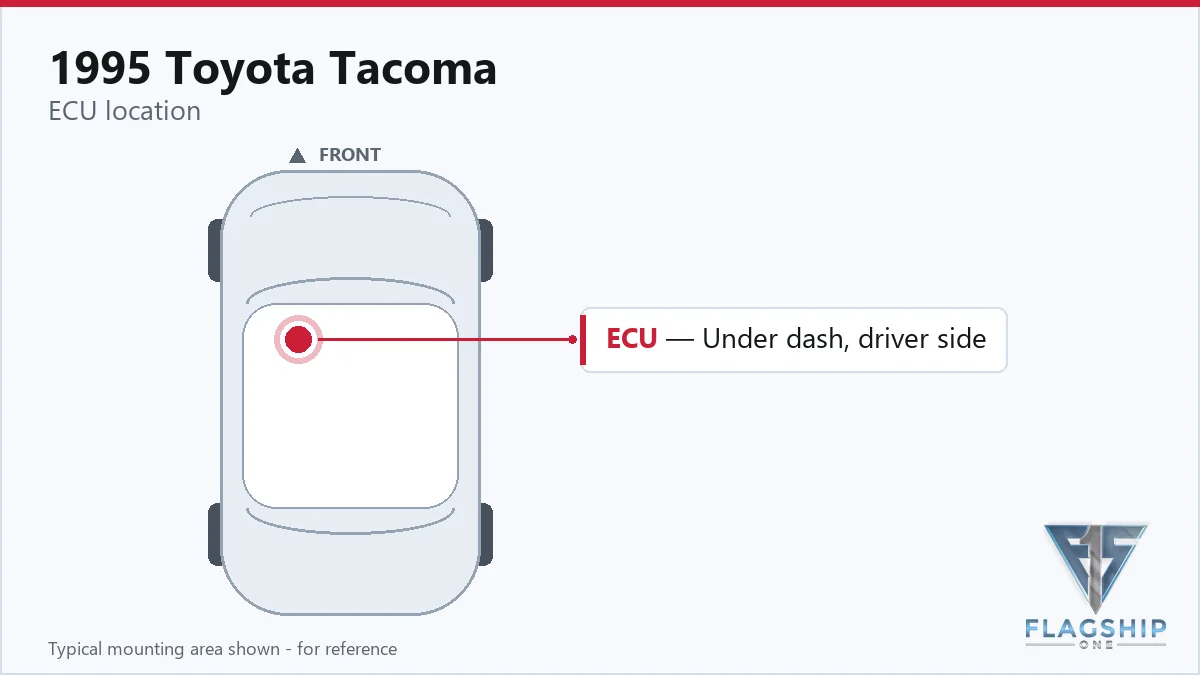
Work with the ignition off, and treat the module as static-sensitive: avoid touching the connector pins at any point.
| Operation | Configuration | Book Time |
|---|---|---|
| Engine Control Module Relearn | All configurations | 0.5 hr |
| Engine Control Module R&R | All configurations | 0.7 hr |
| Powertrain Control Module R&R | All configurations | 0.7 hr |
| Powertrain Control Module Relearn | All configurations | 0.5 hr |
After replacing the ECM in your 1995 Tacoma, Toyota’s factory procedure requires a 0.5-hour relearn process to ensure proper communication with the engine’s sensors. However, a VIN-programmed replacement unit arrives pre-configured, eliminating the need for this step. This saves time and reduces the risk of incomplete initialization, allowing your vehicle to return to normal operation more quickly.
A failing ECM in your 1995 Toyota Tacoma may cause a range of issues, including intermittent stalling, rough idle, or a complete no-start condition. You might also notice poor acceleration or erratic shifting if the module isn’t communicating properly with the transmission. In some cases, the engine may crank but fail to start due to incorrect fuel or spark delivery. If the module’s internal memory is corrupted, it could trigger a module memory fault, signaling the need for replacement.
Toyota issued two service bulletins addressing idle speed concerns in 1995-1997 Tacoma models. TSB #EG001-98 covers idle vibration issues in the 2.4L (2RZ-FE) engine, while TSB #EG003-99 focuses on idle speed irregularities in the 3.0L (3RZ-FE) variant. Both bulletins provide factory-recommended diagnostic steps and potential ECM-related solutions for persistent idle problems.
| Bulletin | Subject | What It Addresses |
|---|---|---|
| EG001-98 | :EG001-98:95-97 Tacoma 2RZ-FE ECM Idle Speed Vibration | — |
| EG003-99 | :EG003-99:95-97 Tacoma 3RZ-FE ECM Idle Speed | — |
While the ECM is accessible behind the instrument panel, replacement requires careful handling of wiring connections and may involve dashboard disassembly. If you’re comfortable with basic electrical work, it’s manageable, but professional installation ensures proper reassembly and avoids potential issues.
A newly installed ECM may need a relearn procedure to synchronize with the engine’s sensors. Without this step, the engine might run poorly or stall. Using a pre-programmed unit eliminates this requirement, allowing immediate operation.
Common signs include rough idle, stalling, or a no-start condition. The engine may also hesitate during acceleration or trigger a check-engine light. If these symptoms persist after checking sensors and wiring, the ECM may be the cause.
If your 1995 Toyota Tacoma is experiencing ECM-related issues, you have options. A repair shop can diagnose and replace the module, though labor costs add up. Alternatively, a pre-programmed replacement unit ensures a quicker, more straightforward installation, allowing you to get back on the road with minimal downtime.
Flagship One stocks a refurbished, VIN-programmed PCM for the 1995 Toyota Tacoma with a lifetime warranty, free shipping and no core charge. The full Toyota Tacoma module lineup covers other engine configurations as well.
The ECM in your 1995 Toyota Tacoma plays a vital role in engine performance. If symptoms point to a failing module, replacement is often the most reliable solution. With the right unit and proper installation, you can restore smooth operation and avoid recurring issues. Consider your options carefully to ensure a lasting fix.