
Last updated on August 25th, 2026 at 12:30 pm
The Powertrain Control Module (PCM) in your 1995 Pontiac Trans Sport manages engine and transmission functions. Failures may cause stalling, poor performance, or a no-start condition, often tied to internal memory or sensor communication issues.
If your 1995 Pontiac Trans Sport is stalling, refusing to start, or shifting unpredictably, the Powertrain Control Module (PCM) may be the culprit. This small but critical computer oversees engine and transmission functions, and when it fails, symptoms can range from subtle drivability issues to complete immobilization. Replacing it isn’t just about swapping a part—it involves careful access, proper installation, and a factory-required relearn procedure. Understanding the process helps you avoid unnecessary delays and ensures your vehicle runs as intended after the repair.
In your 1995 Pontiac Trans Sport, the PCM acts as the brain for both the engine and transmission. It processes data from sensors to optimize fuel delivery, ignition timing, and shift points, ensuring smooth operation. A failure here can disrupt these functions, leading to poor performance or even a no-start condition. When replacement becomes necessary, you’ll need replacement PCMs for the Trans Sport, which must match the vehicle’s original calibration to avoid drivability issues. The module also houses the PROM, a chip containing vehicle-specific details like weight, axle ratio, and transmission type, which must be accounted for during installation.
1995 Pontiac Trans Sport
OEM programmed ECM for your 1995 Pontiac Trans Sport — plug & play, no dealer visit.
Free shipping · Lifetime warranty
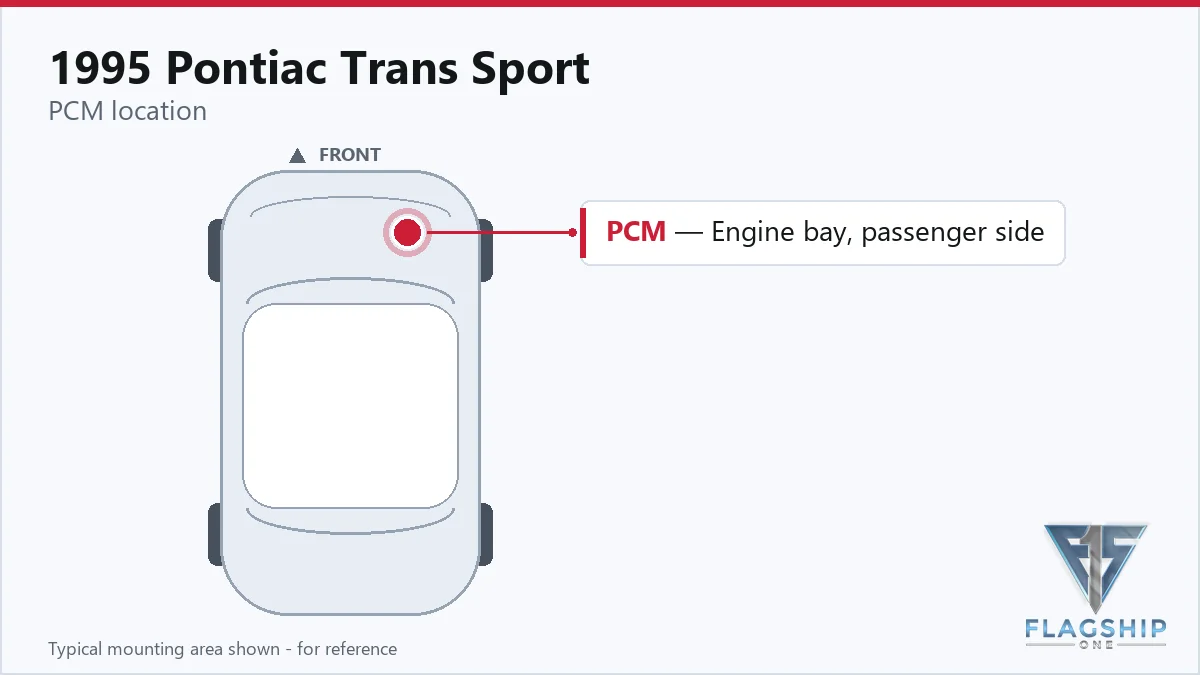
The PCM in your 1995 Pontiac Trans Sport is tucked behind the convenience center on the right side of the dashboard. Accessing it requires removing interior panels, which adds to the labor time. According to factory estimates, replacing the PCM takes 1.3 hours, while the Engine Control Module (ECM) swap is slightly quicker at 1.4 hours. After installation, the module must be secured properly to avoid vibration or moisture exposure, though no specific torque values are provided for this vehicle. The location makes the job straightforward but not trivial, as dashboard disassembly is required.
Work with the ignition off, and treat the module as static-sensitive: avoid touching the connector pins at any point.
| Operation | Configuration | Book Time |
|---|---|---|
| Engine Control Module R&R | All configurations | 1.4 hr |
| Engine Control Module Relearn | All configurations | 0.5 hr |
| Powertrain Control Module Relearn | All configurations | 0.5 hr |
| Powertrain Control Module R&R | All configurations | 1.3 hr |
After installing a new PCM in your 1995 Pontiac Trans Sport, the factory procedure requires a 0.5-hour relearn process to synchronize the module with the vehicle’s systems. This step ensures proper communication with sensors and actuators. However, if you opt for a VIN-programmed replacement unit, this relearn is already completed, saving you time and potential headaches. The pre-programmed module arrives ready to install, eliminating the need for additional programming steps and reducing the risk of post-installation issues.
A failing PCM in your 1995 Pontiac Trans Sport may cause a range of symptoms. Common signs include intermittent stalling, rough idling, or a no-start condition, often due to disrupted sensor communication. You might also notice erratic shifting, as the module controls transmission functions. In some cases, the vehicle may exhibit poor fuel economy or hesitation under acceleration. If the module’s internal memory is corrupted, you could experience an internal control module memory check fault, though scan tool communication may be limited on this pre-OBD-II system. Addressing these symptoms promptly can prevent further drivability issues.
Replacing the PCM is possible if you’re comfortable with dashboard disassembly and electrical work. However, the factory requires a relearn procedure afterward, which may require specialized tools. A pre-programmed unit simplifies the process by eliminating this step.
Stalling after a PCM replacement often indicates the relearn procedure wasn’t completed. The module needs to synchronize with the vehicle’s sensors and actuators. Using a pre-programmed unit avoids this issue, as it arrives ready to install.
Common signs include stalling, no-start conditions, erratic shifting, or poor performance. Since this vehicle lacks OBD-II, a scan tool may not retrieve detailed codes, so symptoms are often the best indicator.
If your 1995 Pontiac Trans Sport is showing signs of PCM failure, you have options. A repair may be possible, but if the module is beyond saving, a replacement is the most reliable solution. Opting for a pre-programmed unit ensures the job is done right the first time, without the hassle of post-install programming. Consider your vehicle’s age and condition when deciding between refurbished or new modules.
Flagship One stocks a refurbished, VIN-programmed PCM for the 1995 Pontiac Trans Sport with a lifetime warranty, free shipping and no core charge. The full Pontiac Trans Sport module lineup covers other engine configurations as well.
The 1995 Pontiac Trans Sport relies on its PCM to keep the engine and transmission running smoothly. If you’re experiencing stalling, no-start conditions, or shifting issues, the module may be the culprit. Replacing it with a pre-programmed unit simplifies the process and gets you back on the road faster. Addressing the issue promptly can prevent further complications down the line.