
Last updated on August 25th, 2026 at 12:08 pm
The powertrain control module (PCM) in a 1993 Pontiac Trans Sport is the central computer that manages fuel delivery, ignition timing, and transmission shift points. When it fails, the engine may crank without starting, stall unexpectedly, or exhibit poor performance because the module can no longer process sensor inputs or command the actuators correctly.
When a 1993 Pontiac Trans Sport with the 3.1L engine begins to exhibit hard-starting, sudden stalling, or transmission behavior that feels unpredictable, the powertrain control module (PCM) is a prime suspect. This vehicle relies on a single computer to orchestrate fuel delivery, spark timing, and shift strategy, so any internal fault can disrupt multiple systems at once. Understanding how the PCM operates, what causes it to fail, and how to replace it correctly can save you from unnecessary parts swapping and repeated diagnostic sessions. This article walks you through the module’s role in your Trans Sport, its physical location, the symptoms that point to a failing unit, and the programming steps that a factory replacement would require. You will also learn how a pre-programmed replacement from Flagship One streamlines the process by arriving ready to install, with no additional relearn procedures needed. By the end, you will have a clear picture of what a PCM replacement involves and how to get your minivan back to dependable performance without a trip to the dealership.
1993 Pontiac Trans Sport
OEM programmed ECM for your 1993 Pontiac Trans Sport — plug & play, no dealer visit.
Free shipping · Lifetime warranty
The powertrain control module in the 1993 Pontiac Trans Sport is a dedicated computer that receives signals from sensors monitoring engine temperature, throttle position, crankshaft rotation, vehicle speed, and other critical parameters. It continuously adjusts fuel injector pulse width, ignition timing, and transmission shift points to match driving conditions. Inside the module, a removable PROM (Programmable Read-Only Memory) chip stores vehicle-specific calibration data, including weight, engine type, transmission, and axle ratio, so the PCM can apply the correct tuning for your exact Trans Sport configuration. When the module begins to fail, these calculations become erratic or stop altogether, leading to a no-start condition, rough running, or transmission that refuses to shift properly. Because the PCM is the brain of the engine management system, even a minor internal fault can mimic major mechanical problems. A reliable replacement PCM for the Trans Sport restores normal operation by providing fresh hardware that processes sensor data accurately and commands the actuators without interruption. Unlike universal or rebuilt units that may carry hidden damage, a quality replacement ensures that the calibration PROM is correctly matched to your vehicle’s specifications, so the engine and transmission behave exactly as the factory intended. This is especially important for a 1993 model, where the module’s age and heat exposure can degrade solder joints and capacitors, leading to intermittent failures that are difficult to diagnose without specialized equipment.
On the 1993 Pontiac Trans Sport with the 3.1L engine, the PCM is mounted in the right-hand side of the dash, behind the convenience center. Accessing the module requires removing trim panels and the convenience center assembly to reach the mounting bracket. The book time for removing and replacing the powertrain control module is 0.9 hours. Once the new module is in place, the factory service procedure calls for a relearn process that takes an additional 0.5 hours. This relearn allows the PCM to adapt to the vehicle’s specific sensors and actuators, but it is only necessary when installing a blank or unprogrammed unit. No torque specifications or special tools are mentioned in the available labor facts, so a standard set of hand tools is typically sufficient for the swap. Care should be taken to disconnect the battery before beginning work to avoid electrical damage, and the replacement module should be handled by its edges to prevent static discharge from harming internal components.
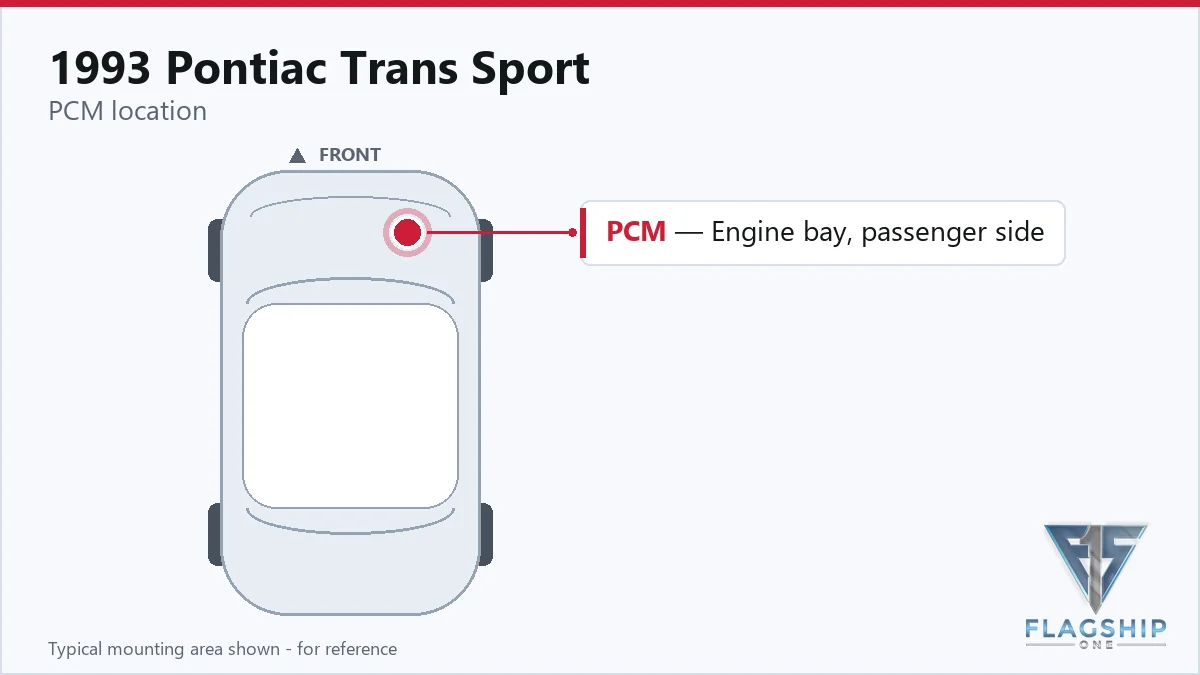
Work with the ignition off, and treat the module as static-sensitive: avoid touching the connector pins at any point.
| Operation | Configuration | Book Time |
|---|---|---|
| Engine Control Module R&R | All configurations | 1.0 hr |
| Engine Control Module Relearn | All configurations | 0.5 hr |
| Powertrain Control Module Relearn | All configurations | 0.5 hr |
| Powertrain Control Module R&R | All configurations | 0.9 hr |
After physically installing a new powertrain control module, the factory procedure for a 1993 Pontiac Trans Sport requires a relearn sequence that can take up to 0.5 hours. This process allows the module to calibrate idle speed, fuel trim, and transmission shift adapts by driving the vehicle under specific conditions while monitoring sensor feedback. However, when you order a replacement from Flagship One, the unit arrives already programmed with your vehicle’s VIN and calibration data, so that relearn step is unnecessary. The module is configured to match the exact engine, transmission, and axle ratio of your Trans Sport, meaning you can simply install it and start the engine without additional dealer-level tools or drive cycles. This plug-and-play approach is made possible because Flagship One pre-loads the correct calibration onto a VIN-programmed replacement unit before shipping, saving you the 0.5-hour relearn time and the potential frustration of incomplete adaptation. As a result, the vehicle should run correctly from the first key turn, with no check engine light or drivability concerns related to module programming.
A failing PCM in a 1993 Pontiac Trans Sport often produces symptoms that can be mistaken for fuel system, ignition, or transmission problems. The engine may crank strongly but refuse to start because the module is not triggering the fuel injectors or ignition coils. Intermittent stalling, especially when the engine reaches operating temperature, is another common sign, as heat-sensitive internal components begin to fail. You might notice that the transmission holds gears too long, shifts harshly, or fails to engage overdrive, since the PCM directly controls shift solenoids. In some cases, the module stops communicating with a scan tool altogether, making it impossible to retrieve diagnostic trouble codes or view live data. A sudden loss of power, backfiring, or a rough idle that cannot be traced to vacuum leaks or ignition parts also points toward an internal PCM fault. Because the 1993 Trans Sport uses an OBD-I system, you may need to retrieve flash codes by grounding the diagnostic terminal and counting check engine light pulses, but a dead PCM will not respond even to that method. When multiple, seemingly unrelated issues appear at once and basic checks of sensors and wiring reveal no problems, the PCM is often the root cause.
First, verify that the engine has spark and fuel pressure. If both are absent and the check engine light does not illuminate with the key on, the PCM may not be powering up. A scan tool that fails to communicate with the module is another strong indicator. When basic checks of fuses, relays, and wiring are good, a faulty PCM is likely.
A blank or remanufactured PCM requires programming with the vehicle’s VIN and calibration data, plus a relearn procedure. However, a unit from Flagship One arrives pre-programmed for your specific Trans Sport, so no additional programming or relearn is necessary after installation.
The PCM is mounted on the right-hand side of the dash, behind the convenience center. You will need to remove the lower dash trim and the convenience center assembly to access the module and its mounting bracket.
The PROM is a removable chip that stores vehicle-specific calibration data such as weight, engine, transmission, and axle ratio. When you purchase a pre-programmed replacement, the correct calibration is already loaded, so you do not need to swap the PROM from the old module.
Yes, the PCM directly controls the transmission shift solenoids. A failing module can cause harsh shifts, delayed engagement, or failure to shift into overdrive. If fluid level and condition are normal, the PCM is a common culprit for erratic transmission behavior.
Repairing a failed PCM is rarely practical for a 1993 Trans Sport because internal component degradation often recurs. A refurbished unit may carry hidden damage from heat or voltage spikes, while a new old-stock module is difficult to find. A pre-programmed replacement from Flagship One offers a dependable solution that matches your vehicle’s exact calibration and arrives ready to install, eliminating the factory relearn step and getting your minivan back on the road quickly.
Flagship One stocks a refurbished, VIN-programmed PCM for the 1993 Pontiac Trans Sport with a lifetime warranty, free shipping and no core charge. The full Pontiac Trans Sport module lineup covers other engine configurations as well.
A failing powertrain control module can bring your 1993 Pontiac Trans Sport to a standstill, but replacing it does not have to be complicated. With the module located behind the convenience center and a book time of 0.9 hours for the swap, the job is manageable for a skilled DIYer. Choosing a VIN-programmed unit from Flagship One removes the programming hurdle, so you can install the part and drive away with confidence.