
Last updated on August 25th, 2026 at 12:30 pm
The Powertrain Control Module (PCM) in your 1994 Pontiac Trans Sport manages fuel delivery, ignition timing, and transmission shifts. A failing PCM may cause erratic idling, stalling, or a complete no-start condition, often without warning.
If your 1994 Pontiac Trans Sport is running rough, stalling, or refusing to start, the Powertrain Control Module (PCM) may be the culprit. This critical component acts as the brain for your engine and transmission, adjusting fuel, ignition, and shift points in real time. When it fails, symptoms can range from subtle performance issues to a complete breakdown. Replacing the PCM involves removing the module from behind the dash, but the process doesn’t end there—your vehicle will need a relearn procedure to sync the new unit. Understanding the steps and what to expect can help you avoid unnecessary delays or repeat repairs.
1994 Pontiac Trans Sport
OEM programmed ECM for your 1994 Pontiac Trans Sport — plug & play, no dealer visit.
Free shipping · Lifetime warranty
In your 1994 Pontiac Trans Sport, the PCM is a replacement engine computers for the Trans Sport that continuously monitors sensor data to optimize engine performance and transmission behavior. It adjusts fuel injection timing, spark advance, and shift schedules based on driving conditions, ensuring smooth operation and fuel efficiency. Because the PCM also stores vehicle-specific calibration data—like weight, axle ratio, and transmission type—it plays a direct role in how your minivan accelerates, idles, and shifts. A malfunctioning PCM may disrupt these functions, leading to noticeable drivability issues or even preventing the engine from starting.
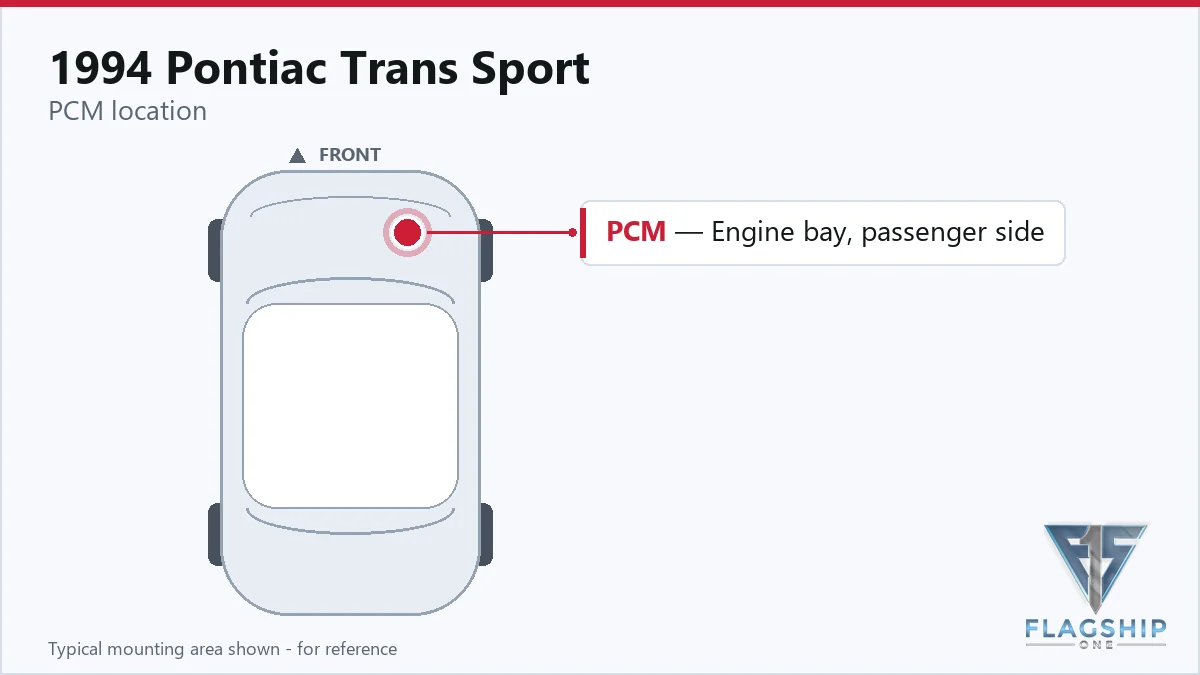
Work with the ignition off, and treat the module as static-sensitive: avoid touching the connector pins at any point.
| Operation | Configuration | Book Time |
|---|---|---|
| Engine Control Module R&R | All configurations | 1.4 hr |
| Engine Control Module Relearn | All configurations | 0.5 hr |
| Powertrain Control Module Relearn | All configurations | 0.5 hr |
| Powertrain Control Module R&R | All configurations | 1.3 hr |
After replacing the PCM in your 1994 Pontiac Trans Sport, the factory procedure requires a relearn process to synchronize the new module with the vehicle’s systems. This typically takes 0.5 hours and involves resetting learned values for fuel trim, idle speed, and transmission shift points. However, a VIN-programmed replacement unit from Flagship One arrives pre-configured with your vehicle’s calibration data, eliminating the need for this step. This saves time and reduces the risk of incomplete initialization, which can lead to poor performance or shifting issues.
A failing PCM in your 1994 Pontiac Trans Sport may cause a range of symptoms, often without warning. Common signs include intermittent stalling, especially at idle or during deceleration, as well as hesitation or surging under acceleration. You might also notice the transmission shifting erratically or failing to engage gears smoothly. In some cases, the engine may crank but not start, or it may run roughly with poor fuel economy. While these issues can stem from other components, a faulty PCM is a likely culprit if multiple symptoms appear simultaneously.
Stalling at idle is a common symptom of a failing PCM. The module may lose its ability to regulate fuel delivery or ignition timing, causing the engine to cut out. Other potential causes include a faulty idle air control valve or vacuum leaks, but the PCM should be checked if the issue persists.
Replacing the PCM is a straightforward process if you’re comfortable working behind the dash. The module is accessible after removing the lower panel, and no special tools are required. However, the factory relearn procedure may require a scan tool, so consider whether you have the equipment to complete the job.
Symptoms like stalling, rough idling, or a no-start condition often point to a faulty PCM. If the vehicle exhibits multiple drivability issues simultaneously, the module is a likely cause. A scan tool can help confirm the diagnosis by checking for stored trouble codes.
If your 1994 Pontiac Trans Sport is experiencing PCM-related issues, you have options. A repair shop can diagnose and replace the module, but labor costs for removal and relearn can add up. Alternatively, a pre-programmed replacement unit ensures a quicker installation and eliminates the need for post-install procedures, getting you back on the road faster.
Flagship One stocks a refurbished, VIN-programmed PCM for the 1994 Pontiac Trans Sport with a lifetime warranty, free shipping and no core charge. The full Pontiac Trans Sport module lineup covers other engine configurations as well.
The PCM in your 1994 Pontiac Trans Sport is a critical component that ensures smooth engine and transmission operation. If you’re dealing with stalling, poor acceleration, or a no-start condition, a faulty module may be to blame. Replacing it with a VIN-programmed unit simplifies the process and restores reliable performance to your minivan.