
Last updated on August 25th, 2026 at 11:47 am
The engine control module in a 2016 Volkswagen Eos serves as the central brain for the powertrain. It manages fuel injection, ignition timing, and emissions. When this unit fails, the vehicle may experience erratic idling, failure to start, or significant loss of power due to incorrect sensor processing.
Dealing with a malfunctioning engine computer in a 2016 Volkswagen Eos often presents a challenging scenario for owners and technicians. Whether the vehicle is suddenly refusing to start or exhibiting strange performance gaps during acceleration, the root cause often traces back to the electronic control unit. This component is responsible for translating sensor data into mechanical action, ensuring the 2.0L engine operates within efficient parameters. When internal circuitry fails, the communication between the engine and the transmission often breaks down, leading to a variety of driveability issues. Understanding the role of this module helps you determine if a simple sensor replacement is sufficient or if the entire computer needs attention. Because modern vehicles rely heavily on electronic coordination, the health of this processor is critical for safety and efficiency. By exploring the installation process and the necessity of proper calibration, you can better understand the requirements for restoring your vehicle to a reliable state. This guide provides a technical overview of the module’s function, its physical location, and the specific labor requirements associated with replacing it in your 2016 Volkswagen Eos.
2016 Volkswagen Eos
OEM programmed ECM for your 2016 Volkswagen Eos — plug & play, no dealer visit.
Free shipping · Lifetime warranty
The engine control module acts as the primary processor for the 2016 Volkswagen Eos, managing a complex array of inputs to maintain optimal performance. It monitors oxygen sensors, throttle position, and crankshaft timing to adjust fuel delivery and spark timing in real-time. This ensures the vehicle meets emissions standards while providing the necessary power for the 2.0L engine. Without a functioning module, the engine cannot coordinate these variables, which typically results in a limp-home mode or a complete failure to ignite. Because this unit interacts with nearly every other electronic system in the car, its health is paramount for overall vehicle stability. When searching for replacement engine computers for the 2016 Volkswagen Eos, it is important to recognize that the module is not merely a part but a sophisticated computer that requires precise synchronization with the vehicle’s VIN. If the internal capacitors or solder joints fail due to heat or vibration, the processor may send erratic signals to the fuel injectors. This can lead to lean or rich conditions that potentially damage other engine components. Maintaining the integrity of this unit ensures that the powertrain operates smoothly, preventing unnecessary wear on the catalytic converters and ensuring a consistent idle during stop-and-go traffic.
The control module for the 2016 Volkswagen Eos is located within the plenum chamber, which is the area found at the base of the windshield. To access the unit, technicians typically follow the factory removal process to reach this specific area. The labor involved in the removal and replacement of the engine control module is listed at 0.9 hours. Similarly, if the powertrain control module is being replaced, the removal and replacement time is also 0.9 hours. Once the new hardware is physically installed, the vehicle requires a relearn process to synchronize the computer with the engine’s current state. The book time for an engine control module relearn is 0.5 hours, and the powertrain control module relearn is also quoted at 0.5 hours. These steps ensure that the new module recognizes the engine’s parameters and operates the 2.0L system correctly.
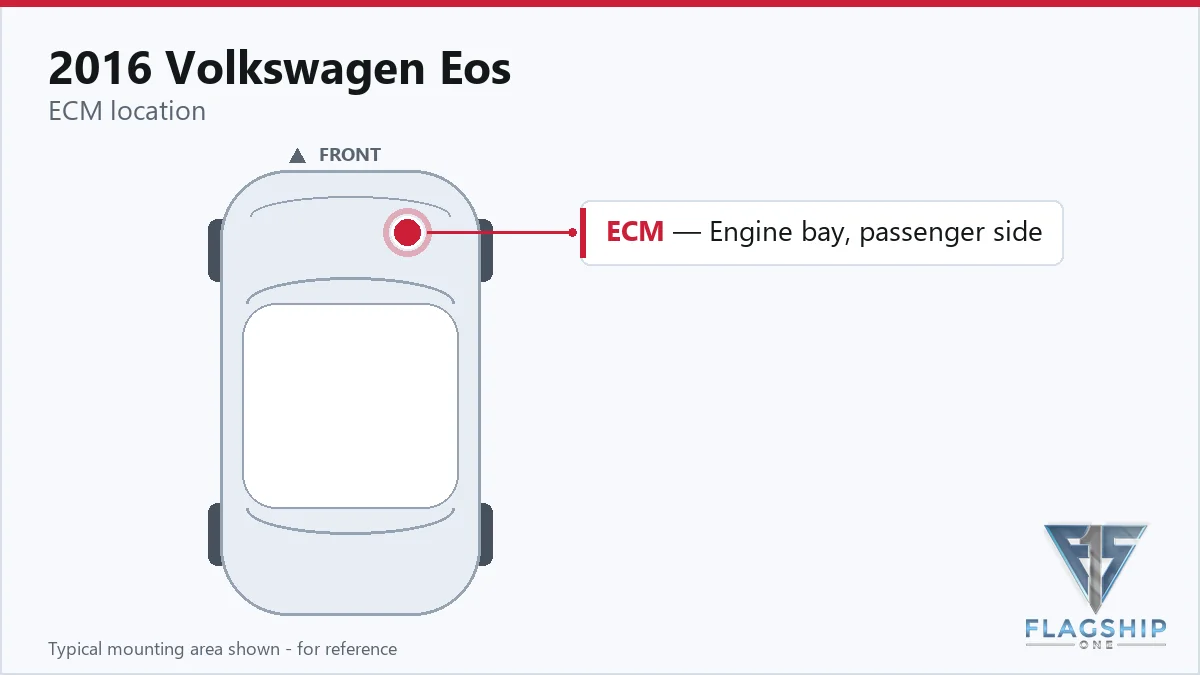
Work with the ignition off, and treat the module as static-sensitive: avoid touching the connector pins at any point.
| Operation | Configuration | Book Time |
|---|---|---|
| Engine Control Module R&R | All configurations | 0.9 hr |
| Engine Control Module Relearn | All configurations | 0.5 hr |
| Powertrain Control Module Relearn | All configurations | 0.5 hr |
| Powertrain Control Module R&R | All configurations | 0.9 hr |
After a new module is installed in a 2016 Volkswagen Eos, the factory procedure requires specific programming and relearn steps to ensure the vehicle operates correctly. Typically, this involves flashing the correct software version and performing a synchronization process that can take 0.5 hours. However, the complexity of these steps often requires specialized dealer equipment. To simplify this process, Flagship One provides units that arrive already configured for your specific vehicle. By using a VIN-programmed replacement unit, you can avoid the tedious factory setup and the associated labor of the initial programming phase. This means the core software and vehicle identification are already embedded in the hardware before it reaches your door. While the physical installation still requires the 0.9 hours of labor and the subsequent 0.5 hours for the relearn process, the most difficult part of the software configuration is already complete, reducing the risk of software mismatches.
A failing control module in a 2016 Volkswagen Eos often manifests as intermittent electronic glitches that can be difficult to pin down. You may notice that the vehicle suddenly stalls while idling or refuses to start entirely, even with a fully charged battery. In some cases, the engine might start but immediately enter a limp-home mode, where power is severely limited and the transmission refuses to shift into higher gears. Misfire codes may appear on the dashboard, yet replacing the spark plugs or coils does not resolve the issue because the computer is sending incorrect timing signals. You might also experience a total loss of communication when attempting to connect a scan tool to the OBD-II port, which often indicates that the module’s internal processor has failed. Erratic idling or sudden surges in engine speed during steady cruising are also common indicators of a degrading ECM. Since the module controls the fuel mixture, you may notice a strong smell of unburnt fuel or a significant drop in fuel economy. These symptoms typically point to internal hardware failure within the computer, such as failed capacitors or corrupted memory sectors, which cannot be fixed with a simple software reset.
The module is situated in the plenum chamber, which is located at the base of the windshield.
The removal and replacement of the powertrain control module typically takes 0.9 hours of labor.
Yes, the factory process involves programming and a relearn procedure that typically takes 0.5 hours.
Common symptoms include no-start conditions, stalling, and a lack of communication with diagnostic tools.
Yes, the book time for the engine control module relearn is 0.5 hours to ensure proper operation.
When deciding how to address a failed computer in your 2016 Volkswagen Eos, you have several paths. Some choose to attempt a repair of the original board, but this often leads to recurring failures. Opting for a refurbished replacement provides a balanced approach, combining professional testing with cost-effective pricing. Ensuring the replacement is tailored to your specific vehicle’s needs ensures the 2.0L engine returns to its original performance levels without the hassle of dealership software hurdles.
Flagship One stocks a refurbished, VIN-programmed PCM for the 2016 Volkswagen Eos with a lifetime warranty, free shipping and no core charge. The full Volkswagen Eos module lineup covers other engine configurations as well.
Restoring the electronic heart of your 2016 Volkswagen Eos requires a combination of precise hardware and correct calibration. By understanding the role of the control module and the labor involved in its replacement, you can make an informed decision about your repair. Whether you are a DIY enthusiast or using a professional shop, ensuring the module is correctly programmed is the key to success. Explore your replacement options to get your vehicle back on the road.