
Last updated on August 25th, 2026 at 11:48 am
The PCM in a 2015 Volkswagen Eos manages engine timing, fuel delivery, and transmission shifts. When it fails, the car may refuse to start, stall, or run unevenly.
When a 2015 Volkswagen Eos exhibits symptoms like stalling, misfires, or a dead scan‑tool, the cause often lies in the Powertrain Control Module or Engine Control Module. Replacing these modules can restore reliable operation and prevent further damage. This guide explains what the PCM does in this specific car, where it is located, the labor involved, and how a VIN‑programmed replacement from Flagship One simplifies the process. By understanding the steps and expected outcomes, you can make an informed decision about repair versus replacement and avoid costly downtime.
The PCM in a 2015 Volkswagen Eos controls engine ignition timing, fuel injection, and transmission shift logic. It receives sensor data from the crankshaft position sensor, throttle position sensor, and other inputs to calculate the optimal engine performance and shift points. replacement engine computers for the 2015 Volkswagen Eos If the PCM loses communication or its internal logic fails, the vehicle may experience erratic throttle response, hard shifting, or complete loss of power. Because the PCM integrates both engine and transmission functions, a malfunction can manifest as a wide range of symptoms, from a rough idle to a stalled engine. A replacement restores the ability of the vehicle to interpret sensor data and send proper commands to the engine and transmission, thereby regaining smooth operation.
2015 Volkswagen Eos
OEM programmed ECM for your 2015 Volkswagen Eos — plug & play, no dealer visit.
Free shipping · Lifetime warranty
The PCM is accessed from the plenum chamber at the base of the windshield. Removing the module requires disconnecting the harness, releasing the mounting clamps, and carefully extracting the unit. The replacement process mirrors the removal: install the new PCM, reconnect the harness, secure the mounting clamps, and ensure proper seating. Labor times are 0.9 hours for the removal or reinstallation and an additional 0.5 hours for relearn procedures on both the engine and powertrain modules.
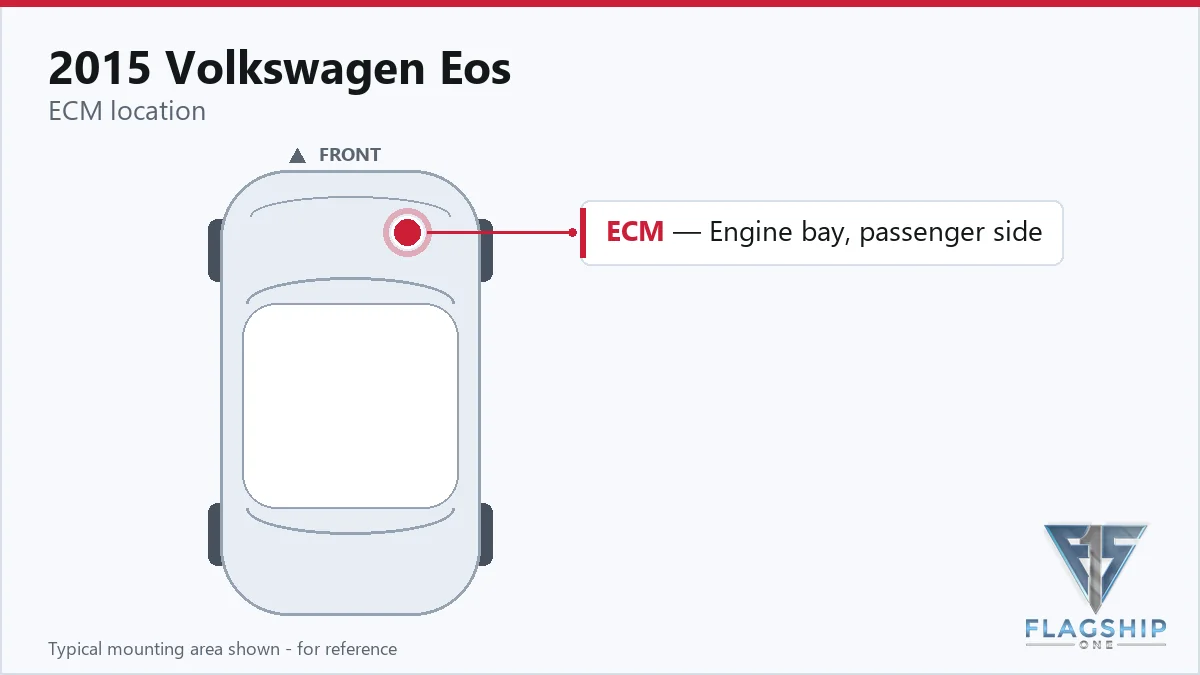
Work with the ignition off, and treat the module as static-sensitive: avoid touching the connector pins at any point.
| Operation | Configuration | Book Time |
|---|---|---|
| Engine Control Module R&R | All configurations | 0.9 hr |
| Engine Control Module Relearn | All configurations | 0.5 hr |
| Powertrain Control Module Relearn | All configurations | 0.5 hr |
| Powertrain Control Module R&R | All configurations | 0.9 hr |
After installing a new PCM, the factory procedure dictates that relearn functions are performed to calibrate engine timing and transmission shift maps. Flagship One units arrive VIN‑programmed, which means those relearn steps are already completed. Consequently, once the new PCM is installed, no further programming or tuning is required. The vehicle will operate with the pre‑programmed parameters matching the original specifications.
Every VIN-programmed replacement unit from Flagship One arrives with these steps already completed.
Common indications that the PCM in a 2015 Volkswagen Eos is failing include a dead scan‑tool that cannot read codes, sudden stalling while driving, or the engine refusing to start. Misfires and irregular idle may also point to PCM issues. If a diagnostic scan shows Powertrain Control Module Powertrain Control Module or similar codes, it is often a sign of PCM communication loss or internal fault. Addressing these symptoms promptly can prevent more severe engine or transmission damage.
The standard labor time for removing or reinstalling the PCM is about 0.9 hours, plus 0.5 hours each for engine and powertrain relearn procedures.
Flagship One units are VIN‑programmed, so the relearn steps are already completed. No additional programming is required once the module is installed.
Symptoms include a dead scan‑tool, engine stalling, misfires, or a refusal to start. Diagnostic codes such as P0601 often confirm PCM communication issues.
It sits in the plenum chamber at the base of the windshield, accessed by removing the module from that location.
Yes, because the PCM controls transmission shift logic. A new, properly programmed module will reestablish correct shift timing and performance.
Whether you choose a professional repair or a refurbished replacement, understanding the PCM’s role and location helps you evaluate your options. A VIN‑programmed unit from Flagship One eliminates the need for post‑install tuning, saving time and ensuring your 2015 Volkswagen Eos returns to reliable operation.
Flagship One stocks a refurbished, VIN-programmed PCM for the 2015 Volkswagen Eos with a lifetime warranty, free shipping and no core charge. The full Volkswagen Eos module lineup covers other engine configurations as well.
The 2015 Volkswagen Eos relies on its PCM for engine and transmission management. By addressing PCM failures promptly and choosing a VIN‑programmed replacement, you can restore performance and avoid costly downtime.