
Last updated on August 25th, 2026 at 11:48 am
The engine control module in your 2013 Volkswagen Eos governs fuel injection, ignition timing, and turbo boost pressure for the 2.0L powerplant. Heat stress and voltage fluctuations often degrade internal circuitry, causing drivability issues that typically require module replacement rather than circuit-level repair.
When your 2013 Volkswagen Eos begins exhibiting unexplained drivability quirks, the engine control module often becomes the prime suspect. This compact German convertible relies heavily on its computer to manage the turbocharged 2.0L engine, coordinating everything from fuel delivery to emissions control. Understanding how this component functions within your specific vehicle helps you make informed decisions about repairs rather than simply authorizing expensive diagnostic bills without understanding the scope.
The engine computer, sometimes called the powertrain control module, serves as the central processing unit for your convertible. It continuously interprets data from sensors throughout the engine bay, adjusting injector pulse width and ignition advance in real time to optimize performance. When this module fails, you may experience symptoms ranging from extended cranking to complete immobilization, often without warning lights appearing on the dash.
You will learn about the physical location of the module within your 2013 Volkswagen Eos, the factory labor allocations for replacement, and the programming requirements that follow installation. You will learn why accessing the plenum chamber at the windshield base requires specific care, how book times break down between removal and relearn procedures, and what steps Flagship One takes to simplify your repair process. Armed with this knowledge, you can discuss options confidently with your technician and avoid unnecessary diagnostic delays or incorrect part substitutions. This knowledge proves particularly valuable for convertible owners who depend on reliable operation during short summer seasons.
2013 Volkswagen Eos
OEM programmed ECM for your 2013 Volkswagen Eos — plug & play, no dealer visit.
Free shipping · Lifetime warranty
The engine control module in your 2013 Volkswagen Eos functions as the brain of the powertrain management system. Mounted within the plenum chamber found at the windshield base, this unit constantly processes input from the mass airflow sensor, oxygen sensors, and crankshaft position sensor to maintain optimal combustion. It calculates injector timing down to the millisecond while simultaneously controlling the wastegate actuator on your turbocharger, balancing performance with efficiency in this compact convertible.
Beyond basic fuel and spark management, this module integrates with the convertible top controller and transmission control unit on automatic models. It stores adaptive values for fuel trim and ignition timing, learning your driving habits over thousands of miles. When internal voltage regulators or memory chips degrade, these learned parameters corrupt, causing rough idle or hesitation during acceleration that typically worsens as the engine warms.
Replacement becomes necessary when internal diagnostics detect irreparable memory faults or communication failures between modules. Technicians often find that replacement computers for the Eos resolve chronic issues that no amount of wiring inspection or sensor replacement fixes. The module contains vehicle-specific immobilizer data that must match your key set, making used units from salvage yards problematic without proper reprogramming. Heat cycling from the engine bay gradually stresses solder joints, particularly in the plenum chamber location where under-hood temperatures fluctuate dramatically during convertible operation with the top down. Water intrusion from clogged drains may also affect the windshield base area, accelerating corrosion of the module connector pins and creating intermittent contact resistance.
Accessing the computer in your 2013 Volkswagen Eos requires reaching into the plenum chamber found at the windshield base. This location places the module directly behind the engine cover, exposed to under-hood heat but protected from direct spray. Your technician removes surrounding trim and hardware to reach the mounting bracket, then disconnects the multi-pin harness before sliding the unit from its cavity.
Book time lists 0.9 hours for the removal and replacement of either the engine control module or the powertrain control module. This allocation covers the physical exchange of the unit, including securing the mounting hardware and reconnecting the electrical connectors. After installation, the factory procedure requires a relearn sequence lasting 0.5 hours for either the engine control module or the powertrain control module. This step allows the new unit to synchronize with the immobilizer system and transmission controller. While the location remains constant regardless of which specific module requires service, always verify whether your particular repair involves the engine management computer or the broader powertrain controller to ensure accurate labor estimates.
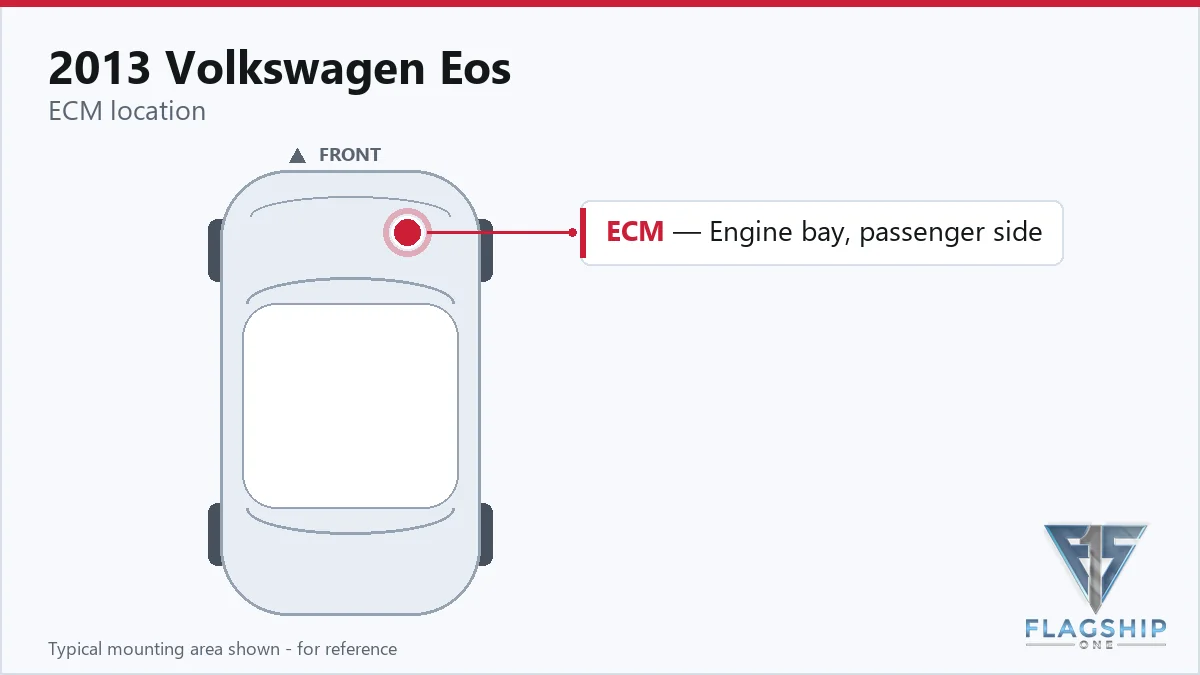
Work with the ignition off, and treat the module as static-sensitive: avoid touching the connector pins at any point.
| Operation | Configuration | Book Time |
|---|---|---|
| Engine Control Module R&R | All configurations | 0.9 hr |
| Engine Control Module Relearn | All configurations | 0.5 hr |
| Powertrain Control Module Relearn | All configurations | 0.5 hr |
| Powertrain Control Module R&R | All configurations | 0.9 hr |
After installing new hardware, the shop must perform specific calibration routines before your 2013 Volkswagen Eos will operate normally. The factory manual mandates a relearn procedure lasting 0.5 hours for either the engine control module or the powertrain control module. This process establishes communication between the replacement unit and your vehicle’s immobilizer, allowing the engine to start and run without triggering security lockouts. Technicians typically use factory scan tools to complete these steps, which cannot be skipped without causing the powertrain to remain disabled.
Flagship One ships a VIN-programmed replacement unit that arrives ready for immediate installation in your convertible. This preparation eliminates the need for your technician to perform the 0.5 hour relearn procedure, effectively saving shop time and reducing the risk of programming errors that could require repeating the process. The module arrives configured with your specific vehicle identification number, matching the calibration data to your 2013 Volkswagen Eos exactly. While the physical installation still requires the allocated 0.9 hours for removal and replacement, the post-installation programming phase becomes unnecessary, streamlining your repair timeline significantly and getting your turbocharged convertible back on the road faster.
Failure of the engine computer in your 2013 Volkswagen Eos typically manifests through distinct drivability disturbances that worsen over time. You may notice extended cranking periods before the starter engages the engine, particularly on hot days when the module sits in the heated plenum chamber. Intermittent stalling at traffic lights often follows, occurring without warning lights or stored diagnostic codes that would normally indicate sensor failures.
As internal memory degrades, the turbocharged 2.0L engine may develop erratic idle speed or sudden hesitation during acceleration. The transmission might shift harshly or enter limp mode, restricting you to lower gears even during highway cruising. Communication errors between the scan tool and the engine control module frequently indicate internal circuit board issues rather than wiring faults. Some owners report complete no-start conditions where the starter spins but the engine never fires, suggesting immobilizer mismatches within the corrupted module.
Electrical anomalies such as flickering check engine lights or random gauge fluctuations may accompany these mechanical symptoms. The convertible top might also operate slowly or stop mid-cycle if the computer cannot process the position sensors correctly. These issues often appear randomly at first, then become more consistent as heat cycling further damages the internal components. Because these symptoms mirror fuel pump or ignition coil failures, professional diagnosis with factory equipment helps confirm whether the module truly requires replacement or if peripheral components need attention first.
Book time lists 0.9 hours for removal and replacement. If your technician must perform the relearn procedure, add 0.5 hours. Flagship One units arrive pre-programmed, eliminating the relearn step.
The factory procedure reaches the module in the plenum chamber at the base of the windshield. Your technician removes surrounding components to access this area.
Used modules contain immobilizer data specific to the donor vehicle’s keys. Without professional reprogramming, the engine typically will not start due to security mismatches.
Internal memory faults often cause stalling before triggering diagnostic codes. Heat exposure in the plenum chamber location may cause temporary processor errors that resolve when the module cools.
Standard replacement units require factory scan tools for the 0.5 hour relearn procedure. However, Flagship One provides VIN-programmed units that arrive ready for immediate installation without additional programming.
You face two paths when addressing a failing computer in your 2013 Volkswagen Eos. Repair shops may attempt board-level fixes, though these often prove temporary given the heat exposure in the plenum chamber location. Alternatively, a programmed replacement unit offers a permanent solution that matches your vehicle’s specifications exactly. Consider the total timeline including labor hours and programming requirements when evaluating your options.
Flagship One stocks a refurbished, VIN-programmed PCM for the 2013 Volkswagen Eos with a lifetime warranty, free shipping and no core charge. The full Volkswagen Eos module lineup covers other engine configurations as well.
Understanding the location, labor requirements, and programming needs of your 2013 Volkswagen Eos engine computer empowers you to make informed repair decisions. With the module positioned in the plenum chamber at the windshield base and book times clearly defined at 0.9 hours plus 0.5 hours for relearn, you can plan the service efficiently. Choose a solution that eliminates unnecessary programming steps while ensuring your convertible returns to reliable operation for years of open-air driving.