
Last updated on August 25th, 2026 at 11:48 am
The engine control module in your 2014 Volkswagen Eos manages fuel delivery, ignition timing, and emissions functions. When this unit fails, your vehicle may experience starting difficulties, erratic idle behavior, or complete loss of scan-tool communication, often requiring replacement of the module to restore drivability.
When your 2014 Volkswagen Eos develops intermittent drivability problems or refuses to start, the engine control module often becomes a suspect. This computer manages the interaction between sensors, fuel injectors, and ignition components, so a fault inside it can disrupt nearly every aspect of engine operation. Owners frequently encounter situations where the vehicle runs fine one day and fails completely the next, leaving them uncertain whether the problem lies in wiring, a sensor, or the module itself. Understanding what this component does, where it lives in the vehicle, and what the replacement process involves helps you make an informed decision about repair options. The factory procedure for accessing and replacing this unit follows specific steps, and the post-installation programming requirements can add complexity if you source a blank module. A pre-programmed unit eliminates much of that burden. This guide walks through the module’s role, its physical location, the labor time involved, common symptoms of failure, and what to expect when ordering a replacement that arrives ready to install. Whether you are diagnosing a stubborn no-start or planning a proactive swap, having the right information keeps the repair process manageable and helps you avoid unnecessary expense.
2014 Volkswagen Eos
OEM programmed ECM for your 2014 Volkswagen Eos — plug & play, no dealer visit.
Free shipping · Lifetime warranty
The engine control module in your 2014 Volkswagen Eos functions as the central processor for the vehicle’s powertrain. It continuously reads input from dozens of sensors monitoring airflow, coolant temperature, throttle position, oxygen content in the exhaust, and crankshaft rotation speed. Using those inputs, the module calculates precise fuel injector pulse widths, ignition advance angles, and variable valve timing commands to keep the engine running efficiently across all operating conditions. When you select replacement engine computers for the Eos, you are addressing the same hardware that originally coordinated these calculations from the factory. The module also controls emissions-related components such as the evaporative purge valve and secondary air injection, ensuring the vehicle meets regulatory standards. Because the Eos pairs a turbocharged engine with specific transmission calibration, the module’s software contains unique maps that differ from other Volkswagen models sharing similar hardware. A failing module may still communicate with a scan tool but produce incorrect outputs, causing rough running or poor fuel economy. In more severe cases, the processor may stop responding entirely, preventing the engine from starting at all. The module stores adaptive learning data for idle control and fuel trim corrections, which means a newly installed unit often needs a relearn procedure to settle into proper operation. The relationship between the module and the vehicle’s immobilizer system also matters, since the engine computer must recognize the existing keys to allow starting. Understanding this component’s role clarifies why simply swapping parts without proper programming rarely resolves the underlying issue.
The factory removal procedure for the 2014 Volkswagen Eos reaches the control module through the plenum chamber at the base of the windshield. This location protects the unit from engine heat but places it in an area where water intrusion can occasionally become a concern if drainage pathways become blocked. Removing the module involves accessing the plenum area, disconnecting the electrical connectors, and unfastening the unit from its mounting. The published labor time for engine control module removal and installation is 0.9 hours, while the powertrain control module carries the same 0.9-hour figure for removal and installation. After physical installation, the factory procedure calls for a relearn process. The relearn time for the engine control module is 0.5 hours, and the powertrain control module relearn also requires 0.5 hours. These times reflect the calibration steps needed for the new module to adapt to your vehicle’s specific sensors and operating parameters.
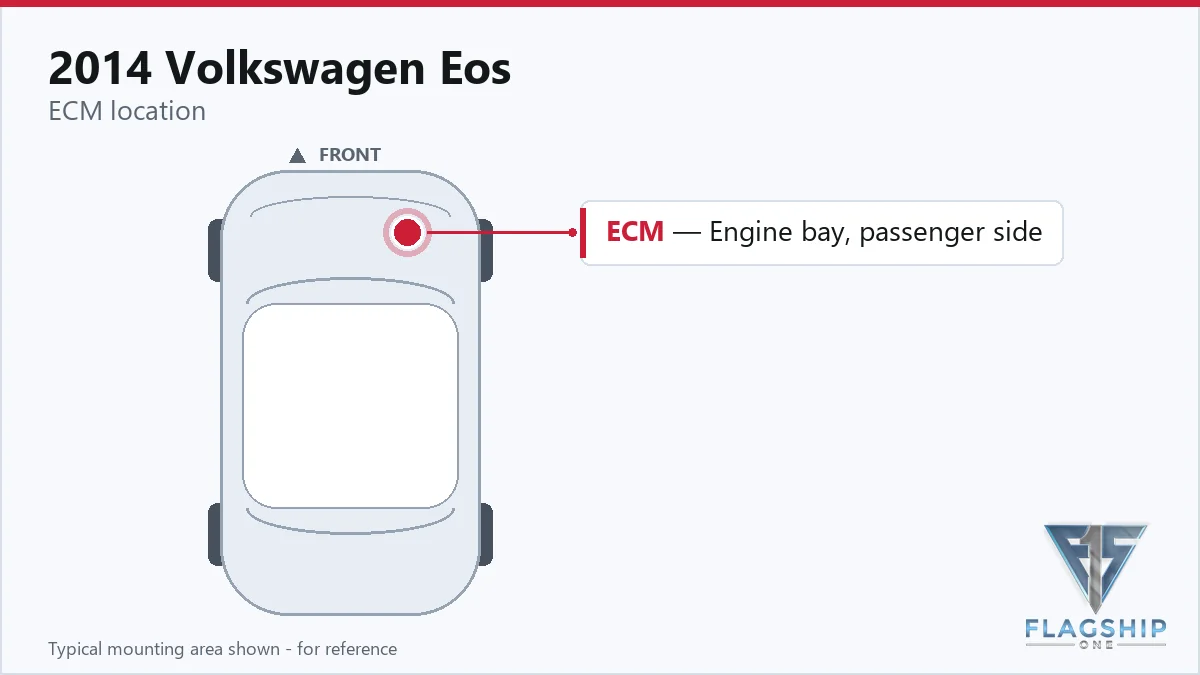
Work with the ignition off, and treat the module as static-sensitive: avoid touching the connector pins at any point.
| Operation | Configuration | Book Time |
|---|---|---|
| Engine Control Module R&R | All configurations | 0.9 hr |
| Engine Control Module Relearn | All configurations | 0.5 hr |
| Powertrain Control Module Relearn | All configurations | 0.5 hr |
| Powertrain Control Module R&R | All configurations | 0.9 hr |
After the replacement module is physically installed in your 2014 Volkswagen Eos, the factory procedure requires a relearn process to synchronize the unit with the vehicle’s sensors, throttle body, and immobilizer system. The engine control module relearn carries a labor time of 0.5 hours, and the powertrain control module relearn requires an additional 0.5 hours. These procedures typically involve using a diagnostic tool to initiate adaptation sequences, clear learned fuel trim values, and confirm that the module recognizes the existing vehicle keys. Without completing these steps, the engine may idle erratically or refuse to start. When you choose a VIN-programmed replacement unit from Flagship One, the module arrives already flashed with your vehicle’s identification number and the appropriate calibration data. This means the relearn steps that the factory procedure prescribes are already handled, and the unit is ready to operate upon installation. You still need to perform the physical removal and installation, but the programming burden that would otherwise require a dealer visit or specialized scan equipment is eliminated.
When the engine control module in your 2014 Volkswagen Eos begins to fail, several symptoms may appear depending on the nature of the internal fault. One of the most common signs is a no-start condition where the engine cranks but never fires, often because the module has stopped sending fuel injector or ignition commands. Intermittent stalling while driving can also occur, sometimes accompanied by the vehicle restarting after sitting for a period, which suggests a thermal failure inside the module’s circuitry. Rough idle, hesitation under acceleration, and misfire codes may surface if the module produces incorrect timing or fuel delivery signals. You might also notice that the check engine light illuminates and stays on, yet the stored codes point to multiple unrelated sensors, which often indicates the module itself is generating erroneous data rather than the sensors being at fault. Complete loss of communication with a diagnostic scan tool represents another telltale symptom; when the module fails to respond to the scanner at all, the problem usually lies within the module rather than in individual sensors or actuators. Transmission shifting irregularities can also appear if the powertrain control module portion of the unit loses its adaptive learning data or experiences internal corruption. Because these symptoms overlap with those of failing sensors, wiring problems, or fuel system issues, thorough diagnosis is essential before concluding the module needs replacement. Voltage spikes from a weak battery or faulty alternator can damage the module over time, so addressing charging-system problems early may help prevent module failure.
The engine control module manages fuel injection, ignition timing, emissions controls, and various sensor inputs to keep your engine running efficiently. It calculates real-time adjustments based on operating conditions and stores adaptive data for idle and fuel trim corrections.
The published labor time for removal and installation is 0.9 hours for either the engine control module or the powertrain control module. The factory relearn procedure requires 0.5 hours per module. Your technician can provide a complete estimate based on which services your vehicle needs.
The factory procedure accesses the control module through the plenum chamber at the base of the windshield. This area is designed to protect the unit from engine heat, though it also means the module sits in a location where proper drainage maintenance matters.
A used module from another vehicle typically carries different calibration data and immobilizer coding. Installing one without proper programming may prevent the engine from starting or cause drivability issues. A VIN-programmed replacement matched to your vehicle avoids these complications.
Common symptoms include a no-start condition with the engine cranking but not firing, intermittent stalling, rough idle, misfire codes, and loss of communication with a diagnostic scan tool. Multiple unrelated trouble codes appearing simultaneously may also point to module failure rather than individual sensor problems.
If your 2014 Volkswagen Eos needs a control module, you have two main paths: repair the existing unit or install a replacement. Repairing a damaged module is sometimes possible when the fault involves a specific component, but internal processor failures often require full replacement. A refurbished, VIN-programmed unit from Flagship One offers a practical alternative that eliminates the dealer programming step and gets your vehicle back on the road with the correct calibration already in place.
Flagship One stocks a refurbished, VIN-programmed PCM for the 2014 Volkswagen Eos with a lifetime warranty, free shipping and no core charge. The full Volkswagen Eos module lineup covers other engine configurations as well.
The engine control module in your 2014 Volkswagen Eos plays a central role in keeping the turbocharged engine running smoothly and efficiently. When symptoms such as no-start conditions, stalling, or scan-tool communication loss appear, diagnosing the module early can save time and prevent unnecessary part replacements. A VIN-programmed unit from Flagship One simplifies the repair by arriving ready to install with the correct calibration for your specific vehicle.