
Last updated on August 25th, 2026 at 11:51 am
The engine control module in your 2000 Volkswagen Golf serves as the central computer that manages fuel injection, ignition timing, emissions controls, and various sensor inputs. When this module fails, the engine may run poorly or not start at all, leaving you stranded.
If your 2000 Volkswagen Golf has developed starting problems, running issues, or is setting check engine lights that refuse to clear, the engine control module may be the culprit. This component acts as the brain of your vehicle’s powertrain, and when it fails, normal driving becomes impossible. This guide explains what the ECM does, where it is located, what replacement involves, and why programming matters after installation. Whether you are diagnosing a current problem or planning ahead, you will find the technical details needed to understand this repair.
The engine control module in your 2000 Volkswagen Golf is the primary computer responsible for managing the 1.8L engine’s operation. It monitors inputs from numerous sensors including the mass airflow sensor, coolant temperature sensor, and throttle position sensor, then adjusts fuel delivery and ignition timing accordingly. The module also controls the idle air control, evaporative emissions system, and communicates with other control units on the vehicle network. Without a functioning ECM, the engine cannot run properly because the fuel injection and ignition systems lose their brain. Replacement engine computers for the Golf are available from specialty suppliers, and choosing the correct unit for your specific engine displacement ensures compatibility with your vehicle’s systems.
Flagship One keeps Volkswagen Golf replacement engine computers in stock for exactly this failure pattern.
2000 Volkswagen Golf
OEM programmed ECM for your 2000 Volkswagen Golf — plug & play, no dealer visit.
Free shipping · Lifetime warranty
The engine control module in this vehicle is mounted inside the plenum chamber, which is the area behind the dashboard on the passenger side. Accessing the module requires removing the plenum chamber cover and related interior components. The replacement process involves disconnecting the battery, removing the old module, installing the new unit, and reconnecting all electrical connectors. According to labor guides, the R&R operation for a Golf with this engine displacement books at 1.1 hours. After the physical installation is complete, the new module requires a relearn procedure to establish communication with the vehicle’s immobilizer system and other control modules.
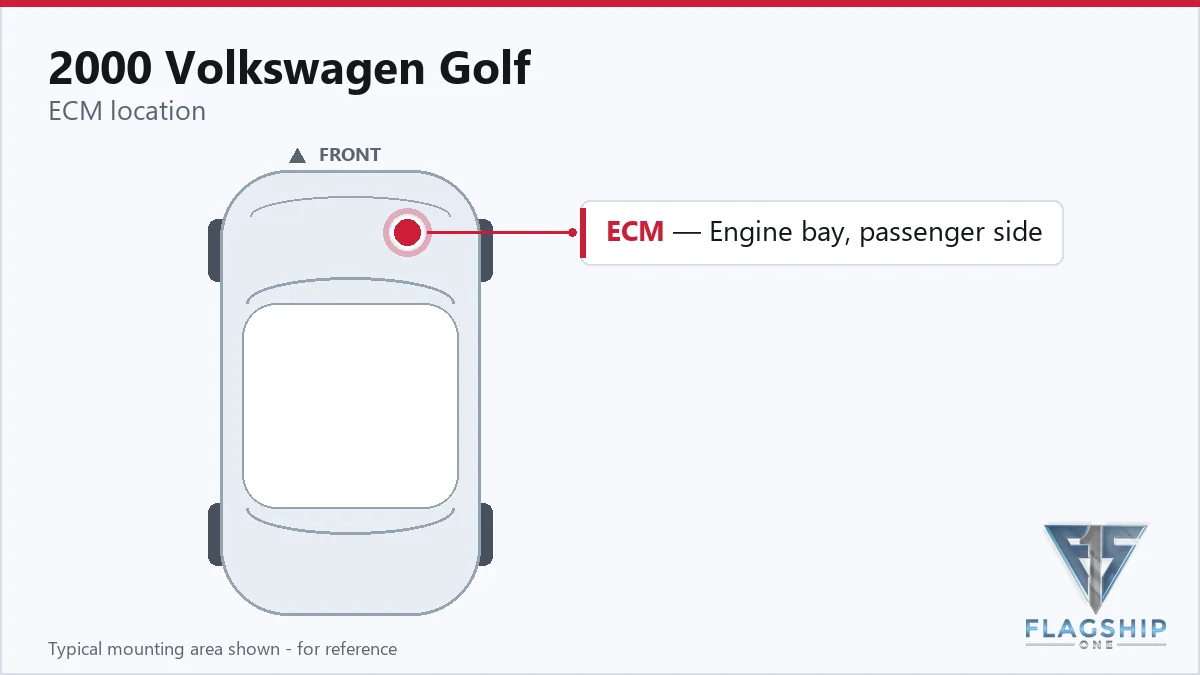
Work with the ignition off, and treat the module as static-sensitive: avoid touching the connector pins at any point.
| Operation | Configuration | Book Time |
|---|---|---|
| Powertrain Control Module Relearn | Golf | 0.5 hr |
| Powertrain Control Module Relearn | Jetta | 0.5 hr |
| Powertrain Control Module R&R | Golf | 1.1 hr |
| Powertrain Control Module R&R | 1.8L | 0.7 hr |
| Powertrain Control Module R&R | 2.0L | 1.1 hr |
| Powertrain Control Module R&R | 1.9L | 0.6 hr |
| Engine Control Module R&R | Golf | 1.1 hr |
| Engine Control Module R&R | 1.8L | 1.5 hr |
After replacing the engine control module, the factory procedure requires a relearn process to synchronize the new unit with your vehicle’s immobilizer and other powertrain components. This adaptation step ensures that the new module can communicate with the key and the fuel injection system. The book time for this procedure is 0.5 hours. Flagship One addresses this requirement by shipping replacement units that arrive VIN-programmed to your specific vehicle, meaning the programming steps that would normally be performed by a dealer or tuning shop are already completed before the unit reaches you.
Every VIN-programmed replacement unit from Flagship One arrives with these steps already completed.
When the engine control module in this vehicle fails, you may experience several telltale signs. A no-start condition is common, where the engine cranks but will not run. The vehicle may also stall unexpectedly while driving or after startup. Misfire codes such as P0300 and individual cylinder misfires often appear when the module cannot properly control fuel delivery. In some cases, the scan tool may not communicate with the ECM at all, indicating a complete module failure. The check engine light may illuminate with internal memory fault codes that persist even after clearing. Shifting irregularities in automatic transmission models can also occur because the ECM shares data with the transmission control module.
The 2000 Volkswagen Golf with 1.8L engine may store specific module-internal trouble codes that indicate hardware failures within the ECM itself. These codes, including P0604, P0605, and P0606, point to internal processor or memory problems rather than sensor issues. When these codes appear alongside drivability symptoms, module replacement is typically necessary.
| Code | Meaning | Full Guide |
|---|---|---|
| P0604 | Internal RAM error | Full P0604 guide → |
| P0605 | Internal ROM error | Full P0605 guide → |
| P0606 | Module processor failure | Full P0606 guide → |
Volkswagen has published factory service bulletins addressing ECM replacement procedures. Bulletin #24-07-102 covers ECM replacement for 1999 and later vehicles with all engine codes except the 2.0L AEG. Additionally, bulletin #96-07-42 addresses immobilizer adaptation procedures when replacing the ECM on models equipped with Immobilizer 3 or 4 systems. These bulletins provide guidance for technicians performing the replacement and programming procedures.
| Bulletin | Subject | What It Addresses |
|---|---|---|
| 24-07-102 | TT 24-07-102 1999 > All Vehicles, All Engine Codes except 2.0L AEG – ECM Replacement | — |
| 96-07-42 | TT 96-07-42 All Models With Immobilizer 3 or 4, Immobilizer Adaptation When Replacing the ECM | — |
No. The replacement module must be matched to your vehicle’s engine displacement and potentially its specific immobilizer configuration. A unit from a different engine size may not have the correct programming for your 1.8L engine.
While the physical replacement can be done by a competent DIY mechanic with basic tools, the post-installation relearn procedure typically requires dealer-level diagnostic equipment. Units pre-programmed by Flagship One reduce this requirement significantly.
If your vehicle displays module-internal codes like P0604, P0605, or P0606, or if it will not start and all other potential causes have been ruled out, replacement is usually the most cost-effective solution. These internal fault codes indicate the ECM hardware itself has failed.
When your 2000 Volkswagen Golf requires an engine control module, you face two primary options: repairing the existing unit or purchasing a replacement. Repair may be suitable for some electrical issues, while replacement with a properly programmed unit gets you back on the road faster. Flagship One specializes in supplying VIN-programmed replacement ECMs specific to this vehicle and engine combination, eliminating much of the dealer programming hassle.
Flagship One stocks a refurbished, VIN-programmed PCM for the 2000 Volkswagen Golf with a lifetime warranty, free shipping and no core charge. The full Volkswagen Golf module lineup covers other engine configurations as well.
The engine control module is the heart of your 2000 Volkswagen Golf’s powertrain management. When failures occur, understanding the location, replacement process, and programming requirements helps you make informed repair decisions. Whether you need immediate replacement or are planning for future needs, having the correct module for your specific vehicle ensures reliable operation.