
Last updated on August 25th, 2026 at 11:51 am
The engine control module (ECM) in the 2001 Volkswagen Golf 1.8L manages fuel delivery, ignition timing, and emissions. When it fails, internal memory corruption can trigger diagnostic trouble codes P0604, P0605, or P0606, leading to drivability issues or a no-start condition.
When a 2001 Volkswagen Golf with the 1.8L engine develops hard-start, stalling, or communication problems, the engine control module is often the prime suspect. This compact computer orchestrates everything from fuel metering to ignition advance, and its failure can leave you stranded. Understanding where the module lives, what replacement involves, and how to avoid unnecessary programming steps can turn a frustrating repair into a straightforward job. This guide walks you through the ECM’s location, the labor times you can expect, the factory service bulletin that may save you from an unneeded swap, and the trouble codes that point directly to internal module faults. You will also learn how a pre-programmed replacement can eliminate the most time-consuming part of the process, getting your Golf back on the road with minimal downtime.
The engine control module in the 2001 Volkswagen Golf 1.8L is the central processor that interprets data from sensors such as the mass airflow meter, crankshaft position sensor, and oxygen sensors to calculate the ideal air-fuel mixture and spark timing. It also oversees emissions controls, idle speed regulation, and communication with the transmission and immobilizer systems. Because the ECM is constantly making real-time adjustments, any internal corruption—whether from voltage spikes, heat cycles, or age—can cause erratic engine behavior or a complete no-start. When internal faults develop, installing a replacement ECMs for the Golf can restore proper operation. Unlike external circuit issues, internal module failures often generate specific diagnostic trouble codes that point directly to the computer itself rather than to a sensor or wiring problem.
2001 Volkswagen Golf
OEM programmed ECM for your 2001 Volkswagen Golf — plug & play, no dealer visit.
Free shipping · Lifetime warranty
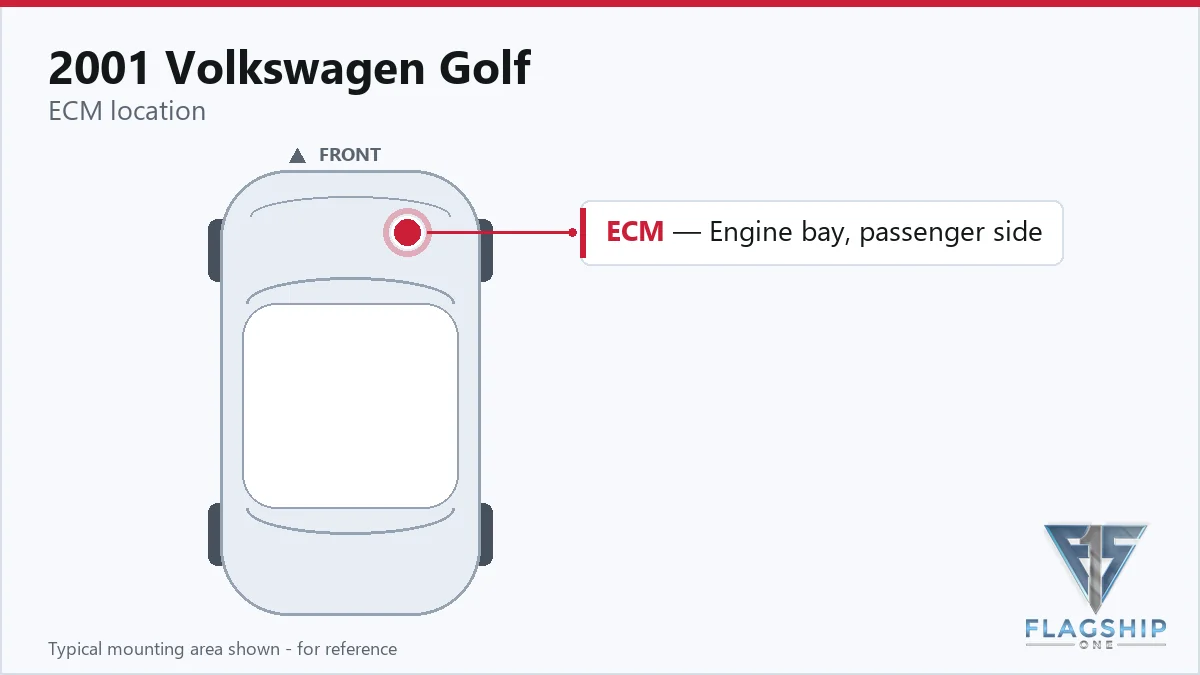
The engine control module is located in the plenum chamber, the enclosed area at the base of the windshield where outside air enters the cabin. Accessing the module typically involves removing the plastic cowl trim and the pollen filter housing to expose the ECM carrier. Once the electrical connectors are unlatched and the mounting fasteners are removed, the module can be lifted out. The book time for engine control module removal and replacement on the 1.8L engine is 1.5 hours. After the physical swap, a powertrain control module relearn procedure may be necessary to synchronize the new module with the vehicle’s immobilizer and throttle body; this step is listed at 0.5 hours. No additional torque specifications or special access steps are provided for this procedure.
| Operation | Configuration | Book Time |
|---|---|---|
| Powertrain Control Module Relearn | Golf | 0.5 hr |
| Powertrain Control Module Relearn | Jetta | 0.5 hr |
| Powertrain Control Module R&R | Golf | 1.1 hr |
| Powertrain Control Module R&R | 1.8L | 0.7 hr |
| Powertrain Control Module R&R | 2.0L | 1.1 hr |
| Powertrain Control Module R&R | 1.9L | 0.6 hr |
| Engine Control Module R&R | Golf | 1.1 hr |
| Engine Control Module R&R | 1.8L | 1.5 hr |
A factory-fresh engine control module for the 2001 Golf requires a series of programming steps before the engine will start and run correctly. The most critical is the powertrain control module relearn, a 0.5-hour procedure that adapts the module to the vehicle’s security system and electronic throttle control. Without this step, the immobilizer may prevent cranking or the throttle response may be erratic. Flagship One supplies a VIN-programmed replacement unit that arrives with these programming tasks already completed. The module is configured to match your specific vehicle identification number, so the relearn and any dealer-level coding are eliminated. You simply install the unit, and the vehicle recognizes it immediately, saving both time and the expense of a scan-tool session.
A failing engine control module in the 2001 Volkswagen Golf often produces symptoms that can be mistaken for sensor or fuel system problems. You may experience an intermittent no-start condition where the engine cranks but does not fire, sudden stalling while driving, or a rough idle that comes and goes. Misfire codes may appear even after replacing spark plugs and coils, and the scan tool may fail to communicate with the module entirely. In automatic transmission models, harsh or erratic shifting can also occur because the ECM shares data with the transmission controller. A stored P0604 internal memory error can indicate the ECM is failing. Other internal fault codes such as P0605 and P0606 are also documented for this vehicle and typically point to a module that cannot be repaired by reflashing alone.
The following diagnostic trouble codes are documented for the engine control module in the 2001 Volkswagen Golf 1.8L. These codes all relate to internal processor faults and are often a strong indication that the module itself has failed rather than an external circuit issue.
| Code | Meaning | Full Guide |
|---|---|---|
| P0604 | Internal RAM error | Full P0604 guide → |
| P0605 | Internal ROM error | Full P0605 guide → |
| P0606 | Module processor failure | Full P0606 guide → |
Volkswagen issued service bulletin #01-07-54 to address a common misdiagnosis involving the engine control module. The bulletin, titled “Engine Control Module (ECM), DO NOT Replace for These Diagnostic Trouble Codes (DTCs),” cautions technicians against condemning the ECM solely based on the presence of certain internal fault codes. It emphasizes that codes such as P0604, P0605, and P0606 can sometimes be triggered by low battery voltage, poor ground connections, or aftermarket programming attempts. The bulletin advises performing a thorough inspection of the charging system, all ECM power and ground circuits, and any recent software updates before deciding to replace the module. Following this guidance can prevent unnecessary parts replacement and ensure that the true root cause is addressed.
| Bulletin | Subject | What It Addresses |
|---|---|---|
| 01-07-54 | 01-07-54 – Engine Control Module (ECM), DO NOT Replace for These Diagnostic Trouble Codes (DTCs | — |
Common symptoms include a no-start condition where the engine cranks but won’t fire, intermittent stalling, rough idle, and misfire codes that persist after ignition service. You may also notice that a scan tool cannot communicate with the module, or that the automatic transmission shifts erratically because the ECM shares data with the transmission controller.
A factory-new ECM requires programming to match the vehicle’s immobilizer and throttle body, including a 0.5-hour powertrain control module relearn. However, a VIN-programmed replacement unit from Flagship One arrives with this programming already completed, so no additional dealer-level coding is needed.
The relearn procedure adapts the new module to the vehicle’s security system and electronic throttle control. It typically requires a professional-grade scan tool to initiate the adaptation, and the 0.5-hour labor time covers the full process. With a pre-programmed unit, this step is already done.
For a 2001 Volkswagen Golf with a failing engine control module, you have two main paths: attempt a repair of the original unit or install a refurbished replacement. Repair can be unpredictable, and a used module from a salvage yard will still need programming to work with your car. A refurbished, VIN-programmed ECM from Flagship One arrives ready to install, eliminating the programming hurdle and getting your Golf back on the road the same day the part arrives.
Flagship One stocks a refurbished, VIN-programmed PCM for the 2001 Volkswagen Golf with a lifetime warranty, free shipping and no core charge. The full Volkswagen Golf module lineup covers other engine configurations as well.
When your 2001 Volkswagen Golf shows signs of ECM trouble, a properly programmed replacement can resolve the issue without a lengthy dealer visit. By understanding the module’s location, the labor involved, and the factory service bulletin that may save you from an unnecessary swap, you can approach the repair with confidence. A VIN-programmed unit makes the job even simpler.