
Last updated on August 25th, 2026 at 11:52 am
The engine control module (ECM), also called the powertrain control module (PCM), in your 1998 Volkswagen Golf 2.0L manages fuel injection, ignition timing, and emissions. Failure can cause no-start, stalling, or poor drivability due to loss of sensor inputs or internal faults.
If your 1998 Volkswagen Golf 2.0L is experiencing drivability issues or a no-start condition, the engine control module (ECM) may be at fault. This module is the brain of your engine management system, controlling fuel delivery, ignition, and emissions. Understanding its location, replacement procedure, and programming requirements can save you time and money. This guide covers the physical replacement steps, factory labor times, and the critical immobilizer adaptation procedure outlined in a Volkswagen service bulletin. You will also learn how a pre-programmed replacement unit can simplify the repair.
1998 Volkswagen Golf 2.0L
OEM programmed ECM for your 1998 Volkswagen Golf 2.0L — plug & play, no dealer visit.
Free shipping · Lifetime warranty
The engine control module (ECM) in your 1998 Volkswagen Golf 2.0L is a sealed computer that processes data from sensors like the oxygen sensor, crankshaft position sensor, and throttle position sensor. It adjusts fuel injection timing, spark advance, and idle speed to maintain performance and meet emissions standards. When the ECM fails, the engine may run poorly or not start at all. For this vehicle, replacement ECMs for the 1998 Golf are available as new or refurbished units. The ECM also communicates with the immobilizer system, which adds a layer of security but requires adaptation after replacement.
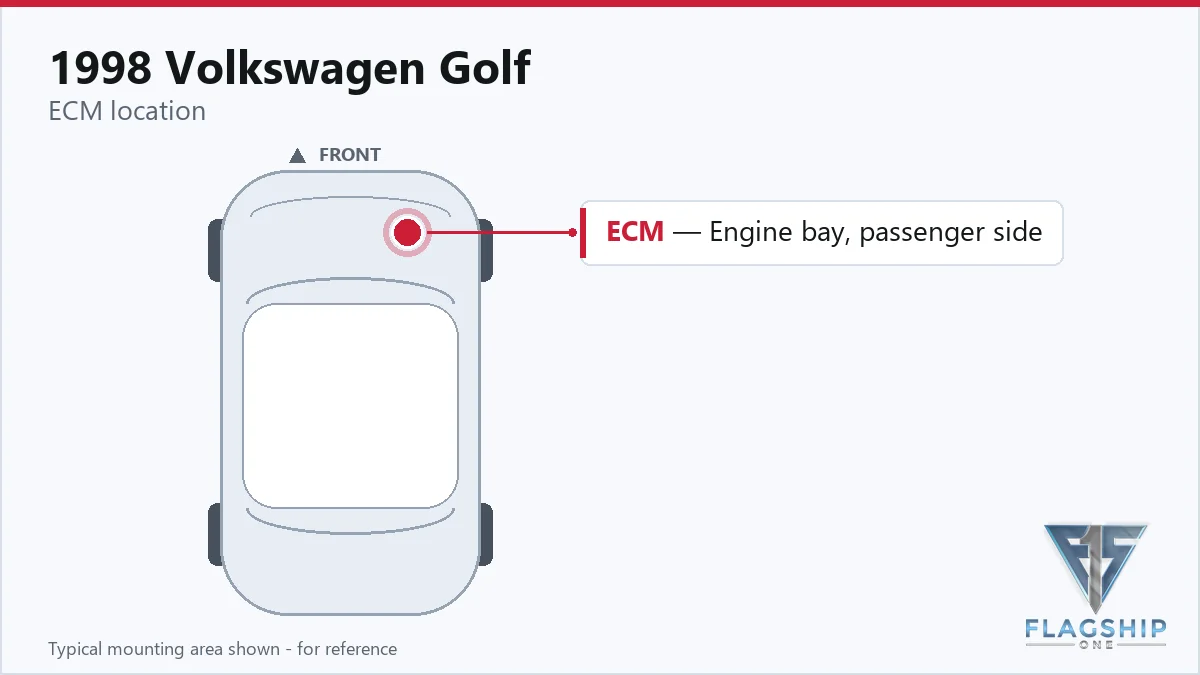
The ECM in your 1998 Volkswagen Golf 2.0L is mounted in the plenum chamber on the right side of the engine compartment. Access typically involves removing the plastic cowl cover and possibly the wiper linkage. The factory book time for removing and installing the ECM is 0.3 hours. After physical replacement, additional labor may be needed: a powertrain control module relearn is listed at 0.5 hours, and an ECM reset at 0.3 hours. These steps ensure the module syncs with the vehicle’s immobilizer and learns idle and fuel trim values. The connector is keyed and should be handled carefully to avoid bent pins.
| Operation | Configuration | Book Time |
|---|---|---|
| Powertrain Control Module Relearn | All configurations | 0.5 hr |
| Powertrain Control Module R&R | All configurations | 0.3 hr |
| Engine Control Module R&R | All configurations | 0.3 hr |
| Engine Control Module Reset | All configurations | 0.3 hr |
| Engine Control Module Relearn | All configurations | 0.5 hr |
After installing a new or used ECM in your 1998 Volkswagen Golf 2.0L, the factory procedure requires an immobilizer adaptation if the vehicle is equipped with Immobilizer 3 or 4, as noted in service bulletin #96-07-42. Additionally, a powertrain control module relearn (0.5 hours) and ECM reset (0.3 hours) are typically needed. Flagship One supplies a VIN-programmed replacement unit that arrives with your vehicle’s immobilizer data and calibration already loaded, so these post-install steps are already completed. This allows you to install the module and start the engine without special diagnostic tools.
A failing ECM in your 1998 Volkswagen Golf 2.0L may cause a no-start condition where the engine cranks but does not fire. You might also experience intermittent stalling, rough idle, or misfire codes that do not trace back to a specific cylinder. The check engine light may illuminate with generic communication faults. In some cases, the scan tool cannot connect to the ECM, indicating a dead module. Transmission shifting may become erratic if the ECM also controls shift points. These symptoms often appear suddenly and can be mistaken for sensor or wiring issues.
Volkswagen service bulletin #96-07-42 TT 96-07-42 applies to all models with Immobilizer 3 or 4, including the 1998 Golf. It states that when replacing the ECM, an immobilizer adaptation procedure must be performed. This ensures the new module recognizes the vehicle’s key transponders and allows the engine to start. Failure to perform this adaptation will result in a no-start condition. The bulletin provides the steps for using a factory scan tool to complete the adaptation.
| Bulletin | Subject | What It Addresses |
|---|---|---|
| 96-07-42 | TT 96-07-42 All Models With Immobilizer 3 or 4, Immobilizer Adaptation When Replacing the ECM | — |
Common signs include a no-start condition, stalling, or misfire codes that persist after replacing sensors. If a scan tool cannot communicate with the ECM, it is likely faulty. However, always check wiring and grounds first.
Yes, the physical replacement is straightforward with basic tools. The ECM is located in the plenum chamber on the right side. However, you will need to address immobilizer adaptation and relearn procedures unless you use a pre-programmed unit.
If your Golf has Immobilizer 3 or 4, the new ECM must be adapted to recognize the vehicle’s keys. This is done with a factory scan tool as described in service bulletin #96-07-42. Without it, the engine will crank but not start.
When your 1998 Volkswagen Golf 2.0L needs an ECM, you have two main options: repair the original module or replace it with a new or refurbished unit. Repair is sometimes possible for minor faults, but replacement is more reliable for internal failures. Flagship One offers refurbished ECMs that are pre-programmed with your VIN, eliminating the immobilizer adaptation and relearn steps, so you can install and drive.
Flagship One stocks a refurbished, VIN-programmed PCM for the 1998 Volkswagen Golf with a lifetime warranty, free shipping and no core charge. The full Volkswagen Golf module lineup covers other engine configurations as well.
Replacing the ECM in your 1998 Volkswagen Golf 2.0L is a manageable repair, but the immobilizer adaptation and relearn procedures add complexity. Using a VIN-programmed unit from Flagship One simplifies the process, saving you time and the need for specialized diagnostic equipment. Ensure you follow the factory service bulletin for immobilizer adaptation if using a standard replacement.