
Last updated on August 25th, 2026 at 12:03 pm
The engine control module in your 2004 Toyota Matrix governs ignition timing, fuel injection, and emissions systems. When this unit fails, you may experience hard starting, erratic idling, or complete powertrain shutdown, often triggered by voltage spikes, moisture intrusion, or internal circuit degradation.
When your 2004 Toyota Matrix refuses to start or stalls without warning, the engine control module often sits at the center of the diagnosis. This onboard computer coordinates ignition timing, fuel delivery, and emissions controls, making it essential for daily operation. Understanding how this component functions and what happens during replacement can save you from unnecessary delays and costly misdiagnosis. You will learn where the module resides, why proper programming matters, and how to avoid common pitfalls that trigger warning lights or inspection failures. Whether you are troubleshooting a no-start condition or planning a replacement, accurate information helps you make informed decisions about your vehicle’s electronic systems. The following sections explain the module’s role in your specific Matrix, detail the installation location behind the instrument panel, and outline the critical VIN programming steps that ensure compliance with emissions regulations. Armed with this knowledge, you can approach repairs with confidence and keep your Toyota running reliably while avoiding common errors that complicate electronic service procedures.
2004 Toyota Matrix
OEM programmed replacements — plug & play, no dealer visit.
Find yours by year, make & model →
Free shipping · Lifetime warranty
The engine control module in your 2004 Toyota Matrix serves as the powertrain’s central processing unit, constantly interpreting data from sensors throughout the vehicle. It adjusts fuel injector pulse widths, manages ignition advance, and regulates evaporative emissions to maintain optimal performance and clean exhaust output. Every calculation happens in milliseconds, balancing power demands with fuel economy and environmental standards. When this computer begins to fail, you may notice hesitation during acceleration, unexplained warning lights, or difficulty maintaining idle speed. Because the module integrates with the immobilizer system on many Matrix configurations, internal faults can also prevent the engine from cranking entirely. Replacement requires careful attention to software configuration, as the unit must recognize your specific vehicle identification number to communicate properly with other controllers. You can explore replacement engine computers for the Matrix to find units that arrive ready for installation. The module’s location inside the cabin rather than the engine bay offers some protection from temperature extremes, though electrical stress and voltage fluctuations remain primary causes of failure. Keeping the charging system in good condition helps extend the service life of this critical component. Modern engine computers store adaptive learning data that fine-tunes transmission shifting and idle characteristics over time, meaning replacement units must relearn these parameters to match your driving style and engine condition.
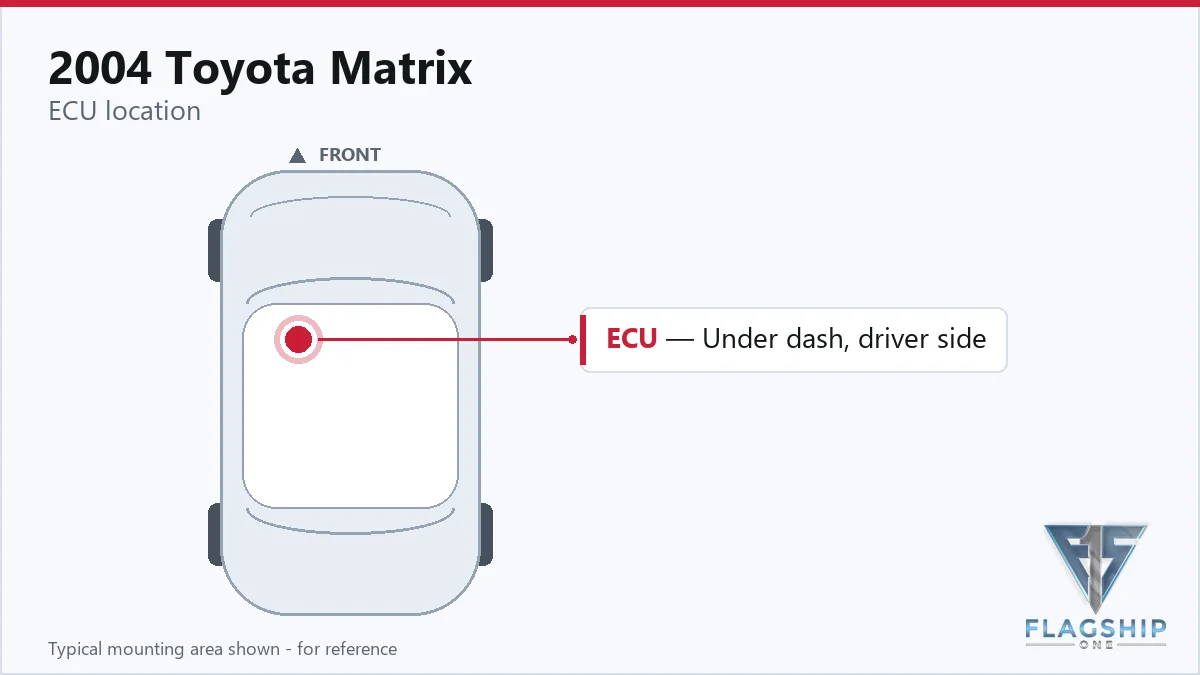
According to factory wiring documentation, the engine ECU resides within the instrument panel behind the dashboard trim. Technicians must remove interior panels to access the module for testing or replacement. The standard book time for Engine Control Module removal and replacement is 0.6 hours, while Powertrain Control Module R&R is also listed at 0.6 hours. Following physical installation, the system requires a relearn procedure that typically takes 0.5 hours for either the Engine Control Module or Powertrain Control Module. These time allowances cover the mechanical aspects of the job but do not include diagnostic verification or testing. You should ensure the battery remains disconnected during service to prevent short circuits, and avoid touching connector pins with bare hands to prevent corrosion. After securing the new module with proper fasteners and reconnecting all wiring harnesses, the technician must proceed to programming procedures before returning the vehicle to service. Accessing the instrument panel requires care to avoid damaging surrounding trim clips and wiring.
| Operation | Configuration | Book Time |
|---|---|---|
| Engine Control Module Relearn | All configurations | 0.5 hr |
| Engine Control Module R&R | All configurations | 0.6 hr |
| Powertrain Control Module R&R | All configurations | 0.6 hr |
| Powertrain Control Module Relearn | All configurations | 0.5 hr |
After installing a new control module, factory procedures mandate specific programming steps to ensure your 2004 Toyota Matrix operates correctly. Service information updated June 3, 2005 indicates that technicians must enter the vehicle identification number into the computer memory. Missing VIN data may cause your vehicle to fail state and local emissions Inspection and Maintenance programs. For many 2005 model year vehicles, omitting this step reportedly triggers a malfunction indicator. You should enter the VIN following the Diagnostic Tester display prompts carefully, verifying that the entered information matches your Matrix exactly. If the displayed data differs from your expectations, you must repeat the writing process after the system indicates completion. The procedure also adds the Highlander HV model to step 4 of the VIN Write Procedure according to the same documentation update. Technicians must confirm the entry matches before finishing. Fortunately, a VIN-programmed replacement unit arrives with your specific vehicle data already installed, eliminating the need for dealer-level programming equipment and reducing the risk of entry errors that could affect emissions compliance and prevent inspection failures.
A failing engine computer in your 2004 Toyota Matrix typically produces distinct symptoms that worsen over time. You may encounter intermittent no-start conditions where the starter cranks but the engine refuses to fire, often accompanied by a security light flashing on the dash when immobilizer communication drops. Rough idling and unexplained stalling at traffic lights suggest the module is struggling to maintain proper air-fuel ratios or ignition timing. During acceleration, you might notice hesitation or surging as the computer fails to adjust injector pulse widths smoothly. Transmission shifting problems can also manifest if the module sends erratic signals to the automatic gearbox controller, though this typically accompanies other engine performance issues. Diagnostic scanners may show communication errors or fail to connect entirely when the internal bus circuits degrade. Stored trouble codes often include generic misfire indicators or oxygen sensor faults that persist despite replacing the sensors themselves. In severe cases, the engine may run for a few seconds then die repeatedly, or the fuel pump might not prime when you turn the key to the on position. These symptoms often appear randomly at first, becoming more frequent as internal solder joints or circuit traces deteriorate. You might also experience sudden drops in fuel economy as the computer defaults to limp-home modes, or notice the cooling fans running constantly due to incorrect temperature signal processing. Addressing these warning signs promptly prevents roadside breakdowns and avoids secondary damage to the catalytic converter from prolonged misfiring.
Factory service bulletins provide critical guidance for servicing the engine computer in your Matrix. A June 3, 2005 update confirms that content now covers 2004 and 2006 model year vehicles alongside other Toyota models. This bulletin specifically adds the Highlander HV model to step 4 of the VIN Write Procedure on page 2. Additionally, factory cautions remind technicians that entering the correct VIN remains mandatory for these vehicles. Documentation warns that automobiles lacking proper VIN programming face automatic failure during state and local emissions Inspection and Maintenance evaluations. Following these bulletin procedures ensures compliance with regulatory requirements and prevents unnecessary inspection rejections.
The factory wiring guide places the engine ECU inside the instrument panel behind the dashboard. Technicians must remove interior trim components to access the module for testing or replacement.
Labor guides list Engine Control Module R&R at 0.6 hours and Powertrain Control Module R&R at 0.6 hours. The subsequent relearn procedure requires an additional 0.5 hours for either unit type.
Factory cautions indicate that vehicles with missing or incorrect VIN data may fail state and local emissions Inspection and Maintenance programs. For many models, improper programming can trigger malfunction indicators or prevent proper system communication.
Installing a used module typically requires VIN reprogramming to match your specific vehicle. Without proper programming, the immobilizer system may prevent starting and emissions systems may not function correctly.
Intermittent stalling often suggests internal processor faults or power supply issues within the engine computer. These faults may not trigger codes immediately but usually worsen until the module fails to maintain idle control entirely.
When facing engine computer problems, you must decide between repairing the existing unit or installing a replacement. Refurbished modules offer a middle ground, providing tested hardware with updated components that address common failure points. For your 2004 Toyota Matrix, selecting a unit that arrives pre-programmed eliminates dealership programming fees and reduces installation time. Consider the age of your current module and the cost of diagnostic time when evaluating the most reliable path forward.
Flagship One stocks a refurbished, VIN-programmed PCM for the 2004 Toyota Matrix with a lifetime warranty, free shipping and no core charge. The full Toyota Matrix module lineup covers other engine configurations as well.
Proper maintenance of the electronic systems in your 2004 Toyota Matrix ensures reliable transportation and regulatory compliance over the long term. Understanding the location behind the instrument panel, the specific replacement procedures, and the critical programming requirements empowers you to make informed decisions about necessary repairs. Addressing symptoms early helps you avoid secondary damage to expensive emissions components and ensures your Matrix remains ready for daily driving.