
Last updated on August 25th, 2026 at 12:02 pm
The ECM (Engine Control Module) is the central computer on your 2006 Toyota Matrix that manages fuel delivery, ignition timing, and emissions systems. Internal memory failures within this unit commonly trigger a variety of stored trouble codes. When the module fails, the vehicle typically exhibits drivability symptoms and may not pass emissions testing without correct module configuration.
When your 2006 Toyota Matrix leaves you stranded or runs poorly, the Engine Control Module may be the root cause. This guide explains how the ECM functions, what failure symptoms typically appear, and what replacement and programming involve. You will learn the access steps required, the time investment to expect, and why a pre-programmed replacement unit from Flagship One simplifies the repair process. Understanding the module’s role and the factory procedure helps you make an informed decision about repair versus replacement options.
The Engine Control Module serves as the primary computer for the 1.8L engine in your 2006 Toyota Matrix. This module continuously processes data from numerous sensors to calculate optimal fuel injector pulse width, spark advance, and emissions control device operation. Your Matrix’s ECM adjusts air-fuel ratios in real time based on inputs including mass airflow, oxygen sensor readings, throttle position, and engine temperature. Without proper ECM function, the engine cannot maintain efficient operation, leading to poor performance, elevated emissions, and potential stalling. The PCM (Powertrain Control Module) handles similar duties and may be referenced interchangeably depending on your service documentation. Replacement engine computers for the 2006 Toyota Matrix must be properly configured with the vehicle identification number to ensure emissions compliance and correct operation of all controlled systems.
Flagship One keeps Toyota Matrix replacement engine computers in stock for exactly this failure pattern.
2006 Toyota Matrix
OEM programmed replacements — plug & play, no dealer visit.
Find yours by year, make & model →
Free shipping · Lifetime warranty
The ECM on your 2006 Toyota Matrix is typically located behind the glove compartment door, requiring removal of this trim piece for access. Before reaching the module, technicians disconnect the battery negative terminal to prevent electrical damage during service. Factory book time for ECM R&R is listed at 0.6 hours, while PCM R&R requires 0.6 hours of labor. After installing a replacement module, additional relearn procedures are necessary—ECM relearn accounting for 0.5 hours and PCM relearn for 0.5 hours. These times represent standard labor estimates and actual duration may vary depending on technician experience and vehicle condition. Proper torque specifications and connector seating are critical to ensure reliable long-term operation of the replacement unit.
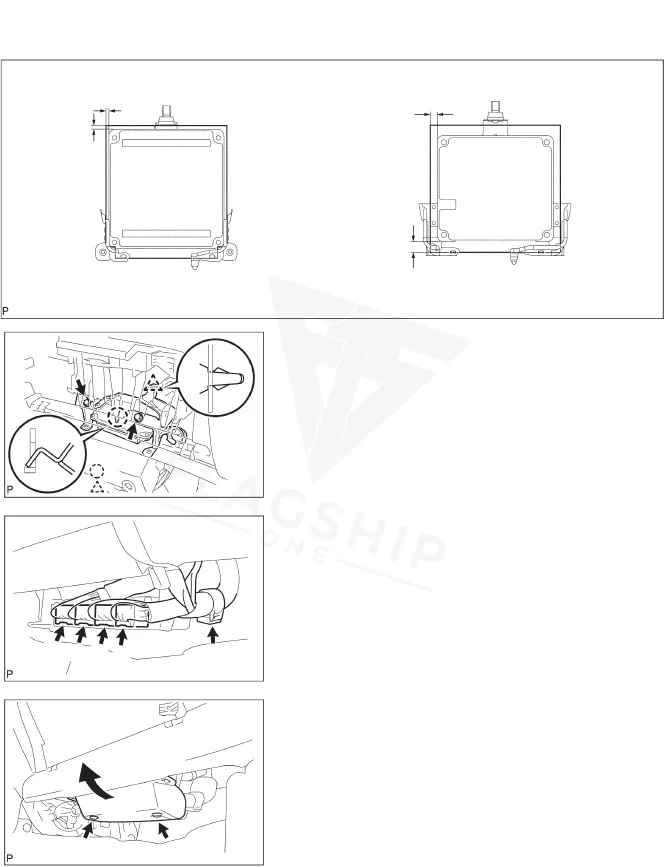
Work with the ignition off, and treat the module as static-sensitive: avoid touching the connector pins at any point.
| Operation | Configuration | Book Time |
|---|---|---|
| Engine Control Module Relearn | All configurations | 0.5 hr |
| Engine Control Module R&R | All configurations | 0.6 hr |
| Powertrain Control Module R&R | All configurations | 0.6 hr |
| Powertrain Control Module Relearn | All configurations | 0.5 hr |
Factory procedure for your 2006 Toyota Matrix requires writing the vehicle identification number into the replacement ECM or PCM using a diagnostic tester. The technician must verify that the written VIN matches exactly before considering the programming complete. For most 2005 model year vehicles, failure to properly program the VIN may result in emissions-related trouble codes that cause inspection failure. This programming step is essential for your vehicle to pass state and local emissions inspection programs. Flagship One addresses this requirement directly by shipping replacement units with the VIN already programmed, so these factory programming steps are typically not necessary when installing one of our modules.
Every VIN-programmed replacement unit from Flagship One arrives with these steps already completed.
Your 2006 Toyota Matrix may exhibit several warning signs when the Engine Control Module begins failing. Common failure symptoms include a no-start condition where the engine cranks but fails to fire, intermittent stalling during acceleration or idle, and persistent check engine light illumination. Stored trouble codes related to internal module failures often include P0601, which indicates memory checksum errors within the control unit. You may also see codes for random misfires, transmission shifting problems, or complete loss of communication with diagnostic scan tools. These symptoms often appear suddenly and may worsen over time as internal circuitry degrades further.
The 2006 Toyota Matrix in this case has multiple module-internal trouble codes documented. These codes indicate various internal faults within the ECM/PCM itself rather than failures of external sensors or wiring. Code P0601 specifically relates to internal memory validation errors, while P0604, P0606, and P0607 point to processor or read-only memory issues. Additional codes P0617 and P0657 reference starter relay control and actuator supply voltage faults that may stem from the same underlying module failure. When you see several of these codes appear simultaneously, internal ECM/PCM failure becomes the most likely diagnosis.
Factory service documentation includes Technical Service Bulletin SS002-07, which addresses Techstream ECU flash reprogramming procedures for applicable Toyota vehicles. A related caution dated June 3, 2005 indicates that reprogramming content was updated to include 2004 and 2006 model year vehicles, with specific additions to VIN write procedures. These bulletins emphasize the importance of proper module programming to prevent emissions inspection failures. The documentation reinforces that vehicles with missing or improperly programmed VINs may fail state and local inspection and maintenance programs.
| Bulletin | Subject | What It Addresses |
|---|---|---|
| SS002-07 | :SS002-07: 01-08 Applicable Toyota: Techstream ECU Flash Reprogramming Procedure | — |
Multiple module-internal trouble codes such as P0601, P0604, or P0606 appearing simultaneously often indicate internal ECM failure. A professional diagnostic scan showing no communication with the module or multiple unrelated codes may also suggest replacement is needed.
A used module would require VIN programming to match your specific vehicle, and its history of exposure to voltage spikes and temperature cycling is unknown. Pre-programmed replacement units from reputable suppliers typically offer more reliable outcomes.
Experienced DIY technicians may handle the physical replacement, which involves battery disconnection, glove compartment removal, and module swapping. However, obtaining proper programming equipment and performing factory relearn procedures presents significant challenges without professional-grade diagnostic tools.
When the Engine Control Module on your 2006 Toyota Matrix fails, you face a choice between repairing the existing unit or installing a replacement. Repair may be possible for minor faults, but refurbishment by an experienced specialist typically provides more reliable results. A pre-programmed replacement ECM arrives ready to install, saving the expense and complexity of factory programming procedures. Flagship One specializes in model-specific replacement modules that arrive configured for your vehicle, helping you complete the repair efficiently.
Flagship One stocks a refurbished, VIN-programmed PCM for the 2006 Toyota Matrix with a lifetime warranty, free shipping and no core charge. The full Toyota Matrix module lineup covers other engine configurations as well.
The Engine Control Module in your 2006 Toyota Matrix plays a critical role in engine operation, emissions compliance, and drivability. Understanding the symptoms of failure, access requirements, and programming necessities helps you approach the repair with confidence. Whether you choose professional service or plan to tackle the installation yourself, selecting a quality replacement module ensures your Matrix returns to reliable operation.