
Last updated on August 25th, 2026 at 12:03 pm
The engine control module in your 2005 Toyota Matrix manages ignition timing, fuel injection, and emission controls while monitoring sensor data continuously. Internal memory corruption or voltage spikes from charging system faults often trigger specific fault codes, causing serious drivability issues or complete failure to start.
If your 2005 Toyota Matrix has developed intermittent stalling, a crank-no-start condition, or illuminated warning lights that diagnostic tools attribute to the powertrain control module, understanding the component’s role helps you make informed repair decisions. The PCM serves as your vehicle’s central computer, continuously processing sensor data to manage fuel delivery, ignition timing, and transmission coordination. When this module fails, you may experience erratic engine behavior or complete drivetrain shutdown. This guide explains the module’s function within your specific vehicle, its physical location behind the dashboard, and the precise labor requirements for professional replacement. You will learn why internal fault codes appear, what symptoms typically manifest, and how proper programming eliminates additional dealership visits. Armed with this knowledge, you can discuss repair options confidently with your technician and avoid unnecessary diagnostic expenses.
The powertrain control module in your 2005 Toyota Matrix functions as the central processing unit for engine and transmission operations. It interprets signals from oxygen sensors, throttle position sensors, and crankshaft position sensors to calculate optimal air-fuel mixtures and ignition advance. When operating correctly, this computer maintains emission standards while delivering efficient performance across varying driving conditions. Over time, thermal cycling and electrical stress may degrade internal solder connections or memory chips, leading to erroneous calculations or communication failures. Replacement requires replacement PCMs for the Matrix that match your specific engine calibration and transmission type. The module stores critical adaptive values for fuel trim and idle speed, meaning any interruption to its power supply or physical damage from previous electrical faults can corrupt these learned parameters. Proper function remains essential for passing emission tests and maintaining daily drivability.
2005 Toyota Matrix
OEM programmed replacements — plug & play, no dealer visit.
Find yours by year, make & model →
Free shipping · Lifetime warranty
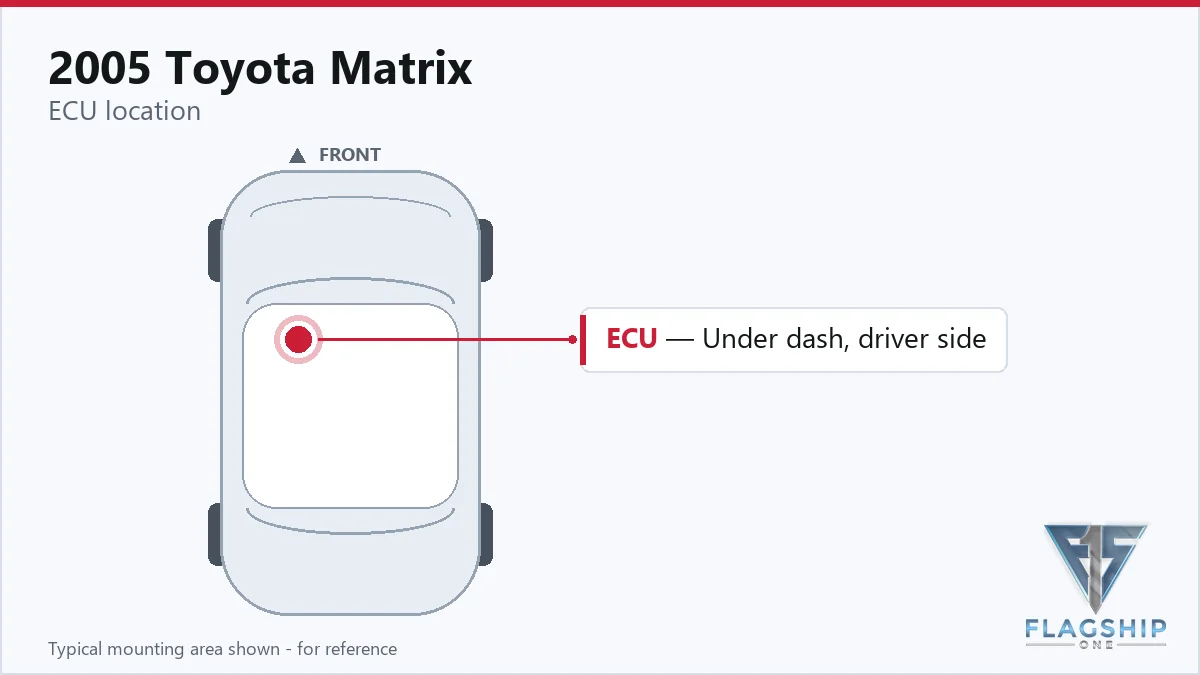
According to the factory wiring guide, the engine ECU sits within the instrument panel of your 2005 Toyota Matrix. Accessing this location typically requires removing trim panels and the glove box assembly to reach the mounting bracket behind the dashboard. Professional technicians follow standard labor guides allocating 0.6 hours for powertrain control module removal and replacement, plus an additional 0.6 hours if servicing the engine control module specifically. The procedure involves disconnecting the negative battery cable, unplugging multi-pin connectors from the module, and extracting the unit from its bracket. Installation reverses these steps with careful attention to connector seating. After physical replacement, the factory procedure mandates a relearn operation requiring 0.5 hours for either the powertrain control module or engine control module. This process allows the computer to establish baseline values for throttle position and idle control.
| Operation | Configuration | Book Time |
|---|---|---|
| Engine Control Module Relearn | All configurations | 0.5 hr |
| Engine Control Module R&R | All configurations | 0.6 hr |
| Powertrain Control Module R&R | All configurations | 0.6 hr |
| Powertrain Control Module Relearn | All configurations | 0.5 hr |
Factory service procedures require specific calibration and security programming after installing a blank module in your 2005 Toyota Matrix. Technicians must perform a relearn operation requiring 0.5 hours to synchronize the computer with your vehicle’s immobilizer system and transmission characteristics. Additionally, powertrain control module replacement calls for 0.6 hours of labor, while engine control module service requires another 0.6 hours. When you order a VIN-programmed replacement unit, these dealership procedures are already completed before shipping. The module arrives configured with your specific calibration codes, meaning your technician installs the component and performs the standard relearn without additional programming fees. This preparation eliminates the need for specialized dealership equipment and reduces total repair time significantly.
A failing PCM in your 2005 Toyota Matrix often produces distinct drivability symptoms that worsen gradually or appear suddenly. You may notice intermittent stalling at traffic lights, hard starting during hot or cold weather, or complete failure to crank despite a charged battery. The check engine light typically illuminates with internal memory fault codes that generic scanners can read. Communication failures between the module and diagnostic equipment may prevent code retrieval entirely. Erratic transmission shifting or incorrect fuel injection timing often accompany processor malfunctions. Specific internal faults include internal control module memory error readings that indicate corrupted checksum calculations within the computer. Other indicators involve sudden idle speed fluctuations, unexplained power loss during acceleration, or persistent misfire codes that resist conventional ignition repairs. These symptoms typically intensify when interior temperatures rise or when electrical system voltage fluctuates.
The following diagnostic trouble codes indicate internal processor or memory failures within your 2005 Toyota Matrix computer. These codes differ from sensor or circuit faults, pointing instead to hardware malfunctions inside the module itself that typically require replacement rather than wiring repairs.
| Code | Meaning | Full Guide |
|---|---|---|
| P0601 | Internal memory checksum error | Full P0601 guide → |
| P0606 | Module processor failure | Full P0606 guide → |
| P0607 | Module performance fault | Full P0607 guide → |
Internal failures typically stem from voltage spikes, thermal stress, or memory corruption. These issues trigger fault codes like P0601 or P0606 and may require module replacement rather than circuit repairs.
Labor guides specify 0.6 hours for physical removal and replacement. An additional 0.5 hours applies for the required relearn procedure. Total shop time varies based on dashboard disassembly complexity.
Used modules require security programming and calibration matching to your specific vehicle. Without proper VIN programming, the immobilizer system will prevent starting. Pre-programmed units eliminate these compatibility concerns.
When your 2005 Toyota Matrix exhibits persistent internal fault codes or communication failures, you face a choice between attempting circuit board repairs or installing a replacement module. While repair services exist, they rarely address underlying memory corruption completely. A replacement unit calibrated specifically for your exact vehicle restores factory performance without the uncertainty of refurbished electronics or recurring drivability concerns.
Flagship One stocks a refurbished, VIN-programmed PCM for the 2005 Toyota Matrix with a lifetime warranty, free shipping and no core charge. The full Toyota Matrix module lineup covers other engine configurations as well.
Understanding the function and failure modes of your 2005 Toyota Matrix control module helps you approach drivability concerns with confidence and clarity. Addressing symptoms early prevents roadside breakdowns and secondary damage to expensive emission components or catalytic converters. Consider your repair timeline and diagnostic costs carefully when evaluating professional replacement options for your specific Matrix configuration and current mileage requirements.