
Last updated on August 25th, 2026 at 12:04 pm
The Engine Control Module (ECM) in your 2003 Toyota Matrix manages fuel, ignition, and emissions systems. A failing ECM may cause erratic engine behavior, stalling, or a no-start condition due to corrupted learned values or internal faults.
If your 2003 Toyota Matrix hesitates, stalls, or refuses to start, the Engine Control Module (ECM) may be at fault. This small but critical computer governs how your 1.8L engine runs, from fuel delivery to spark timing. Replacing it isn’t just about swapping parts—it involves careful handling to avoid resetting learned values that keep your engine smooth. Understanding the process helps you avoid unnecessary delays or performance hiccups after the repair. Whether you’re diagnosing a no-start issue or preparing for a replacement, knowing the steps and precautions ensures a smoother outcome.
The ECM in your 2003 Toyota Matrix acts as the brain of the engine, continuously adjusting fuel injection, ignition timing, and idle speed based on sensor inputs. Over time, it stores adaptive values—like fuel trims and idle settings—to compensate for wear in components such as the oxygen sensors or fuel injectors. If the module fails, these learned adjustments are lost, which may lead to rough running or even a no-start condition. Replacing it requires installing replacement engine computers for the Matrix to restore proper engine management. Without these adaptations, your vehicle might struggle to maintain smooth operation until the ECM relearns them.
2003 Toyota Matrix
OEM programmed ECM for your 2003 Toyota Matrix — plug & play, no dealer visit.
Free shipping · Lifetime warranty
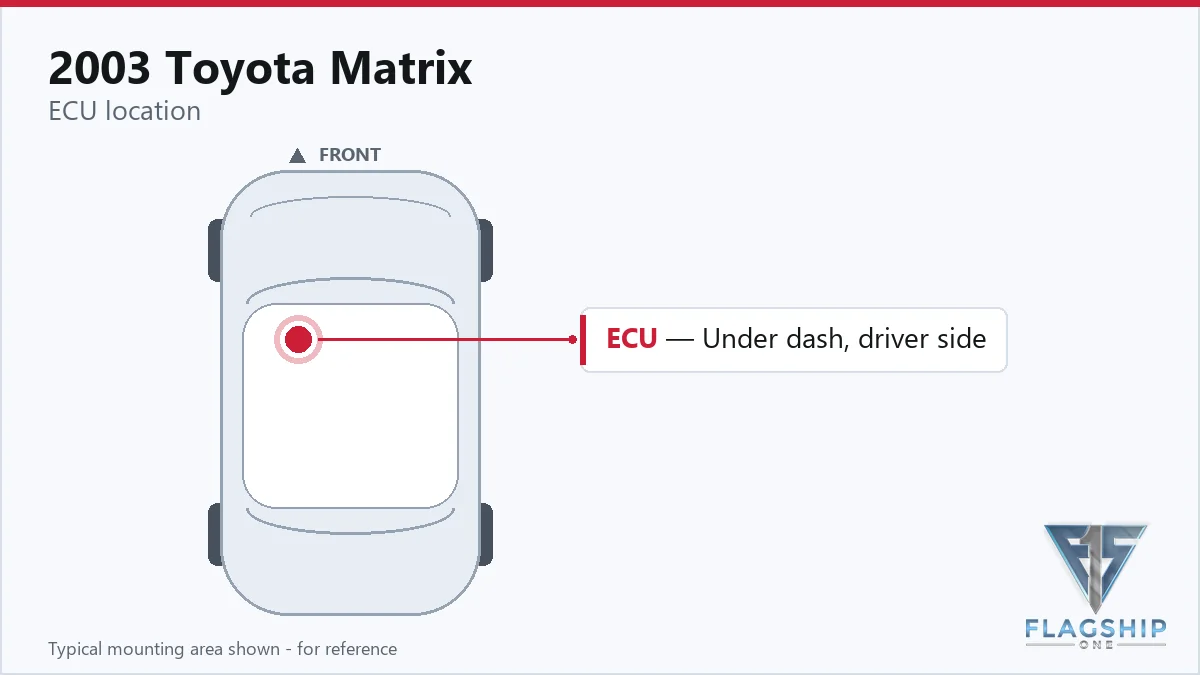
In the 2003 Toyota Matrix, the ECM is mounted behind the instrument panel, which means accessing it requires removing interior trim or the dashboard lower cover. The factory wiring guide confirms this location, and replacement typically involves disconnecting the battery, unplugging the wiring harness, and removing the module’s mounting bolts. Labor estimates for removal and reinstallation (R&R) are 0.6 hours. Once the new unit is in place, reconnecting the harness and battery completes the physical swap. Torque specifications for mounting hardware are not provided, but snug, even tightening is recommended to avoid stress on the module.
| Operation | Configuration | Book Time |
|---|---|---|
| Engine Control Module Relearn | All configurations | 0.5 hr |
| Engine Control Module R&R | All configurations | 0.6 hr |
| Powertrain Control Module R&R | All configurations | 0.6 hr |
| Powertrain Control Module Relearn | All configurations | 0.5 hr |
After installing a new ECM in your 2003 Toyota Matrix, the factory procedure requires a relearn process to restore adaptive values. This step, which takes 0.5 hours, ensures the engine runs smoothly by recalibrating fuel trims and idle settings. However, a VIN-programmed replacement unit from Flagship One arrives pre-configured, eliminating the need for this step. The factory caution notes that resetting learned values without cause may lead to temporary performance issues, so skipping unnecessary relearns is beneficial. If you’re using an aftermarket or unprogrammed module, follow the repair manual’s instructions closely to avoid driveability concerns.
A failing ECM in your 2003 Toyota Matrix may cause a range of symptoms, from subtle to severe. Common signs include intermittent stalling, rough idle, or a no-start condition, often accompanied by warning lights on the dashboard. You might also notice poor acceleration, misfires, or fuel efficiency dropping unexpectedly. If the module loses communication with the scan tool, it could indicate an internal fault. Trouble codes like internal control module memory checksum error may appear, signaling corruption in the ECM’s memory. Shifting issues are less common in this model but can occur if the ECM fails to communicate with the transmission control module.
Toyota issued service bulletin #SS002-01 covering ECM flash reprogramming for 2001 and later models, including the 2003 Matrix. The bulletin outlines the revised process for updating the module’s software, which may be required if the ECM is replaced or if certain driveability issues arise. While the bulletin doesn’t specify symptoms, it emphasizes following the correct procedure to avoid complications during reprogramming. If your vehicle exhibits persistent performance issues, this bulletin may guide the repair process.
| Bulletin | Subject | What It Addresses |
|---|---|---|
| SS002-01 | :SS002-01: 2001 & Later Applicable Models: ECU Flash Reprogramming Process (Revised) | — |
Stalling after an ECM replacement often occurs if the module hasn’t relearned adaptive values like fuel trims or idle settings. The factory procedure requires a 0.5-hour relearn process to restore smooth operation. If the ECM wasn’t programmed or relearned correctly, the engine may run poorly until these adjustments are made.
Driving with a failing ECM is risky. While the vehicle might start and run briefly, symptoms like stalling, misfires, or a no-start condition may worsen. A faulty ECM can also cause poor fuel economy or leave you stranded. If you suspect an issue, diagnose and replace the module promptly to avoid further complications.
Common signs include a no-start condition, persistent stalling, or warning lights on the dashboard. Trouble codes like P0601 may indicate internal ECM faults. If the scan tool can’t communicate with the module, it’s another red flag. A professional diagnosis can confirm whether the ECM or another component is at fault.
If your 2003 Toyota Matrix ECM has failed, you have options. A dealership may offer a new module with factory programming, but it often comes at a premium. Refurbished or aftermarket units can be cost-effective alternatives, especially when pre-programmed to your VIN. For a balance of reliability and value, consider a replacement unit that skips the need for post-install reprogramming, saving time and potential headaches.
Flagship One stocks a refurbished, VIN-programmed PCM for the 2003 Toyota Matrix with a lifetime warranty, free shipping and no core charge. The full Toyota Matrix module lineup covers other engine configurations as well.
The 2003 Toyota Matrix relies on its ECM to keep the 1.8L engine running smoothly. Whether you’re dealing with a no-start issue or erratic performance, understanding the replacement process and factory cautions helps you avoid pitfalls. With the right module and proper installation, your vehicle can return to dependable operation without unnecessary delays.