
Last updated on August 25th, 2026 at 12:04 pm
The engine control module in the 2003 Toyota 4Runner manages critical functions like fuel delivery and ignition timing. When this computer malfunctions, it often causes rough idling, starting failures, or unexpected stalling, severely disrupting your vehicle’s normal operation and drivability.
Encountering sudden drivability issues with your 2003 Toyota 4Runner can be frustrating, especially when the root cause points to the engine control module. This critical computer dictates how your vehicle’s powertrain operates, adjusting fuel maps and ignition timing based on sensor inputs. When it fails, you might experience anything from intermittent hesitation to a complete no-start condition. Understanding what this module does, where it is located, and how it is replaced demystifies the repair process. This guide provides straightforward, mechanic-level insight into the function of your vehicle’s engine computer, the symptoms of its failure, and what to expect during a replacement. You will gain a clear understanding of the labor times involved, the necessity of programming, and how to identify warning signs before they leave you stranded. By learning about the specific service precautions and common issues associated with the 2003 Toyota 4Runner, you can make informed decisions about repairing or replacing the unit, ensuring your SUV returns to reliable daily service without unnecessary expense or delay. We will also explore how pre-programmed options simplify the installation process.
The engine control module in your 2003 Toyota 4Runner serves as the central brain for the powertrain, constantly processing data from various sensors scattered throughout the vehicle. It takes inputs regarding airflow, crankshaft position, and engine temperature to calculate the precise amount of fuel needed and the exact moment to fire the spark plugs. This continuous calculation ensures the 4.0L V6 engine runs efficiently and cleanly under all driving conditions. Beyond basic fuel and spark control, the module also oversees emission controls and communicates with other onboard computers. When you start evaluating 2003 Toyota 4Runner replacement engine computers, understanding their role clarifies why a malfunction has such widespread effects on vehicle performance. A failing unit cannot accurately interpret sensor data, leading to incorrect fuel mixtures or ignition timing. This miscalculation often manifests as poor fuel economy, sluggish acceleration, or rough idling. Because the module coordinates so many vital functions, even a minor internal fault can disrupt the entire drivetrain ecosystem. The engine control module essentially acts as the orchestrator of your vehicle’s mechanical symphony; without its precise direction, the various components operate out of sync. Recognizing its importance helps you appreciate why prompt diagnosis and replacement are necessary when symptoms arise, restoring the precise control required for reliable engine operation. Furthermore, the module actively protects the engine from damage by enforcing operational limits and activating failsafe modes when it detects irregularities.
2003 Toyota 4Runner
OEM programmed ECM for your 2003 Toyota 4Runner — plug & play, no dealer visit.
Free shipping · Lifetime warranty
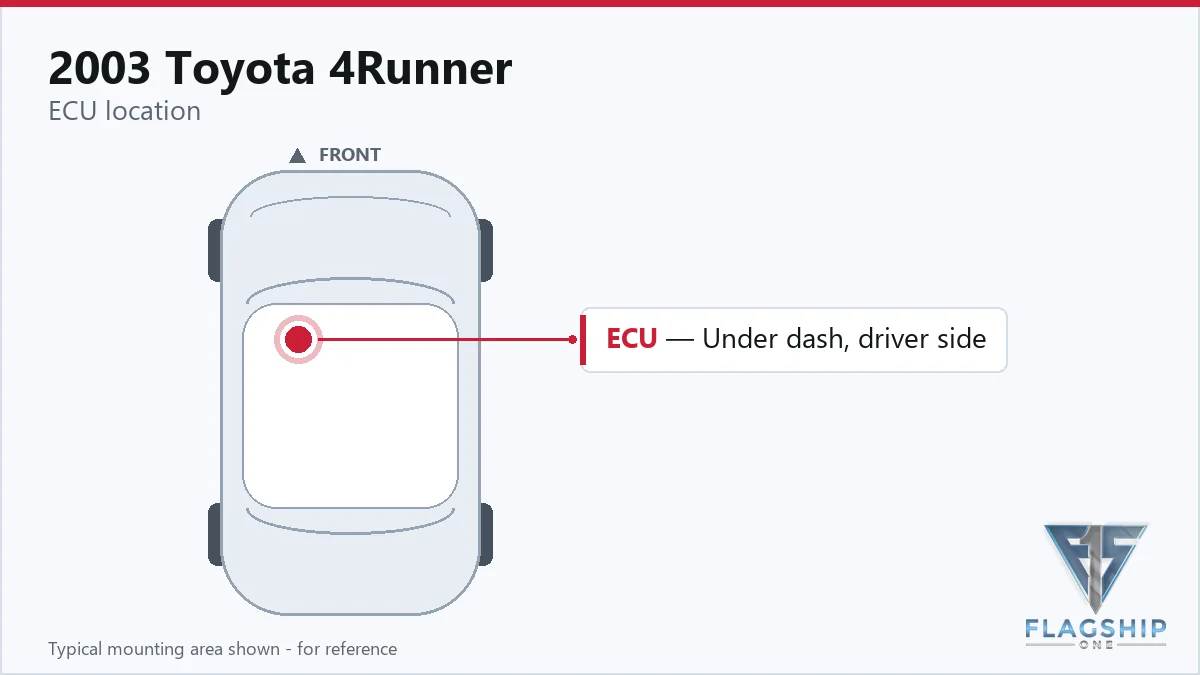
Locating the engine control module in your 2003 Toyota 4Runner requires accessing the interior of the vehicle. According to the factory wiring guide’s component grid, the engine ECU resides within the instrument panel. Replacing this unit involves removing the old computer and installing the new one, a process that typically takes 0.5 hours of labor for the removal and installation procedure. After physically swapping the hardware, the vehicle requires a relearn procedure to ensure the new module recognizes the existing sensor adaptations and idle characteristics. The labor time allocated for this relearn process is an additional 0.5 hours. In total, the replacement involves careful extraction from behind the dashboard, followed by the necessary programming steps to integrate the new hardware with your vehicle’s existing electronic architecture. Taking these book times into account helps you plan the repair efficiently.
| Operation | Configuration | Book Time |
|---|---|---|
| Powertrain Control Module R&R | All configurations | 0.5 hr |
| Powertrain Control Module Relearn | All configurations | 0.5 hr |
| Engine Control Module Relearn | All configurations | 0.5 hr |
| Engine Control Module R&R | All configurations | 0.5 hr |
After physically installing a new engine computer in the 2003 Toyota 4Runner, the factory procedure mandates a relearn process. This step is essential so the vehicle recognizes the new hardware and calibrates idle parameters along with fuel trims. The specified book time for this relearn procedure is 0.5 hours, which accounts for the diagnostic work required to cycle the ignition and allow the module to adapt to the engine’s specific mechanical characteristics. Skipping this step often results in erratic idle or suboptimal performance. However, choosing a pre-programmed engine computer from Flagship One eliminates the need for this extensive post-installation adaptation. Because the unit arrives already flashed with your vehicle’s specific VIN information and operational parameters, the 0.5-hour relearn labor is effectively bypassed. You simply install the module, and the 4Runner is ready to start and drive, avoiding the typical dealership service delays. This streamlined approach saves both time and labor costs, ensuring your vehicle returns to the road quickly and operates seamlessly from the moment the key is turned.
When the engine control module in your 2003 Toyota 4Runner begins to fail, several distinct symptoms often emerge. One of the most common indicators is a no-start condition, where the engine cranks but fails to fire up because the module is not commanding fuel or spark. You might also experience intermittent stalling, particularly at idle or when coming to a stop, which creates hazardous driving situations. Misfire codes frequently appear on diagnostic scanners, as the failing computer struggles to maintain proper ignition timing across the cylinders. Another telltale sign is dead scan-tool communication; if your diagnostic scanner cannot establish a link with the powertrain module, the internal processor has likely failed or lost power. Shifting issues also occur, especially since the engine computer communicates directly with the transmission control unit; a faulty engine module can send incorrect data, causing harsh or delayed shifts. Unexplained drops in fuel economy or persistent check engine lights that return immediately after clearing are further evidence of internal computer faults. Because these symptoms can overlap with failing sensors, thorough diagnostics are crucial. However, when multiple seemingly unrelated issues occur simultaneously, the engine control module is often the root cause requiring replacement. Recognizing these patterns early prevents further drivability degradation and ensures your vehicle remains reliable.
Toyota issued technical service bulletin DL001-04, specifically addressing 03-04 4Runner V6 models regarding 4WD ECU service precautions, which has been revised. This bulletin highlights specific care required when working on or diagnosing the four-wheel-drive electronic control unit in your 2003 Toyota 4Runner. While the primary focus is on the 4WD system, it underscores the importance of following exact factory precautions when handling any onboard computer module. Ignoring these manufacturer guidelines during service could lead to unintended damage or misdiagnosis. Always consult the revised bulletin DL001-04 before performing electrical work on your vehicle to ensure proper safety protocols are maintained.
| Bulletin | Subject | What It Addresses |
|---|---|---|
| DL001-04 | :DL001-04: 03-04 4Runner V6: 4WD ECU Service Precautions (Revised) | — |
The factory wiring guide places the engine ECU within the instrument panel, requiring interior access for removal and replacement.
The standard book time for removing and reinstalling the engine control module is 0.5 hours, with an additional 0.5 hours allocated for the necessary relearn procedure.
Yes, the factory procedure requires a 0.5-hour relearn process after installation so the new module adapts to your vehicle’s specific sensors and idle parameters.
Bulletin DL001-04 outlines revised service precautions for the 4WD ECU on 03-04 4Runner V6 models, emphasizing careful handling of electronic components.
Yes, because the engine computer shares data with the transmission, a failing module often sends incorrect signals that result in harsh or delayed shifting.
Deciding between repairing your existing computer or upgrading to a refurbished replacement depends on the severity of the failure. For the 2003 Toyota 4Runner, opting for a pre-programmed unit often eliminates the dealership visit entirely. Choosing a reliable replacement tailored to your specific VIN ensures seamless integration and restores full drivability without the uncertainty of rebuilding a failing original module, getting your SUV back on the road efficiently.

Flagship One stocks a refurbished, VIN-programmed PCM for the 2003 Toyota 4Runner with a lifetime warranty, free shipping and no core charge. The full Toyota 4Runner module lineup covers other engine configurations as well.
Addressing engine control module issues in your 2003 Toyota 4Runner promptly prevents frustrating breakdowns and expensive secondary damage. By understanding the location, labor times, and necessary programming steps, you can approach the repair with confidence. Explore reliable replacement options to restore your vehicle’s performance and ensure your SUV continues to deliver dependable service for years to come. Weigh your choices carefully to make the best repair decision.