
Last updated on August 25th, 2026 at 12:07 pm
The engine control module in the 1995 Toyota Supra manages fuel delivery, ignition timing, and emissions functions for the 3.0L engine. When this unit fails, your vehicle may experience stalling, refused starts, or complete loss of diagnostic communication.
When your 1995 Toyota Supra begins exhibiting drivability problems that point toward the engine computer, understanding what that module does and how replacement works can save you time and frustration. The engine control unit in this vehicle serves as the central processor for fuel injection, ignition timing, and emissions management on the 3.0L powerplant. Because this model year falls before the OBD-II standardization that arrived in 1996, diagnostic approaches differ from what many technicians use on newer cars. You will not find the familiar P-code structure here, which makes recognizing symptoms and confirming module failure especially important before ordering a replacement. This article walks through the module’s role in your Supra, where it sits in the vehicle, what the factory relearn procedure involves, and how a pre-programmed unit from Flagship One can simplify the repair. Whether you are a Supra owner planning a DIY swap or a technician verifying book times for a customer job, having the right labor figures and installation context helps you approach this repair with confidence and avoid unnecessary delays.
The engine control module in your 1995 Toyota Supra functions as the digital brain overseeing the 3.0L engine’s operation. It continuously reads input from sensors monitoring throttle position, coolant temperature, intake airflow, oxygen content, and crankshaft position, then calculates the precise fuel injector pulse width and ignition advance needed for efficient combustion. Because this Supra predates OBD-II, the module uses Toyota’s proprietary diagnostic protocol rather than the standardized P-code system found on 1996 and later vehicles. That distinction matters when troubleshooting, as generic scan tools may not communicate with this ECU the way they would with a newer car. The module also regulates idle speed control, evaporative emissions purge, and fuel pump relay activation during cranking. When internal circuitry degrades, the processor may corrupt those fuel and spark calculations, leading to rough running or complete shutdown. A failing unit can also prevent the fuel pump from priming or cut injector ground signals entirely. Owners seeking Supra engine control modules should verify the part number on their original unit, as Toyota sometimes used different calibrations depending on market and trim. The module’s role is critical enough that even subtle failures can mimic other issues like bad mass airflow sensors or ignition coil breakdowns, making thorough diagnosis essential before condemning the computer itself.
Engine computer (ECM/PCM)
OEM programmed replacements — plug & play, no dealer visit.
Find yours by year, make & model →
Free shipping · Lifetime warranty
The factory wiring guide for the 1995 Toyota Supra places the engine ECU within the instrument panel area, which means accessing it typically involves working around or behind dashboard trim panels. Removal and replacement of the engine control module carries a book time of 1.0 hour, while the same 1.0 hour figure applies to powertrain control module R&R if your specific configuration uses that terminology. Once the new unit is physically installed, a relearn procedure is required. The engine control module relearn is listed at 0.5 hours, and the powertrain control module relearn carries the same 0.5 hour figure. These book times assume a technician familiar with the vehicle and working under standard conditions; actual repair time may vary depending on access difficulty, connector condition, and whether any surrounding components need removal to reach the module. The instrument panel location keeps the computer protected from engine heat and moisture but means you will be working inside the cabin rather than under the hood.
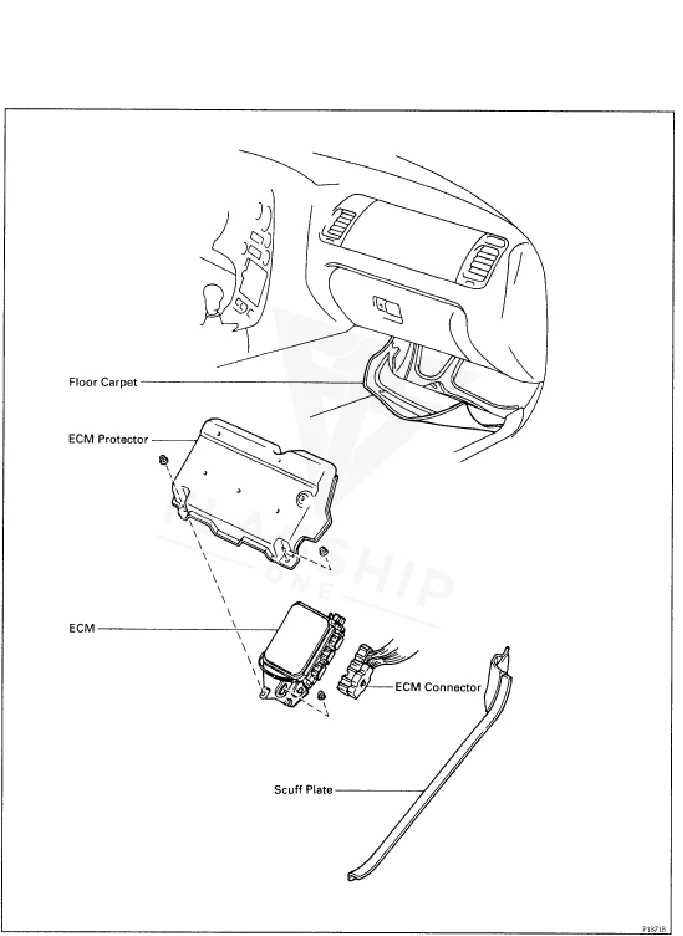
Work with the ignition off, and treat the module as static-sensitive: avoid touching the connector pins at any point.
| Operation | Configuration | Book Time |
|---|---|---|
| Engine Control Module Relearn | All configurations | 0.5 hr |
| Engine Control Module R&R | All configurations | 1.0 hr |
| Powertrain Control Module R&R | All configurations | 1.0 hr |
| Powertrain Control Module Relearn | All configurations | 0.5 hr |
After physically installing a replacement engine computer in your 1995 Toyota Supra, the factory procedure calls for a relearn process that teaches the new module the specific operating parameters of your engine. This relearn, which carries a book time of 0.5 hours, typically involves allowing the module to recalibrate idle parameters, fuel trim baselines, and throttle position correlations during initial startup and a short drive cycle. Without completing this step, your Supra may idle erratically or exhibit hesitation during acceleration as the new computer defaults to generic values rather than learned adaptations. The same relearn requirement applies whether the service literature refers to the unit as an engine control module or powertrain control module, with both listing 0.5 hours for the procedure. Flagship One addresses this by supplying a VIN-programmed replacement unit that has already been configured with the appropriate calibration data for your specific vehicle identification number. Because the programming is completed before shipment, the relearn steps that would normally consume additional shop time are already handled, allowing you to install the unit and proceed with startup.
When the engine computer in your 1995 Toyota Supra begins to fail, several symptoms may surface that overlap with other engine management issues, making careful diagnosis important. One of the most common indicators is a no-start condition where the engine cranks but refuses to fire, often because the module has stopped triggering the fuel injectors or ignition coils. Intermittent stalling is another frequent complaint, particularly when the vehicle is warm or during deceleration, as internal component degradation can cause the processor to drop signals momentarily. You may also notice rough idle, hesitation under load, or a noticeable drop in fuel economy if the module begins miscalculating fuel delivery. In some cases, the check engine lamp may illuminate and store a diagnostic code in the ECU’s memory, though retrieving that code on a pre-OBD-II Supra requires Toyota’s specific diagnostic procedure rather than a standard scan tool. Complete loss of communication with a diagnostic tool is a strong indicator of module failure, as a functioning ECU should respond to protocol-specific requests. Shift quality issues may also appear if the engine computer shares data with the transmission controller, as timing and load signals influence shift decisions. Because these symptoms can mimic bad sensors, ignition component failures, or fuel delivery problems, confirming that the module itself is at fault typically requires ruling out those other possibilities first. A methodical approach that checks power and ground supplies to the ECU, verifies sensor inputs, and inspects wiring integrity will help distinguish a genuine computer failure from a simpler external cause.
The book time for removing and reinstalling the engine control module is 1.0 hour, and the required relearn procedure adds another 0.5 hours. Actual repair time may vary depending on access conditions and connector integrity in your specific vehicle.
According to the factory wiring guide’s component grid, the engine ECU is positioned in the instrument panel area. Accessing it typically requires working behind or around dashboard trim components inside the cabin.
No, the 1995 model year predates the OBD-II standardization that began in 1996. Diagnostic codes stored in this vehicle’s ECU follow Toyota’s proprietary format and require manufacturer-specific retrieval procedures rather than a generic scan tool.
A replacement module typically requires a relearn procedure to adapt to your specific engine’s operating parameters. Flagship One supplies units that arrive already programmed to your vehicle identification number, eliminating the need for additional shop programming steps.
Common signs include a no-start condition with the engine cranking but not firing, intermittent stalling, rough idle, hesitation under load, and loss of diagnostic communication. Because these symptoms overlap with sensor and ignition failures, thorough diagnosis is recommended before replacing the module.
Deciding between repairing your existing engine computer and replacing it with a refurbished unit depends on the nature of the failure. If the module has suffered internal circuit damage, a replacement is typically the more reliable path. Flagship One offers pre-programmed units configured specifically for your 1995 Toyota Supra, which means the factory relearn procedure is already handled. Choosing a pre-programmed replacement reduces shop time and eliminates the risk of installing a unit that lacks the correct calibration data for your vehicle’s specific configuration.
Flagship One stocks a refurbished, VIN-programmed PCM for the 1995 Toyota Supra with a lifetime warranty, free shipping and no core charge. The full Toyota Supra module lineup covers other engine configurations as well.
Your 1995 Toyota Supra relies on a healthy engine control module to manage the 3.0L engine’s fuel, ignition, and emissions functions with precision. Recognizing the symptoms of module failure early and understanding the replacement process helps you make informed repair decisions. When the time comes for a replacement, a VIN-programmed unit from Flagship One can simplify the job and get your Supra back on the road with minimal downtime.